Anyone arriving here from New York, Philadelphia, Chicago or most of New Jersey notices the same absence within a week. There is no slice. Not none at all - there are a handful of windows and they are treasured - but nothing resembling the ambient, every-third-block availability of a two-dollar wedge that those cities take for granted. San Francisco has excellent pizza and it is nearly all sold as a whole pie, in a room, to a table. That is not an accident of taste. It is the predictable result of what it costs to run a small food business in this particular city.
Because pizza here is a sit-down category, the room you want is probably taking its last order earlier than you think and may need booking. Tell Karpo the hour you actually want to eat and whether you need a table or a window.
The economics that killed the slice
A slice counter is a specific business model: high volume, tiny margins per unit, minimal staff, long hours, and a location with heavy foot traffic. Every one of those inputs is hostile in San Francisco. Ground-floor commercial rent in a high-footfall corridor is among the most expensive in the country. Labour costs are high, with a substantial minimum wage plus mandated healthcare contributions, which hurts most in a format that needs someone standing behind a counter for fourteen hours selling three-dollar items.
Then there is footfall itself. Slice culture depends on large numbers of people walking past at all hours - subway mouths, late transit, dense residential blocks above street level. San Francisco has that in maybe five corridors and not the citywide continuity that New York does. The city also empties earlier: a large share of the dining population leaves over a bridge or down the peninsula, so the eleven-to-two window that keeps a slice shop alive elsewhere is thin here.
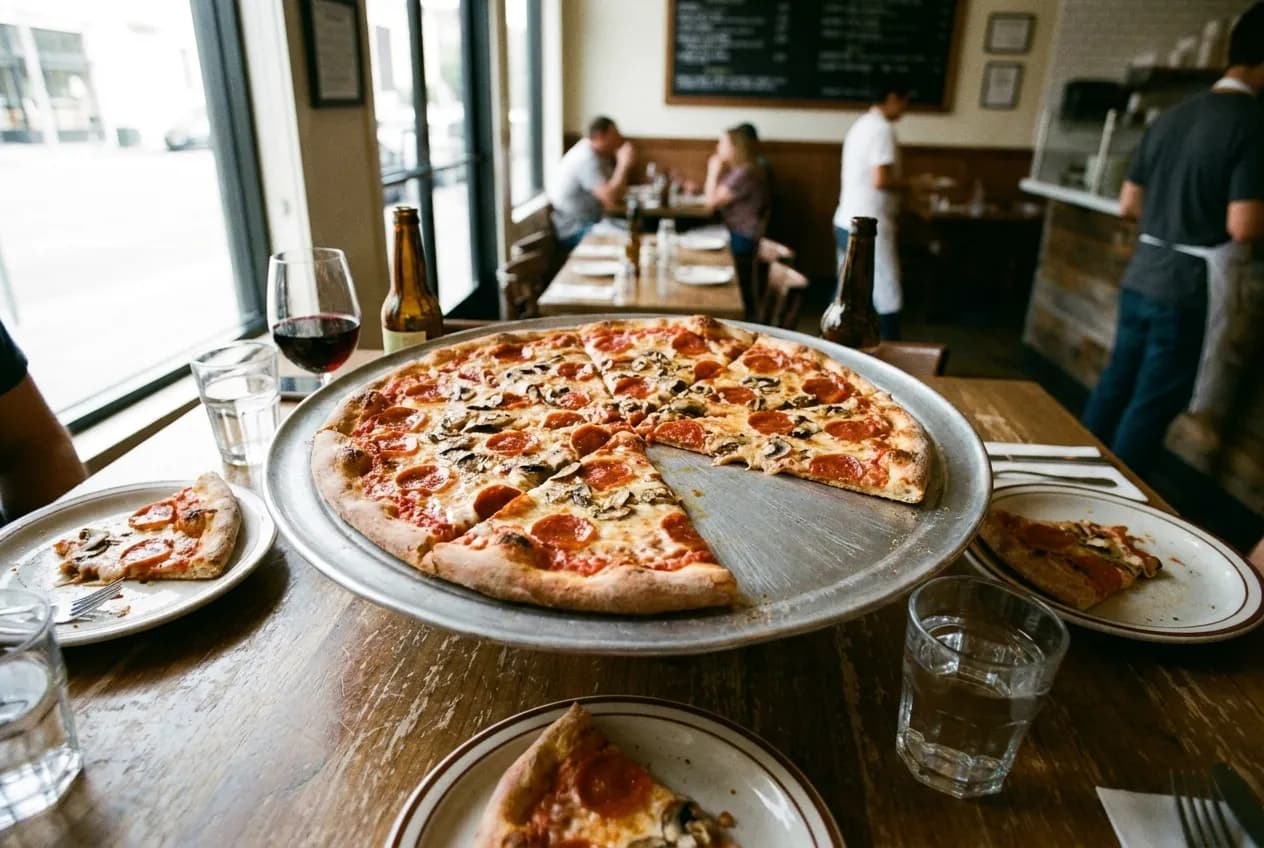
What replaced it
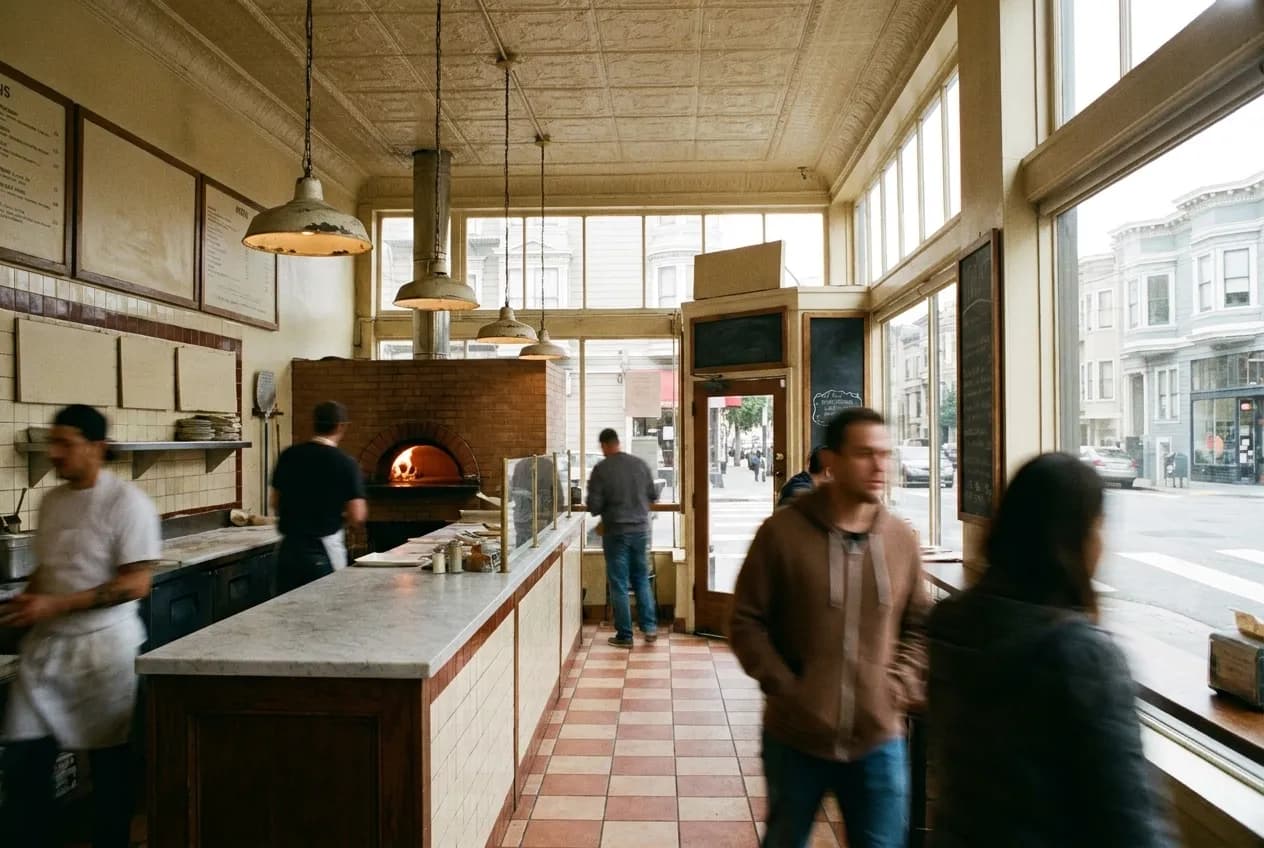
The whole-pie restaurant. San Francisco's pizza supply is overwhelmingly sit-down rooms with a booking system, a short wine list, seasonal toppings and a kitchen that closes at a normal local hour. Economically it makes sense: higher spend per head, alcohol margin, a defined service, and no need for foot traffic at midnight. Culturally it changed what pizza is for here - it is a dinner you plan rather than a thing you grab, and it is usually shared rather than eaten alone standing up.
The quality is genuinely high. The city has a deep bench of wood-fired and modern rooms, many run by people who came out of the bakery world rather than the pizzeria world, working long cold ferments and topping seasonally. What it does not have is the thing you want at half past eleven when you have had two drinks and no dinner, which is a different product entirely and is not a criticism of the restaurants.
The counters that do exist, and why they survive
Golden Boy Pizza on Green Street in North Beach is the emblem. Square Sicilian slices from a window, in business since the seventies, cash-friendly, essentially no seating, and the clam and garlic slice as its calling card. It survives for two specific reasons: North Beach's Green Street has genuine late bar traffic, and the square pan format holds and reheats far better than a round Neapolitan pie, so it can sit in a case without collapsing.
That second point explains the whole pattern. Where slices do exist in San Francisco, they are usually square or New York style, because those are the doughs engineered to survive being made in advance. A ninety-second Neapolitan pie has about five good minutes and then it is a different food, which makes it structurally impossible to sell by the wedge from a case. The Mission has a few windows on the same logic, and they are open late for the same reason - the neighbourhood stays awake.
How to order given all this
Decide first whether the evening is a plan or a rescue. If it is a plan, you want a room, and you should book it - the good pizzerias in North Beach, the Mission and Hayes Valley fill on Friday and Saturday, and their kitchens generally stop between half past eight and half past nine on weeknights. Order the plainest pie on the menu at least once, because a margherita on a well-made base tells you more than any six-ingredient specialty.
If it is a rescue - late, hungry, no reservation - stop looking for a pizzeria and look for a window, and accept that the list is short and concentrated in North Beach and the Mission. Trying to get a wood-fired pie at midnight in the Richmond is a category error, not bad luck. The Mission is the general answer to being hungry late in San Francisco and pizza is no exception.
Delivery, which behaves differently here too
The whole-pie orientation makes delivery more central than it is in slice cities, and it exposes the same physics. A Neapolitan-style pie steams itself soft inside a closed box within about ten minutes; by the time it has crossed two hills it is a good pizza that has been ruined by transport. New York style and square pan pizza both survive the journey - the drier base and the sturdier structure are exactly what a twenty-minute ride requires.
So the practical rule for ordering in: pick the style by the distance. Under ten minutes, anything works. Over that, order the sturdier styles and leave the wood-fired ones for eating in the room. Asking for the lid cracked helps a little by letting steam out, and reheating in a dry pan on the hob rather than a microwave recovers more than people expect.
Practical notes
Prices: roughly twenty to thirty dollars for a whole pie in a sit-down room, four to seven dollars for a square or a slice at the few windows. Hours: pizzerias mostly take their last order between half past eight and half past nine, with weekend extensions to about ten; the North Beach and Mission windows run considerably later. Booking is worth doing for Friday and Saturday in North Beach, the Mission and Hayes Valley, and is generally unnecessary in the Richmond and the Sunset. Cash still moves faster at the counters. And the general shape of the city applies here as everywhere else: if the night is going to run late, be in the Mission or on Green Street, because that is where the food is.
Tags: #PizzaNearMe #SanFrancisco #SFPizza #GoldenBoyPizza #NorthBeach #MissionDistrict #SicilianSlice #WholePie #PizzaDelivery #HayesValley #SFEats #LateNightSF #GreenStreet #SliceShop
All trademarks are the property of their respective owners.
Ask Karpo first
In a whole-pie city the failure mode is turning up at nine-forty expecting a counter that does not exist. Ask Karpo which pizzerias near you are still taking orders tonight, which of them needs booking, and where the nearest window is if what you actually want is a slice on the way home.