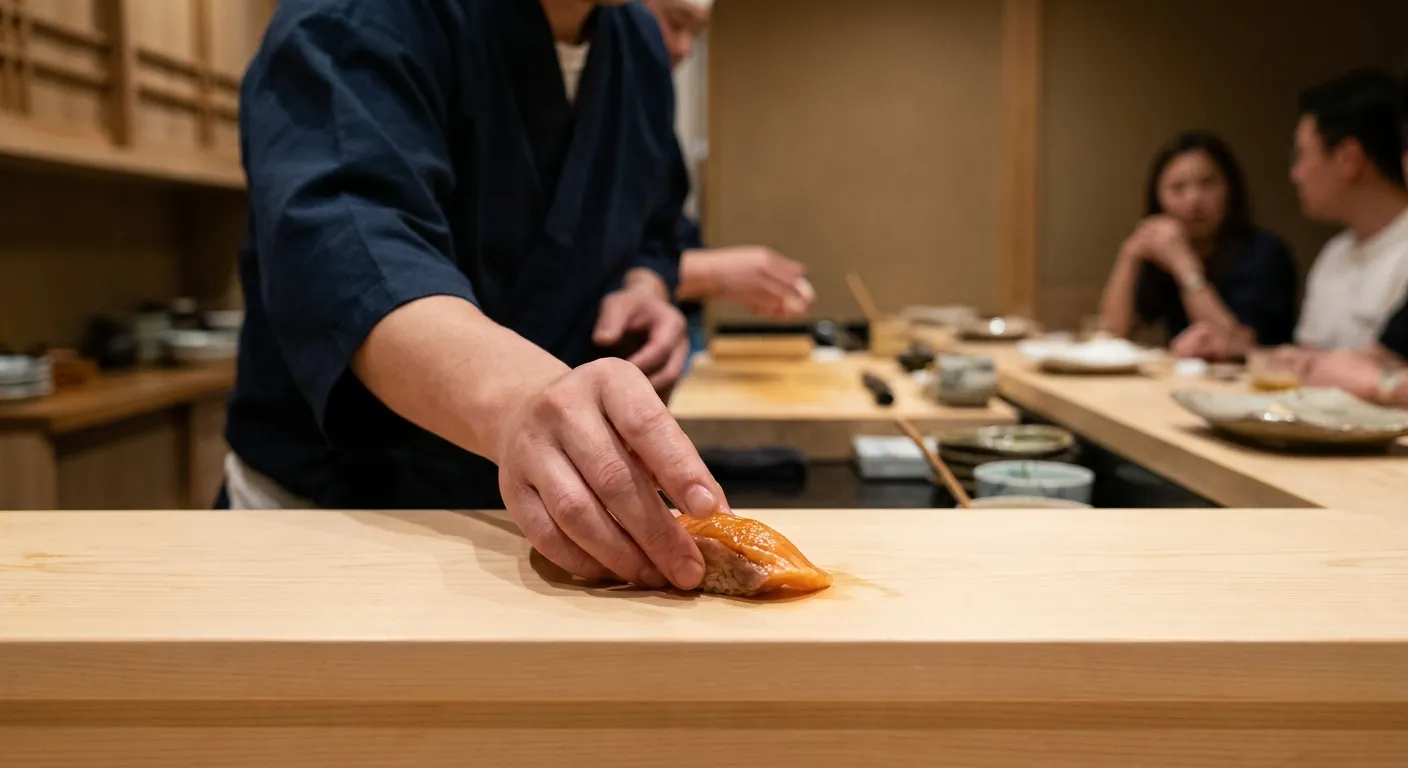
Omakase has a reputation problem in San Francisco. The famous counters run $225 to $330 before you've glanced at the sake list, and the internet will tell you that's simply the price of trusting a chef. It isn't. Scattered across Bernal Heights, the Inner Sunset, and Japantown are tasting counters where the full ritual — the pacing, the warm seasoned rice, the chef reading your face after each bite — lands for less than a hundred dollars.
This is a guide to those rooms: what each one actually serves, what you give up compared to the temples (spoiler: less than you think), and how to get a seat without setting a midnight reservation alarm.
What Under $100 Actually Buys You
Let's be honest about the trade. The $300 rooms are selling rarity: fish flown in from Japan several times a week, dry-aging programs, caviar flourishes, eighteen courses stretched over three hours. The sub-$100 counters compress that into fewer courses and a shorter sitting, and the fish list leans a little more Californian. What doesn't change is the format — nigiri built one piece at a time, rice still warm, a chef who adjusts to how you're eating. If your goal is the experience of omakase rather than bragging rights, the compression costs you surprisingly little.
One calibration note: prices in this tier move around. Every number below reflects recent menus, but treat them as 'around' rather than gospel, and confirm when you book.
Chīsai Sushi Club: Bernal's Gateway Counter
Chīsai means 'small,' and this Bernal Heights spot wears the name well — a compact, unstuffy room that treats omakase as a neighborhood dinner rather than a ceremony. The entry-level tasting runs around $95 for roughly 13 courses that move through nigiri, sashimi, and hand rolls before landing on mini taiyaki for dessert, which is the kind of ending that tells you this place doesn't take itself too seriously. There's a longer 17-course option for a bit more, and — rare in this city — a full vegetarian omakase at around $70 that isn't an afterthought.
Zentarou: The Inner Sunset's Calm Room
On 9th Avenue between Irving and Judah, Zentarou has been an Inner Sunset go-to since it opened in 2024, and its six-course omakase starts around $92 — one of the gentlest entry points to a proper tasting in the city. The room is quiet and spare in a way reviewers keep comparing to a spa, and the food ranges from a velvety chawanmushi to charred white tuna and red snapper brushed with smoky mentaiko. If you're celebrating, the Supreme tier climbs toward $136 and finishes with A5 wagyu under gold leaf and caviar; if you're just hungry on a Tuesday, the entry menu is the move.
Japantown's Mall Counters: Oma Station and Sasa
The best-kept non-secret in this price tier is that two legitimate omakase counters operate inside the Japan Center malls. Oma San Francisco Station is a tiny counter in the West Mall — Michelin-recommended, styled like a little train station — where menus start around $95 and run upward past $165 for longer sets. Precision nigiri anchors the meal, but the detours are the fun part: slow-cooked duck breast, udon slicked with uni sauce.
Across the way in the East Mall, Sasa serves a kaiseki-leaning omakase that hovers right at the hundred-dollar line — about $98 for six courses as of late 2025 — in a proper dining room that makes you forget there's a mall food court a floor below. Between the two, Japantown quietly beats most of the city for omakase value per square foot.
The Sub-$50 Loophole
Two more names stretch the definition but respect the spirit. Wabi-Sabi SF in SoMa serves a moriawase — a chef-composed set of around 11 pieces of nigiri, each one already seasoned so no soy sauce is needed — for roughly $32 to $49. It skips the course-by-course choreography, but the fish arrives dressed exactly as the chef intends, which is the whole point of omakase anyway. And Sanraku on Sutter Street near Union Square, an old-school room that's been feeding downtown for decades, will run you a chef's-choice sushi selection at the bar for well under the marquee counters' prices — ask about the omakase when you book, since the exact composition shifts with the fish.
Booking Without the Stress
The good news about this tier: none of these rooms require the reservation bloodsport of the famous counters. A little planning still helps.
- Counters are small — often six to twelve seats — so book a few days ahead rather than gambling on a Saturday walk-in.
- Early weeknight seatings are the easiest to land and the calmest to sit through.
- Solo? You're the easiest booking in the house. Odd single seats open up constantly.
- Flag allergies and dietary restrictions when you reserve, not when you sit down — the menu is built in advance.
- Budget drinks separately. Sake pairings can quietly double a sub-$100 bill.
Omakase FAQs
Is a sub-$100 omakase actually good, or just cheap?
Actually good. Several of these rooms carry Michelin recognition or serious critical attention, and the fundamentals — rice temperature, knife work, pacing — are the same craft you'd get at triple the price. What you lose is length and rarity: fewer courses, fewer luxury garnishes, less imported showpiece fish. The skill stays.
How long does an omakase dinner take?
At this tier, plan on one to two hours. Shorter six-course menus can move briskly; a 13-plus course sitting like Chīsai's takes closer to two. The three-hour marathon is a feature of the expensive rooms, not these.
Do I need to know sushi etiquette before sitting down?
No. The only near-universal rules: eat each piece soon after it lands (the rice is at its best for about a minute), eat nigiri in one bite if you can, and skip drowning anything in soy sauce — at these counters the chef has usually seasoned each piece already. Everything else is just dinner. Ask Karpo before you go and it'll point you to whichever counter fits your night and your budget.