The standard list of the best things to do in Los Angeles is a short loop: a sign, a walk of fame, a pier, a theme park. All of it is fine and none of it explains why people who live here are attached to the place. The city's actual character is in a much odder set of things — some of them ambitious, some of them the work of a single obsessive person over decades, most of them free or nearly free.
Several of these keep strange hours or are closed more often than they are open. Ask Karpo whether the one you want is actually open today.
The Museum of Jurassic Technology
In Culver City there is a small dark museum with exhibits on the bat that flies through solid walls, the horn that grew from a woman's head, and a collection of microscopic sculptures set into the eyes of needles. Some of it is true. Some of it is not. The museum will not tell you which, and that ambiguity is the entire point of the institution. It has a tea room upstairs. It is one of the genuinely great cultural experiences in Los Angeles and about ninety per cent of visitors to the city have never heard of it.
The old zoo in Griffith Park
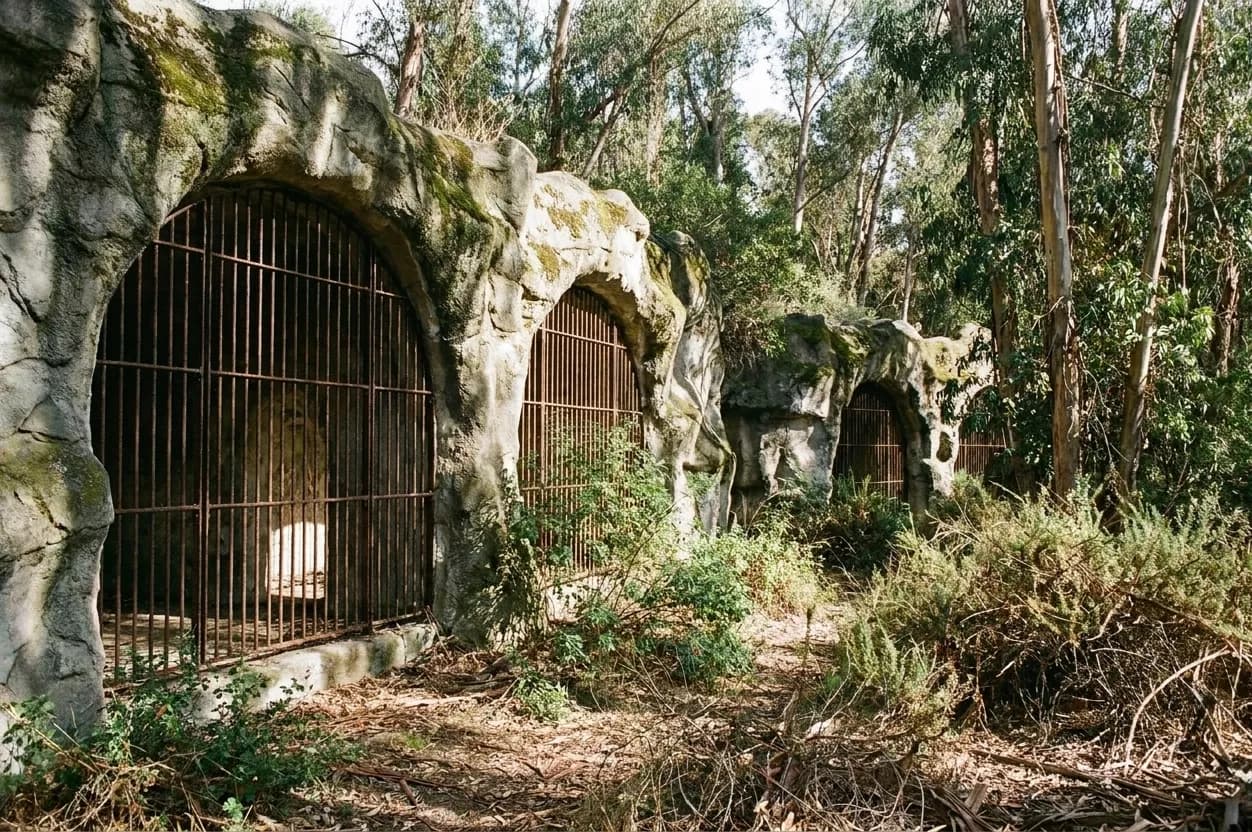
Griffith Park contains the abandoned enclosures of the original Los Angeles zoo, closed in the 1960s when the animals moved to the current site. The cages, faux-rock grottos and concrete pens were simply left, and they are now an unfenced public picnic area you can walk into and climb around. It is free, it is genuinely strange to stand inside a seventy-year-old bear enclosure with trees growing through it, and it is a fifteen-minute walk from a car park.

Watts Towers
Simon Rodia, an Italian immigrant construction worker, spent thirty-three years between 1921 and 1954 building seventeen interconnected sculptural towers in the back garden of his lot in Watts, out of steel rod, mortar, broken tile, bottle glass and shells, with no scaffolding, no bolts and no plan. Then he gave the property away and left. The tallest tower is nearly a hundred feet. It survived a city attempt to demolish it in 1959 when a stress test failed to pull it down. It is one of the most remarkable pieces of folk art anywhere in the world and it sits in a residential street in south Los Angeles.
The Velaslavasay Panorama and the older strangeness
In West Adams there is a small theatre housing a hand-painted 360-degree panorama, a nineteenth-century entertainment format that has almost entirely disappeared, presented with complete seriousness in a building with a garden behind it. Downtown, the Bradbury Building's 1893 atrium of wrought iron and open lifts is free to enter and looks like the future as imagined a hundred and thirty years ago, which is why it has been in so many films. Angels Flight, the tiny funicular railway that has been dismantled, moved and restored more than once, still runs up Bunker Hill for a dollar or so.
Out at the edges
Sunken City in San Pedro is a stretch of clifftop where a 1920s landslide dropped a residential street into the sea, leaving broken road, kerbstones and foundations scattered down the slope, now heavily covered in graffiti. Nearby, the Korean Friendship Bell sits in a painted pavilion on a headland with an enormous ocean view. Further north, Vasquez Rocks — the dramatically tilted sandstone slabs that have stood in for alien planets in decades of film and television — is an hour out and free to walk around.
The archive tier
There is a further layer for anyone who likes this sort of thing: the specialist collections that exist because somebody in Los Angeles decided they should. The Neon Museum in Glendale preserves and relights the salvaged commercial signage of a twentieth-century city that has otherwise thrown it away. Heritage Square in Montecito Heights is a collection of Victorian houses physically relocated from across the city to save them from demolition, sitting incongruously beside a freeway.
Further out, the Mount Wilson Observatory on the ridge above the basin is where Edwin Hubble established that the universe is expanding, and the hundred-inch telescope he used is still there and can be visited on open days. Access up the mountain has been affected by recent fire closures in the range, so this is one to check before setting out rather than to drive to on spec.
How to approach this list
Two practical notes. Several of these keep limited or unusual hours — small institutions run by very few people frequently open only a few afternoons a week, and turning up unchecked is how the day gets wasted. And a number of them, particularly the cliff and ruin sites, are genuinely unmaintained; the interest and the risk come from the same source, so pay attention to where you are putting your feet.
The larger point is that this is what the city is actually like. Los Angeles has always attracted people who arrived with an idea and enough space to build it without anyone stopping them, and the residue of that is scattered across the basin in the form of towers, panoramas, museums of dubious fact and abandoned zoos. That is a considerably better story than the tourist loop tells, and almost all of it is free.
Tags: #LosAngeles #OffbeatLA #HiddenGems #WeirdLA #WattsTowers #GriffithPark #MuseumOfJurassicTechnology #SunkenCity #SanPedro #CulverCity #ThingsToDoLA #FreeLA #ExploreLA #LAGuide #FolkArt
All trademarks are the property of their respective owners.
Ask Karpo first
Ask Karpo which of the stranger places near you in Los Angeles are open today, what they cost, and how to string two of them into one afternoon.