 Dog Costume Parade Near Me in East Village: Boris and Horton
Free Things to Do
Washington Square Park Piano: The Free Concert That Plays Until Dark
Under the arch, a public piano transforms strangers into performers and sidewalks into concert halls. The music starts when someone brave enough sits down, and it doesn't stop until the park lights flicker on.
The setup nobody planned
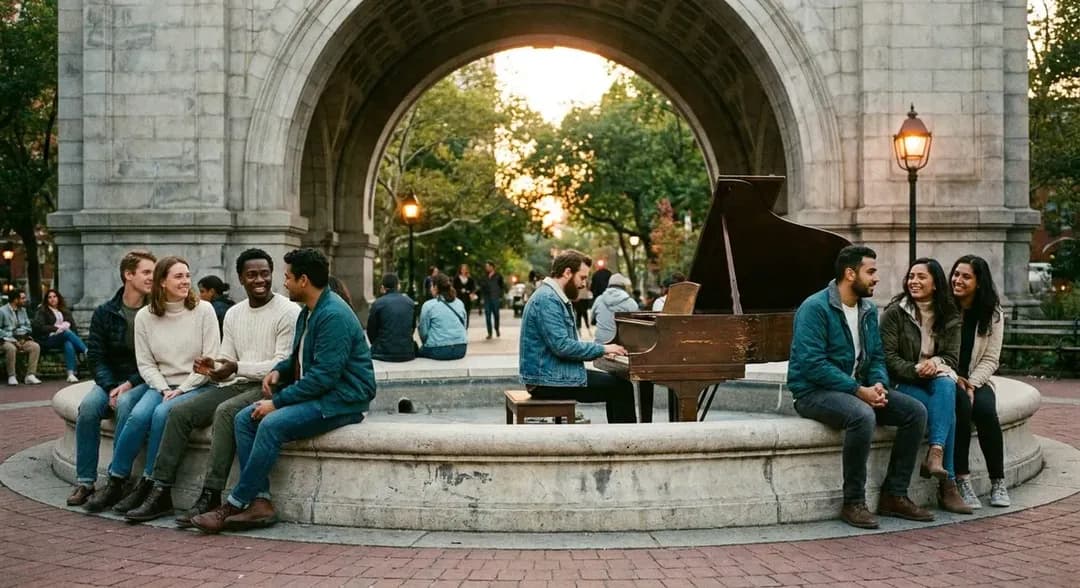
On warm evenings when the weather cooperates, a baby grand piano appears near the Washington Square Arch—not a public installation anyone can play, but the personal instrument of Colin Huggins, the park's devoted piano man. He wheels his own 900-pound grand into the park several times a week, positions it south of the arch where the acoustics favor him, and plays classical repertoire for hours. You're sitting on the fountain's stone rim with takeout, and suddenly there's Chopin floating across the plaza, performed by a single busker who's made this his stage for years. The crowd gathers without announcement. Huggins famously invites listeners to lie beneath the piano while he plays, turning a street performance into something intimate and strange. This isn't a rotating cast or a community piano—it's one musician, one instrument, and whatever audience the evening brings.
The devoted busker
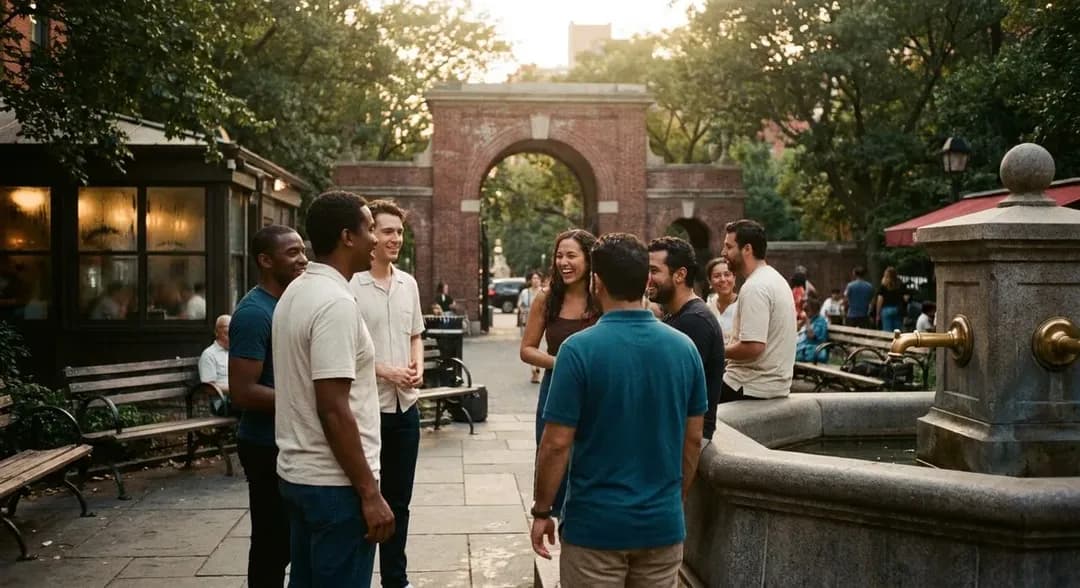
Colin Huggins is the constant. He arrives with his grand piano, sets up near the arch, and plays classical pieces—Rachmaninoff, Debussy, Chopin—for tips. The logistics alone are remarkable: moving a 900-pound instrument into the park, positioning it, performing for hours, then wheeling it back out. He does this several times weekly when weather permits, building a following among regulars who time their park visits to his schedule. You'll see NYU students who've learned his patterns, tourists who stumble into something unexpected, and locals who treat his performances as their evening soundtrack. The fountain's concrete rim becomes informal seating—the west side catches late sunlight in summer, making it prime territory for listeners who settle in for the duration. Some bring jackets to sit on; the stone stays cold even on warm days. The invitation to lie beneath the piano while he plays transforms spectators into participants, the music vibrating through the instrument's body into theirs.
The fountain rim audience
The fountain itself provides the backdrop—its splash mixing with piano notes, the arch rising behind, the plaza's geometry turning the space into an accidental amphitheater. On a typical evening, dozens of people sit within listening range, the number swelling when Huggins hits a particularly powerful passage. Children dance. Couples lean together. Solo listeners close their eyes. The crowd knows this performance might end whenever the pianist decides, so attention stays focused. Nobody's checking phones because the moment is unrepeatable—this specific piece, this light, this gathering of strangers who happened to be here now. The fountain's rim offers tiered seating, the plaza's openness means you can drift closer or hang back, and the arch's marble surfaces bounce sound in ways that shift depending on where you stand.
The technical reality
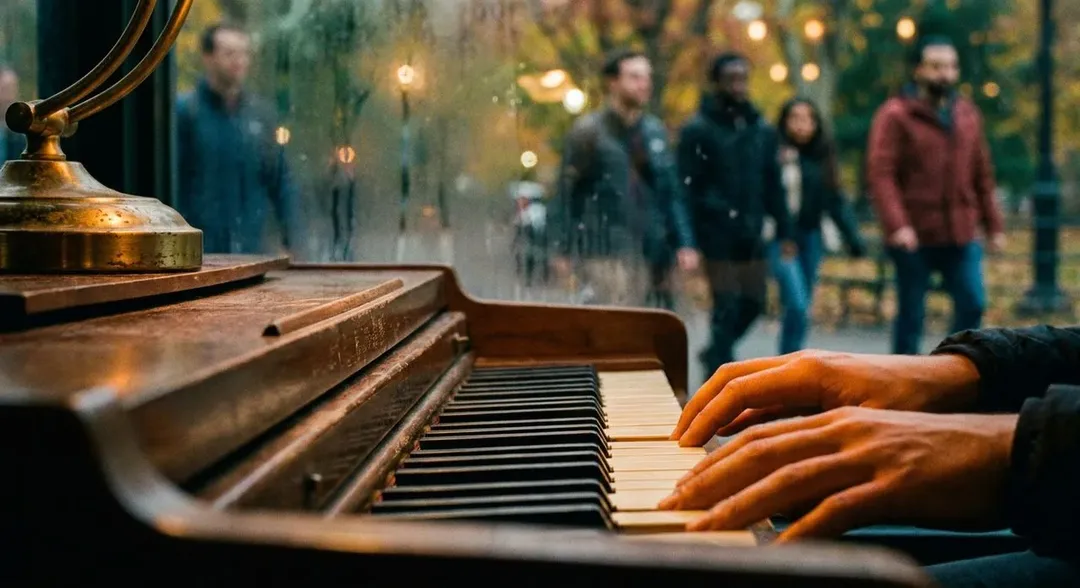
A 900-pound grand piano wheeled into a public park faces immediate challenges. Weather affects tuning—spring rain, summer humidity, the constant exposure to elements. The instrument requires maintenance that happens out of public view, adjustments and care that keep it playable despite the conditions. Huggins adapts his repertoire to the piano's state on any given day, working with whatever the instrument can deliver. The performance depends on his willingness to transport, set up, play for hours, and pack out again, a cycle of effort most listeners never consider. The piano's presence is never guaranteed—weather cancels performances, schedules shift, and the whole enterprise rests on one person's commitment to bringing classical music to a public park. When it works, it's because the pianist showed up and made it work.
The atmosphere it creates
The magic is in the convergence: a skilled classical pianist, a grand piano in an unexpected setting, a plaza designed a century ago that happens to have perfect acoustics, and an audience that ranges from knowledgeable to curious. Huggins plays pieces that demand attention—nothing casual, nothing background. The music fills the space, and the space responds. The arch frames the scene. The fountain provides rhythm. The crowd becomes part of the performance simply by being present and listening. These aren't collaborations or jam sessions—they're solo classical recitals happening in public space, free to anyone who walks by. The recordings people make on phones never quite capture it: the sound bouncing off marble, the park's ambient noise weaving through, the physical presence of a grand piano where it shouldn't logically be.
When to catch it
Huggins performs several times a week during warmer months, weather permitting, often in late afternoon and early evening. His schedule isn't fixed or published—you find him by showing up and hoping the conditions aligned. Weekday evenings tend to draw more locals and students. Weekend afternoons bring families and tourists. The hour before sunset offers the best light, particularly in late spring and early fall when temperatures cooperate and the crowds are manageable. Rainy days mean no performance; the logistics of moving a grand piano require dry conditions. The season runs roughly April through October, with winter months too harsh for the instrument. September evenings carry a particular quality—the summer crowds have thinned, the weather is reliable, and there's awareness that the season is ending. Arrive early if you want a fountain rim spot during popular times, though the plaza is large enough that you can usually find somewhere to listen.
Practical notes
Washington Square Park is located in Greenwich Village, accessible via the A/C/E/B/D/F/M trains to West 4th Street-Washington Square, or the N/R/W to 8th Street-NYU. The arch is visible from Fifth Avenue. Colin Huggins typically sets up south of the arch when he performs, several times weekly during warm months (approximately April-October), weather permitting. No admission, no tickets, no guaranteed schedule—just show up and see if he's there. Performances are funded by tips. Bring something to sit on if you're planning to stay on the fountain rim. Cafes and restaurants line the surrounding streets. Public restrooms are located on the southwest side of the park. Street parking is extremely limited; public transit is recommended. The music is free, the atmosphere is free, and the only cost is your time.
Tags: #WashingtonSquarePark #NYCPiano #FreeMusic #GreenwichVillage #LiveMusic #PublicPiano #NYCParks #SingForHope #WashingtonSquareArch #ClassicalMusic #StreetPerformance #NYCCulture #FreeNYC #OutdoorConcert #ManhattanParks
Sources consulted: en.wikipedia.org · thevillagesun.com
All trademarks are the property of their respective owners.
Ask Karpo for more information.
Keep reading
- Dog Costume Parade Near Me in East Village: Boris and Horton
 Dog Costume Parade Near Me in Astoria: Château le Woof
 Dog Costume Parade Near Me on Upper West Side: Black Lab Cafe