 Jackson Heights Thrift Store Crawl Planner: Kids' Coats
Hidden Gems & Odd Finds

Flushing Thrift Store Crawl Planner: A First Kitchen Haul
Plan a Flushing thrift crawl around one goal: a working first kitchen. Start with heavy pans, test lids at the shelf, then refuel in a basement food hall.
A thrift store crawl in Flushing works best when it has one job, and for a lot of people landing here the job is a kitchen. Students starting a semester in Queens, cousins who just moved in above a relative's shop, and couples signing their first lease all arrive with the same empty cabinets. This thrift store crawl planner treats the neighborhood's secondhand racks, church-basement sales and housewares bins as a supply run, with a food hall stop in the middle so nobody shops hungry.
Why Flushing Suits a Kitchen Hunt
Flushing is one of the busiest cooking neighborhoods in New York, and that shows up in what people give away. Families upgrade rice cookers, retire carbon steel woks that have years of seasoning left, and clear out stacks of blue-and-white rice bowls when a grandparent downsizes. Those pieces land in donation bins and thrift shelves around downtown Flushing and the quieter blocks toward Murray Hill and Auburndale, where a crawl turns up gear that a big-box store simply does not stock.
The other reason is density. Main Street, Roosevelt Avenue and the side streets off Kissena Boulevard pack shops close together, so a crawl on foot covers a lot of shelves in one morning. You can carry a light haul between stops, drop heavier items at home if you live nearby, and still finish with lunch. Compared with thrift trips that need a car between every store, Flushing rewards people who walk and carry a big tote.
Make the List Before You Leave
Write down what your kitchen actually needs, in order. A typical starter list looks like this: one heavy pan for searing, one pot with a lid that fits, a wok or deep skillet, a cutting board, two knives, a colander, four bowls and four plates. Add one thing you cook often, such as a steamer basket for dumplings or a clay pot for braises. Anything outside the list waits for a second trip.
Measure two things at home first: the width of your cabinet shelf and the diameter of your stove burners. Small apartments in this part of Queens often have narrow ranges, and a wok that looks perfect on the shelf can wobble over a tiny burner. Keep those numbers on your phone, along with a photo of your counter, and you will stop yourself from buying a giant stockpot that has nowhere to live.
Morning Start: Heavy Metal First
Start the crawl with cookware, because the heavy items go fast and they are the ones worth inspecting carefully. Pick up every pan you like and look at the bottom. A flat base that sits evenly on the shelf will sit evenly on your burner, while a warped base rocks when you press one edge. Carbon steel and cast iron can look rusty and still be fine. Surface rust scrubs off, but deep pitting and cracks do not.
Lids are where most first kitchens fall apart, so match them on the spot. Thrift shelves often separate pots from lids, and regular shoppers carry a pot over to the lid bin and test them together before paying. A loose glass lid with a steam hole is better than no lid at all. Skip nonstick pans with scratched or flaking coating. They are cheap for a reason, and a used carbon steel wok will outlast several of them.
The Bowl and Plate Shelf
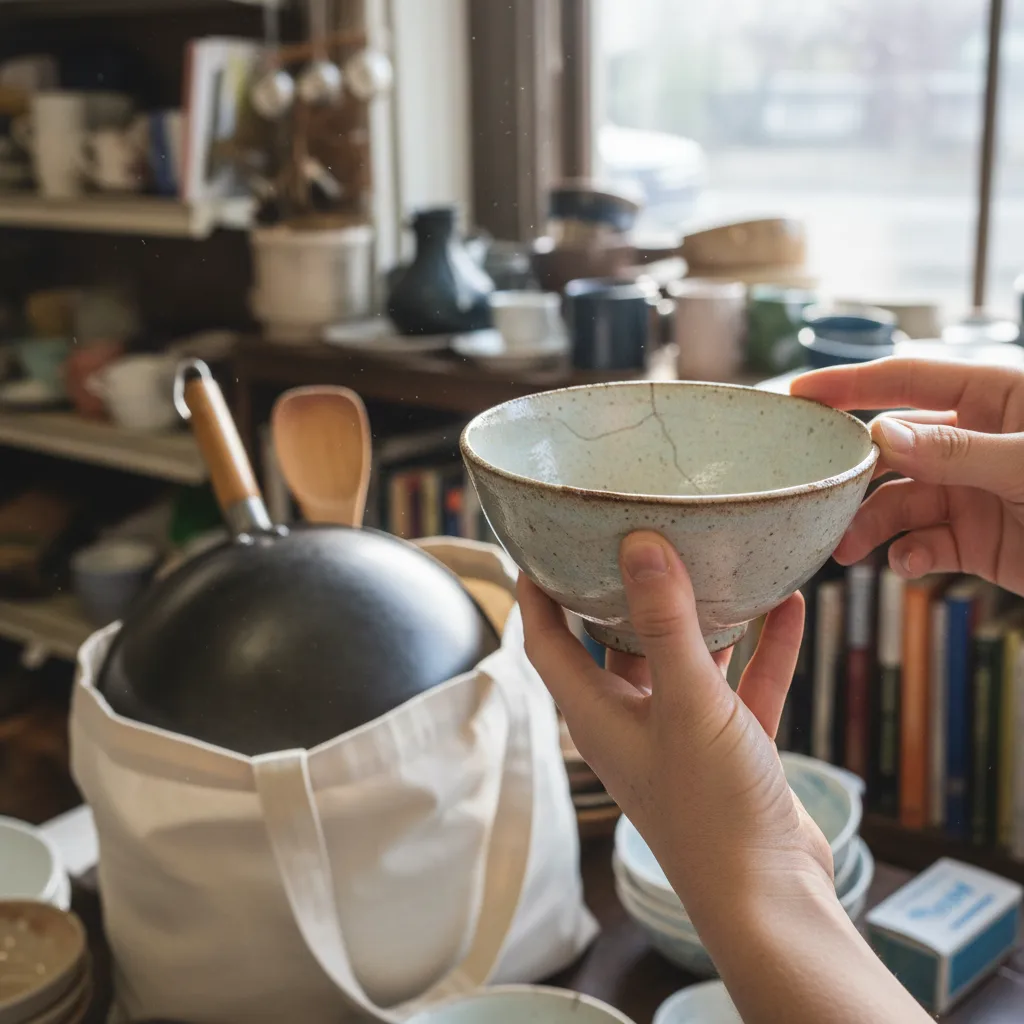
Tableware is where Flushing thrift shelves get interesting. Look for rice bowls in sets of four, shallow noodle bowls, small sauce dishes and heavy ceramic soup spoons that rarely show up in other neighborhoods. Mismatched pieces are fine if they share a color or a glaze, and a table of blue rims or celadon greens looks deliberate even when every bowl came from a different donation bag.
Run a finger around each rim before you add it to the basket. Chips catch on your lip and crack further in the dishwasher, if you have one. Turn plates over and tap them lightly. A clear ring means no hidden crack, while a dull thud suggests one. Older pieces with hand-painted decoration are lovely to eat from, though for daily use the plain restaurant-weight bowls tend to survive roommates better.
Mid-Crawl Break in a Food Hall
By late morning the bags get heavy, and that is the moment to drop into one of the basement food halls near the Main Street subway exit. Find a table, set the haul down and eat something you might cook later in your new kitchen: hand-pulled noodles, dumplings, a bowl of congee. Watching cooks at the counters is also a quick lesson in which tools matter, from long chopsticks to a spider strainer.
Use the break to review the list. Cross off what you found, note the gaps and look at what you bought with fresh eyes. If you picked up two woks because both looked good, decide now which one goes back on the donation pile someday. Groups of friends furnishing separate apartments often swap here too, trading a spare colander for a cutting board over a shared plate.
Afternoon: Small Tools and Appliances
The second half of the crawl is for small tools: ladles, spatulas, a spider strainer, measuring cups, a grater and storage containers. Housewares bins in Flushing thrift shops often hold sturdy restaurant-style tools, and a wooden wok spatula with a worn edge is a better buy than a shiny new plastic one. Bring a small zip bag for loose utensils so they do not slide around in the tote.
Electric rice cookers are the most common appliance on these shelves, and many work for years after donation. Ask the staff if there is an outlet for testing. At some shops someone will plug it in for you, and at others you take your chance. Look inside the inner pot for scratched coating and make sure the steam vent and the cord are intact. A rice cooker without its inner pot is not a bargain, so walk past it.
Who You Meet on These Shelves
Flushing thrift aisles have their regulars. Grandmothers with rolling carts move through housewares with a practiced eye, picking out steamer baskets and glass jars for pickling. International students compare finds on group chats, sending photos of rice cookers to roommates before buying. Resellers scan for brand-name cookware, and young couples argue gently over whether a second set of plates is necessary.
The unspoken rule is to keep the aisles clear and not hold items you are not sure about. If you set a pan down to think, someone else may claim it, and that is fair. Be polite at the register, carry your own bag, and if a staff member is restocking a bin, wait until they finish rather than digging through the cart. Patience earns better finds than speed.
What to Skip and When to Walk Away
Not everything on a thrift shelf belongs in a first kitchen. Skip knife sets in blocks unless you can see every blade, since often half the knives are missing or bent. Skip plastic containers with warped lids or cloudy stains, and leave decorative platters for a later trip when you know how you like to host. A full drawer of mismatched gadgets feels productive and then clutters a small kitchen for years.
If a shop feels picked over, move on rather than forcing a purchase. Flushing has enough housewares on its shelves that a dry stop rarely means a dry day, and coming back on a different weekday can change everything because donations arrive in waves. A rainy morning is often a good time to go, since fewer shoppers browse and the staff have time to put out new bags.
Getting the Haul Home
Plan the route so the last stop is closest to home or to the subway. A rolling cart or a large insulated grocery bag with flat handles makes the trip back much easier than plastic bags that cut into your hands. Wrap ceramics in a scarf or a dish towel you bought on the crawl, and stack bowls inside the wok so the bulky items carry together.
On the 7 train, stand near the doors with the bag between your feet so it does not tip when the train brakes. If the haul includes a rice cooker or cast iron, consider a short ride share instead of carrying it up several station stairs. Once home, wash everything in hot soapy water, season the wok and cook something simple the same night so the new kitchen feels real.
Planning the Next Round with Karpo
A good first crawl usually leaves two or three gaps on the list, maybe a good knife or a proper steamer. Open the Karpo APP and ask for secondhand and housewares shops near Flushing or along the 7 line, then save a few to try next time. Karpo can also suggest a lunch stop close to the shops you pick, so the second round fits the same rhythm as the first.
For a longer day, pair the crawl with a walk through Queens Botanical Garden or a loop around Kissena Park after lunch. The point of the route is not to buy the most, but to come home with a kitchen that works and a few pieces with history. A seasoned wok from someone else's family meals is a fine way to start your own.
Ask Karpo for more information.
Keep reading
- Jackson Heights Thrift Store Crawl Planner: Kids' Coats
 Crown Heights Thrift Store Crawl Planner: Holiday Table Haul
 Tribeca Plant Shop Crawl Planner for Office Desks and Gifts