 Lower East Side Axe Throwing Group Night Picker: Bride Crew
Sports Social
NYC Tennis Court Above the Tracks: Play at Vanderbilt
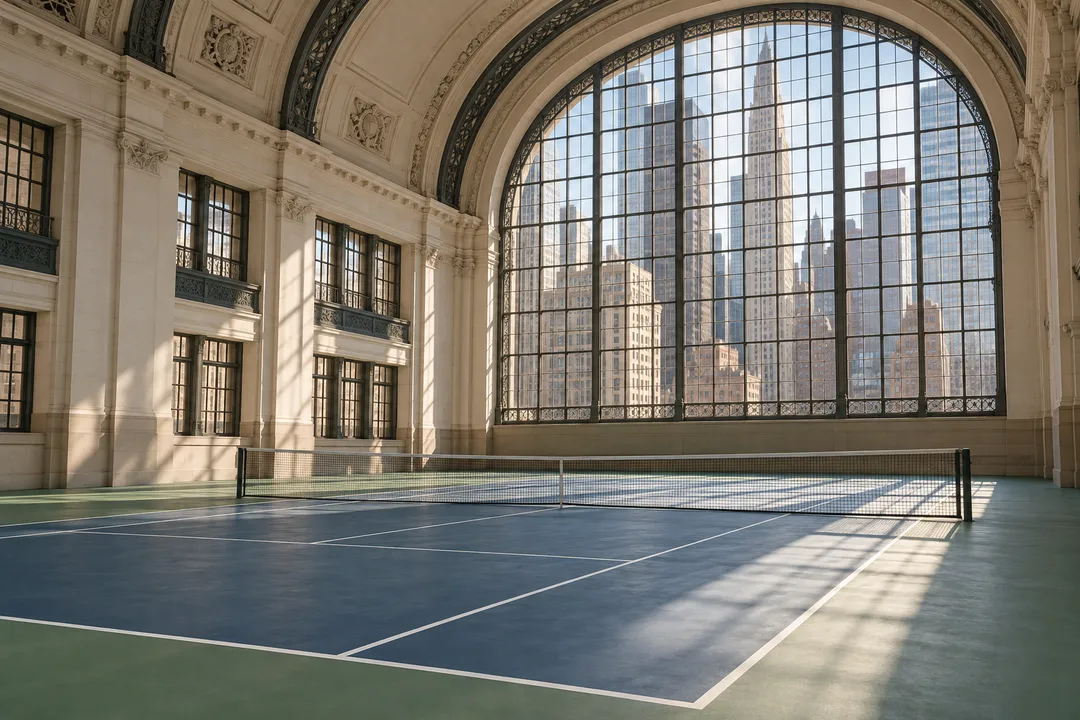
Vanderbilt Tennis Club welcomes the public inside Grand Central Terminal. Reserve its single full-size court or choose a practice lane for solo hitting.
Vanderbilt Tennis Club is open to the public on the fourth floor of Grand Central Terminal. Its one full-size indoor hard court is the match-play option, while separate practice courts support ball-machine training. For anyone looking for a tennis court in Midtown, that distinction matters before making a reservation. Vanderbilt Tennis Club lists its address as 15 Vanderbilt Avenue, fourth floor. You can visit without buying a club membership, but booking a practice lane is not the same as reserving the main court.
One main court changes the booking decision
The official court-time page is unusually direct about capacity: there is just one full-size main court. It offers hourly reservations and seasonal recurring slots, with no membership or guest fee. The homepage directs players to a finder for openings over the next seven days. Choose the appropriate reservation type first. If two friends want a proper singles match, the main court is the relevant product. A short machine lane serves a different purpose, even if it appears at a more convenient time.
Because only one regulation court is available, keep your timing flexible instead of treating a particular evening as guaranteed. Have your partner agree to two possible windows before starting the booking process. When a suitable slot appears, the useful comparison is between the actual reservation and your combined travel time. A spectacular location loses its appeal if one player can reach it only halfway through the session. This is an especially good choice when both people already pass through Midtown.
Getting upstairs is part of the visit
The club's FAQ gives a specific street approach. From Vanderbilt Avenue between East 42nd and East 43rd Streets, look for the red awning associated with The Campbell, enter that lobby and use an elevator to the fourth floor. The destination is inside the terminal building, not an outdoor court on a nearby block. Build a little orientation time into your arrival. Searching the busy concourse for a tennis entrance after your reservation starts is an avoidable way to shorten the game.
For someone arriving within the terminal, the FAQ also describes elevators near the ramp toward the Oyster Bar and Tracks 100–117. Those are wayfinding landmarks, not instructions to enter a train platform. Keep the club's entrance directions accessible before leaving the concourse. If a friend is coming from the street while you arrive by train, meet at the club reception instead of vaguely agreeing to meet at Grand Central. The terminal is too large for that shorthand to be useful.
Practice lanes are for repetitions, not sets
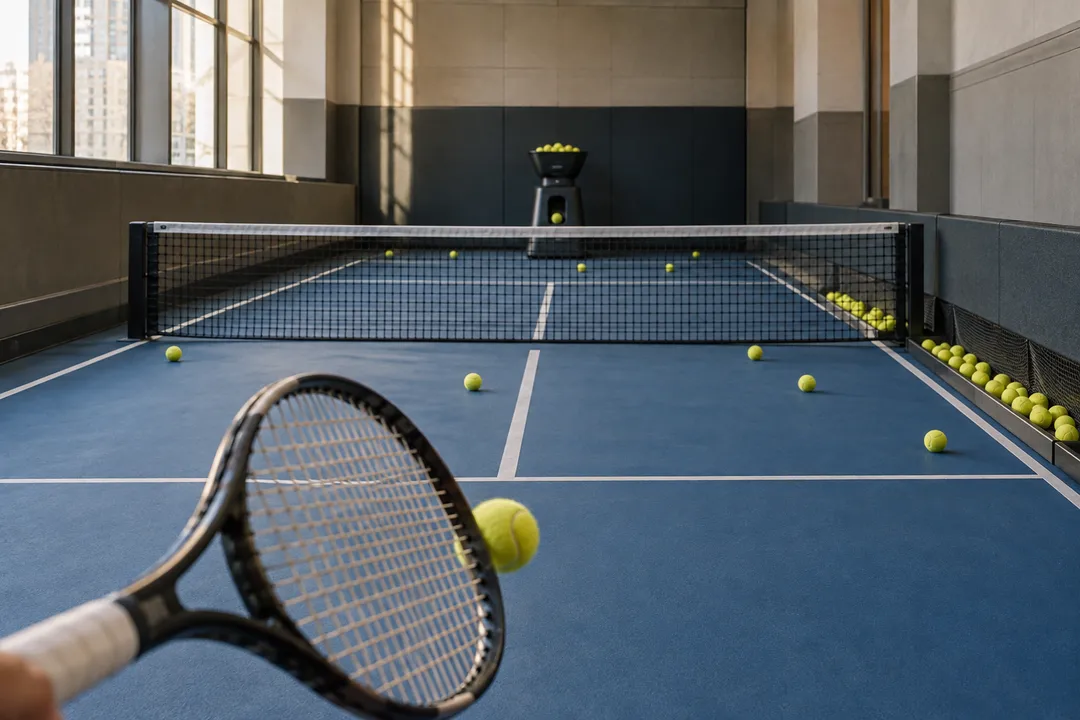
Vanderbilt's practice-court page describes a lane as half a court long, with automated ball feeding and a retrieval system. The point is concentrated stroke work. The court-time page says controls allow adjustments to speed, spin, direction, elevation and feed rate. That is a useful setup for repeating a backhand or finding a more stable contact point without arranging an opponent. It does not recreate the space, movement or tactical choices of a full singles match.
Use a solo session with one technical objective. For example, begin with controlled forehands aimed at the same target, pause to assess your contact point, then repeat the exercise from the backhand side. This is an editorial practice suggestion, not a club lesson plan. A machine gives you repeated feeds, but it cannot replace a coach's explanation of why a movement is breaking down. If you need diagnosis rather than repetition, choose instruction and let the pro help set the task.
A strange and appealing terminal history
The club's history page describes the space's earlier uses as an art gallery and a CBS recording studio. It says that in 1966 a Hungarian immigrant introduced tennis courts and an artificial ski slope. That unusual account helps explain why this visit feels different from a standard park reservation. The attraction is the transformation of an unlikely upper-floor space into somewhere people actually play. You do not need to be a tournament player to appreciate a tennis stop hidden within a major transport building.
The current operation describes its tennis community as dating from 2011. Treat that separately from the much older sporting uses of the space. A visitor is booking today's indoor club, with its present mix of a regulation hard court and practice facilities. The sensible reason to pay for this setting is to enjoy real playing time in an unusual location. Skip the idea of booking a session purely as a photo stop: the people on court need the space for their game.
Pack a towel and the appropriate shoes
There is no general dress policy, according to the FAQ, but shoes must have flat, non-marking soles. The same page says the club has men's and women's locker rooms, showers and lockers. Towels are not supplied, and you need to bring your own lock if using a locker. Pack those items before heading to work or boarding a train. A compact sports bag is easier to organize than trying to improvise after arriving upstairs with only a racket.
The published demo-racket rental price is $10, with the cost applicable toward rackets or strings when you retain the receipt. That can be useful for an occasional player who does not want to carry a frame around the city. Keep rental and court charges distinct when planning a shared visit. The club does not publish one universal main-court price on its homepage, so choose your actual reservation before deciding whether the outing fits your budget.
Turn the terminal into a useful meeting point
For a pair coming from different parts of the city, Grand Central provides a clear neighborhood anchor. Agree on whether the tennis session comes before dinner, before a train or after the working day. A hard departure time should shape your chosen reservation rather than become a reason to leave the court early. If you have only a short gap, a booked practice session may fit a solo visit better than trying to coordinate an entire match with another person's commute.
After changing, consider a walk west along East 42nd Street toward Bryant Park. The route makes a straightforward contrast with the enclosed court and the terminal's busy interior. Leave the extra stop optional if you are carrying equipment or catching a train. There is no advantage in filling every minute with attractions. A satisfying version of this outing can be simply a well-timed hit, a shower and an unhurried departure through the terminal.
Practical Notes
Use its Court Time page for the main court and its Practice Court page for ball-machine work. A seasonal slot is a recurring reservation, while hourly court time is for an individual booking. Select the full court for a match, bring flat-soled non-marking shoes, and pack a towel and lock if you intend to shower. The demo-racket fee on the FAQ is separate from any playing charge.
Ask the Karpo APP to help organize an indoor Midtown tennis plan around your arrival station, partner and departure time. Include whether you want a full-court game or solo practice so those options are not confused. Keep the club reservation as a distinct step through Vanderbilt's own channels. If the main court has no suitable opening, change the time or choose a different session type deliberately. A practice lane is a useful fallback only when repetition, rather than a competitive match, is your goal.
Ask Karpo for more information.
Keep reading
- Lower East Side Axe Throwing Group Night Picker: Bride Crew
 West Village Axe Throwing Group Night Picker: Quiz Rivals
 Carroll Gardens Axe Throwing Group Night Picker: Parents Off