 Tribeca Bowling Group Night Planner for Wedding Guests
Sports Social
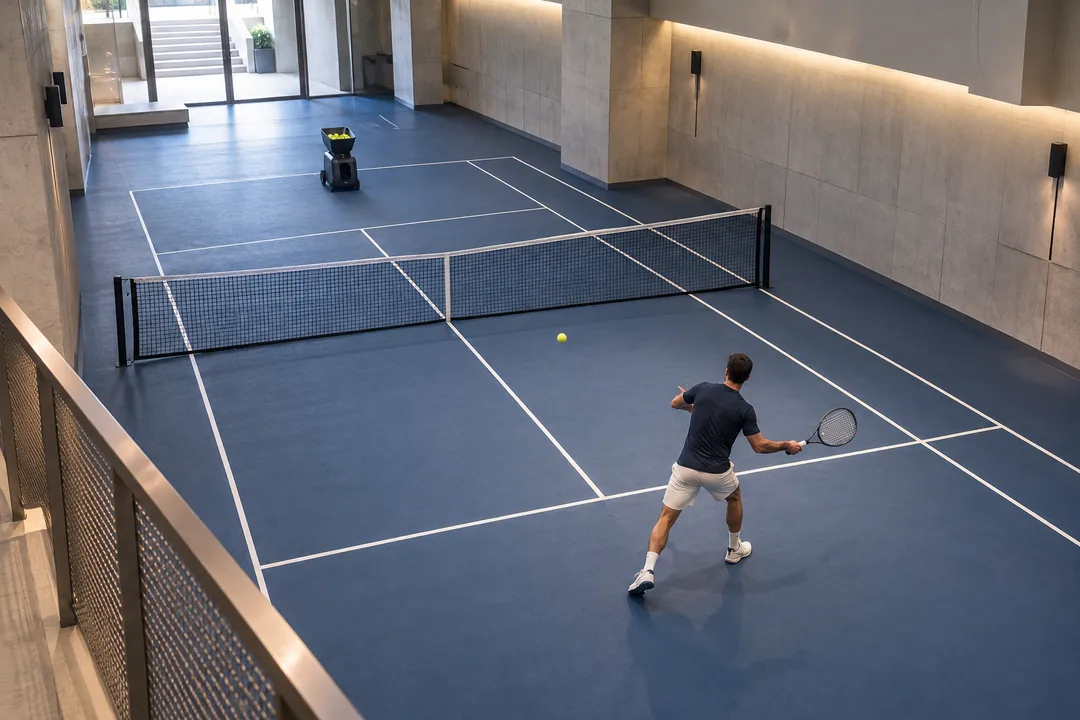
FiDi Tennis Court for Solo Training: Try Court 16
Court 16 FiDi offers ball-machine training and 44-foot tennis courts at 28 Liberty Street. Choose focused practice or coaching rather than a full-size match.
Court 16 FiDi combines ball-machine training with 44-foot tennis courts in the Financial District. Its tennis offer is useful for focused practice and instruction, rather than reserving a regulation-length court for a singles match. Court 16 gives its address as 28 Liberty St SC1. Adults can enroll in classes without purchasing a membership. For a tennis court session near work, this is a place to arrive with a defined training objective and the appropriate booking, especially if you are coming alone.
The compact court is the starting point
The FiDi location page describes cushioned, USTA-sanctioned kid-sized courts and an integrated ball-machine training program. It specifically lists 44-foot tennis courts. That scale should shape your expectations before you enter a booking flow. A smaller training space is not an inferior version of every other tennis activity: it serves particular exercises and learning stages. It also cannot provide the same length and movement as a 78-foot regulation court, so avoid choosing this branch solely because an indoor tennis search brought it up.
Think of your visit as a practice appointment. You might want repeated groundstrokes, individual instruction or a controlled introduction to hitting. A full match against a friend asks a different question of a facility. Court 16 also lists pickleball at this location, but that is a separate sport and reservation category. Read the activity name as carefully as the time. A convenient slot is valuable only if the equipment, court format and instruction suit the reason you came.
Choose between diagnosis and repetition
The brand's ball-machine page offers private, group and solo training on shorter courts. It describes private coaching as personalized instruction, group work as a way to focus on topspin and footwork, and solo training as repetition for consistency and endurance. Those are distinct uses of similar equipment. If you know the movement you want to repeat, solo practice can provide a clear task. If you are unsure what is causing a problem, a coach can help identify it before you repeat the same mistake.
A useful example is a backhand that works from an easy feed but breaks down when you move. Merely hitting more balls does not tell you whether the issue is spacing, preparation or balance. Describe the difficulty to an instructor and let the lesson establish a manageable exercise. This is a suggestion for framing your request, not a guarantee about a coach's method. The value of instruction lies in making the next repetition more purposeful, rather than counting every ball as automatic progress.
Give a solo session one measurable aim
Before travelling, write a short practice intention in ordinary language. You could aim to prepare before the bounce, finish balanced or direct a gentle ball toward the same area. Choose one priority rather than trying to rebuild every stroke in a single visit. Begin at a pace that lets you notice what happens. If your movement becomes rushed, pause and recover your attention. Concentration matters more than treating the machine as a challenge to keep hitting without interruption.
Afterwards, record what became easier and what remained uncertain. A few observations can make a later coaching session more specific. Avoid measuring success only by how tired you feel or by the number of balls you believe you hit. The club's website makes promotional claims about training volume, but an individual player's useful workload depends on the exercise. This article does not promise a particular ball count, improvement rate or result from a machine session.
Lessons remain an option for people arriving alone
You do not need to bring a partner to take instruction. Court 16's adult program distinguishes absolute beginners from players already able to rally, then offers progressively more demanding levels. It also has one-to-one, semi-private and group formats. Someone who has never held a racket should start with the introductory description. Someone returning after a long break can explain prior experience without assuming that old match fitness or timing will immediately return.
The adult enrollment page welcomes nonmembers. That makes it possible to consider a lesson before deciding on an ongoing club relationship. Membership benefits and a single class are separate decisions. A colleague's enthusiasm can be a good reason to try tennis, but it does not require you to purchase the same package or join the same level. For a first visit, choose a session you understand and a realistic objective you can discuss with the instructor.
Protect the appointment with simple preparation
Court 16 requires each adult to create an individual Mindbody profile before purchasing classes. If a colleague joins you, that person also needs their own account. Select FiDi deliberately when navigating the brand's locations. The Brooklyn flagship includes a full-size court, while this branch emphasizes its smaller formats. Keeping those differences in mind is more useful than assuming every Court 16 site offers an identical playing experience because the booking screens share the same branding.
The adult policies require athletic shoes with non-marking soles and encourage bringing a racket. A work shoe that happens to look flat is not a substitute for suitable sports footwear. Keep your playing kit packed before heading to the office, and leave time to change. The same policy says that players more than five minutes late join only at the next ball pickup. A tightly scheduled lunch break should therefore include arrival and departure time, not just the booked session.
A short walk can close the loop
The attraction of this address is a training stop within the Financial District rather than a special trip to a distant sports complex. If you work nearby, choose a slot that leaves a realistic margin before your next obligation. The reservation is the fixed point in the plan. Coffee, lunch or a walk can follow according to how much time remains. Do not let an optimistic itinerary turn a carefully booked practice session into a hurried dash through the neighborhood.
After tennis, a walk along Liberty Street toward Broadway gives you a straightforward way to rejoin the surrounding streets. You could continue toward the waterfront only when a longer break fits your day. Carrying a racket bag and changing after exercise adds practical friction, so keep the route uncomplicated. Meeting a colleague after training can work just as well as asking them to play. The outing does not need a competitive match to provide a useful change from office routine.
Practical Notes
The official location is Court 16 FiDi, 28 Liberty St SC1, New York. Use court16.com/manhattan-fidi for the branch description and the brand's Ball Machine Training page to understand the session formats. No training price is quoted here. The adult enrollment terms require at least 24 hours for rescheduling, with group-class changes made through the account and private-lesson changes requested by email. Follow the terms attached to your selected purchase.
Tell the Karpo APP you want focused tennis practice in FiDi, whether you are a beginner or returning player, and how much time you have around the appointment. Include that a 44-foot training court is acceptable if that is your goal. Make the reservation through Court 16's own channels. For an outing centered on regulation match play, select a facility that explicitly offers a full-size court instead. Here, the strongest fit is a purposeful session built around learning or repeating a skill.
Ask Karpo for more information.
Keep reading
- Tribeca Bowling Group Night Planner for Wedding Guests
 Flushing Bowling Group Night Planner for Thanksgiving Break
 Bushwick Bowling Group Night Planner After Band Practice