 Tribeca Bowling Group Night Planner for Wedding Guests
Sports Social
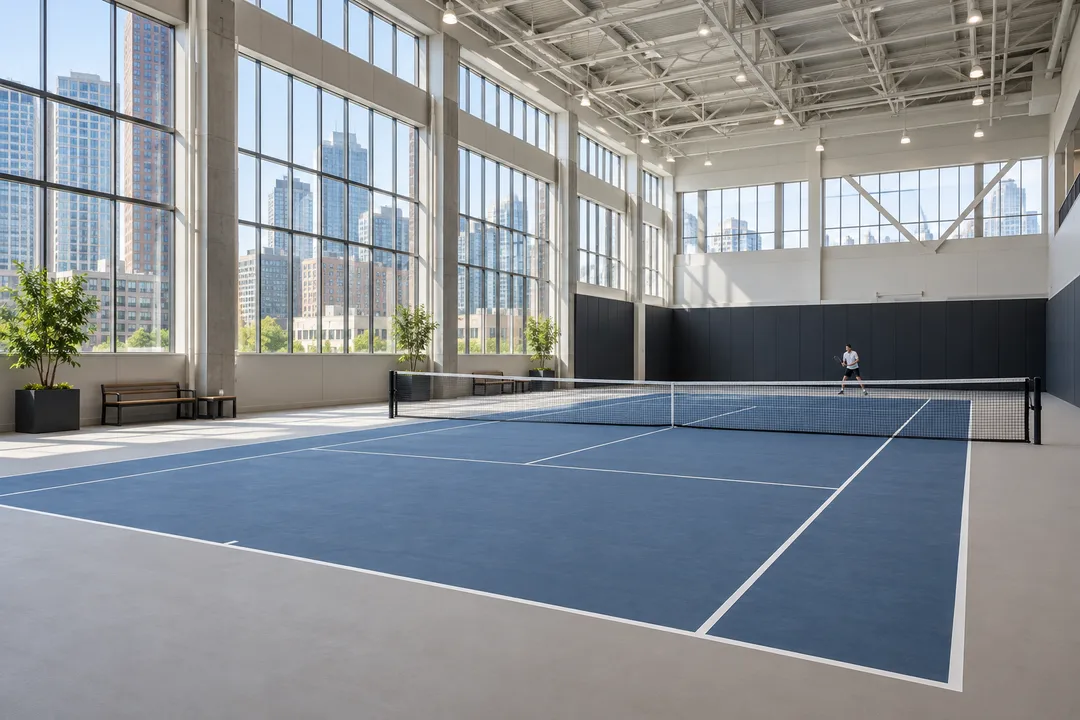
Brooklyn Tennis Court With 5 Sizes: Choose Court 16
Court 16 Downtown Brooklyn combines a full-size tennis court with smaller training formats. Choose your session by playing level, court length and group size.
Court 16 Downtown Brooklyn has a 78-foot full-size tennis court alongside smaller formats for learning and practice. Adults can enroll without buying a membership. For a Brooklyn tennis court search, the useful question is which court size and session match your goal. Court 16 lists the club at 445 Albee Square W, Suite 4-500. Its mix of training spaces suits a beginner learning to rally, a parent arranging lessons and a stronger player seeking instruction, but those visitors need different bookings.
A flagship built around different stages of play
The official Downtown Brooklyn page describes a 28,000-square-foot flagship with five court sizes. Its listed facilities include 44-foot courts for younger players, a 60-foot court and a 78-foot full tennis court. Ball-machine training and pickleball are also part of the facility. This variety is the defining feature of the club. A reservation labeled tennis does not automatically mean unrestricted use of its largest court, and the presence of a regulation-length surface does not make every class a full-court match.
Start with the activity you actually want to finish. A person who hopes to sustain ten controlled exchanges needs a learning environment with manageable distances. A player preparing for competitive singles needs room and coaching appropriate to that task. A family organizing a child's first lesson has a third priority: an age-appropriate program. These are practical ways to interpret the club's range of formats. They are not a promise that a particular court or coach will be available at your preferred time.
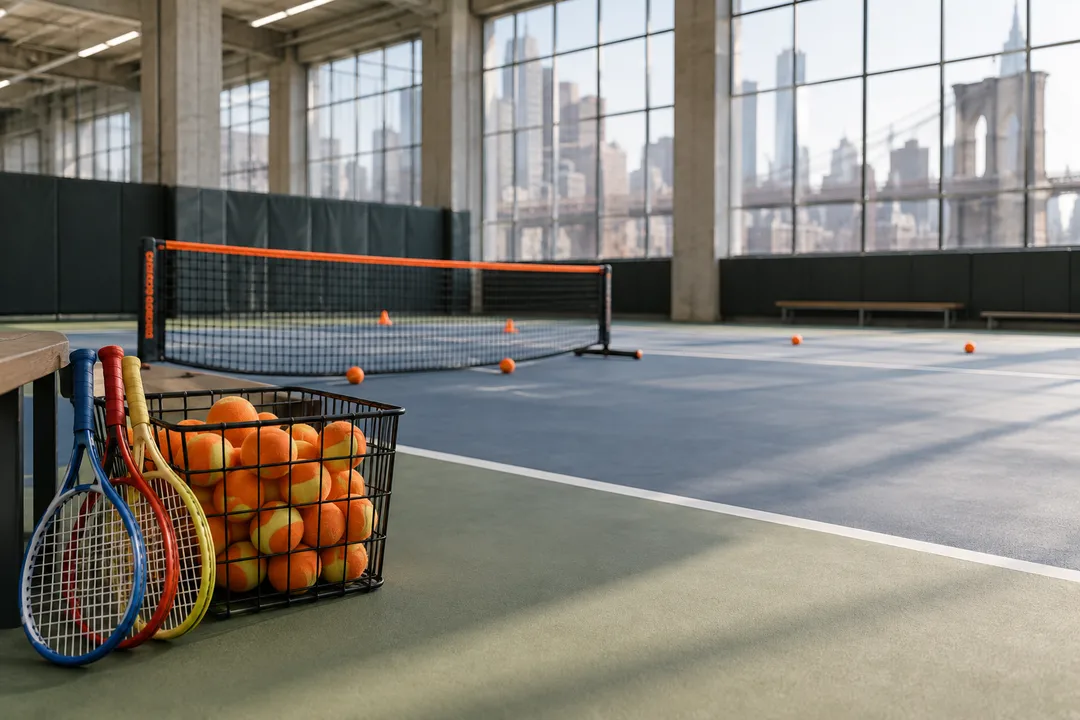
Your first booking starts with the level descriptions
Court 16 separates Introduction to Tennis from its Beginner class. Introduction is for people entirely new to the game and includes holding the racket, learning basic checkpoints and establishing a gentle rally at close range. Beginner, listed at USTA 1.0 to 2.5, develops forehands, backhands, volleys and serves. If you have never played, choosing the introductory track gives the coach an accurate starting point. There is no advantage in presenting yourself as more experienced merely to join a friend.
The Advanced Beginner description is more specific than its name suggests. Players should already understand basic grips and swing paths, rally consistently with a coach from the 60-foot baseline and make consistent serves with a basic swing. Intermediate is listed at 2.5 to 3.5, while Advanced begins at 3.5. Use those functional descriptions when deciding where you fit. Someone returning after years away can explain their previous experience and present limitations rather than treating an old rating as the whole story.
Bring a partner or join a coaching group
The adult program offers group classes with a maximum of six players, private lessons and semi-private instruction for pairs. Friends and families can also organize a private group pod with coaching. That creates several ways into the same building. For two people with similar experience, a semi-private lesson keeps the session focused on shared goals. A mixed group of friends should describe its differences honestly before purchasing instruction, since one person's first forehand and another person's competitive serve need different attention.
A group class is a coached session, not a guarantee of uninterrupted hitting or a court reserved solely for you. Think about whether you learn well while watching others and rotating through exercises. A private lesson may be more useful when you need detailed feedback on one stroke. For a social return to the game, a group can make participation easier without requiring you to recruit an opponent. Select the format for how you want to learn, then consider the calendar.
The registration details that prevent a rushed arrival
Every adult needs an individual Mindbody profile before purchasing classes. Court 16 explicitly says that couples need two separate profiles. One person paying or coordinating the outing does not remove that requirement. Complete both accounts before choosing a joint session, and ensure you are selecting Downtown Brooklyn rather than another Court 16 location. The chain has several clubs with different court formats, so a familiar brand name alone is not enough to identify the right destination.
The adult enrollment page requires athletic shoes with non-marking soles and strongly encourages players to bring their own rackets. Its late-arrival rule says that anyone more than five minutes late must wait until the next ball pickup to join. Arriving early therefore protects actual learning time rather than simply making reception easier. Pack the racket, appropriate shoes and water before leaving home. If you are bringing a child as well, keep your own adult enrollment separate from the child's lesson arrangements.
A repeatable practice plan beats a vague workout
The club lists ball-machine training among its facilities. A useful reason to choose it is to repeat a clearly defined movement without depending on a partner's feeds. Decide whether your priority is contact, recovery steps or directing the ball toward a target. Do not assume that hitting a large number of balls automatically solves a technical problem. When the issue is understanding the stroke, coaching offers a different kind of help from a machine's repeated deliveries.
For a first coached visit, arrive with one sentence describing what would make the lesson useful. You might want to stop crowding the ball on the backhand, learn a reliable service motion or return comfortably after time away. Let the instructor choose appropriate exercises and distances. These are editorial suggestions for preparing, not Court 16's prescribed curriculum. The smaller courts make sense when they help the lesson, while the full-size court is relevant when your task requires its length.
Make the neighborhood fit around the reservation
The club lists DeKalb Avenue, Hoyt Street, Hoyt–Schermerhorn and Nevins Street among nearby stations. Pick the stop that fits your actual route and allow time to reach the suite inside the building. Meeting a friend at reception is clearer than naming an entire Downtown Brooklyn intersection as the rendezvous. A reservation is easier to enjoy when the first few minutes are spent warming up rather than exchanging messages about which entrance each person has found.
After the session, a walk along Fulton Street can be a simple way to unwind before heading home. If you want a longer neighborhood outing, continue toward Fort Greene and its park rather than trying to squeeze sightseeing into the period before class. Carrying a racket and changing shoes already adds some logistics. Keep the tennis appointment as the fixed element and choose the rest of the walk according to your energy, weather and travel direction.
Practical Notes
Court 16's adult enrollment policy requires rescheduling at least 24 hours in advance. Group-class changes go through your account, while private-lesson changes go through the office by email. Membership is optional for adult classes. Choose the actual Brooklyn session before budgeting: this article does not quote a lesson or court-rental price. A private lesson, a group class and a court booking are different purchases even when they happen at the same club.
Use the Karpo APP to organize a Downtown Brooklyn tennis outing around your level, companion and transport route. Say whether your goal is instruction, machine practice or a full-court game so the plan reflects that distinction. Enrollment and payment belong in Court 16's own booking process. For a first visit, the strongest plan is uncomplicated: the correct club, a realistic level, completed individual profiles and enough arrival time to join from the beginning.
Ask Karpo for more information.
Keep reading
- Tribeca Bowling Group Night Planner for Wedding Guests
 Flushing Bowling Group Night Planner for Thanksgiving Break
 Bushwick Bowling Group Night Planner After Band Practice