 Flatiron Holiday Window Walk Planner for Remote Teams
Free Things to Do
Sculpture Garden Near Me in Flatiron: Roberto Lugo's Urn in Madison Square Park
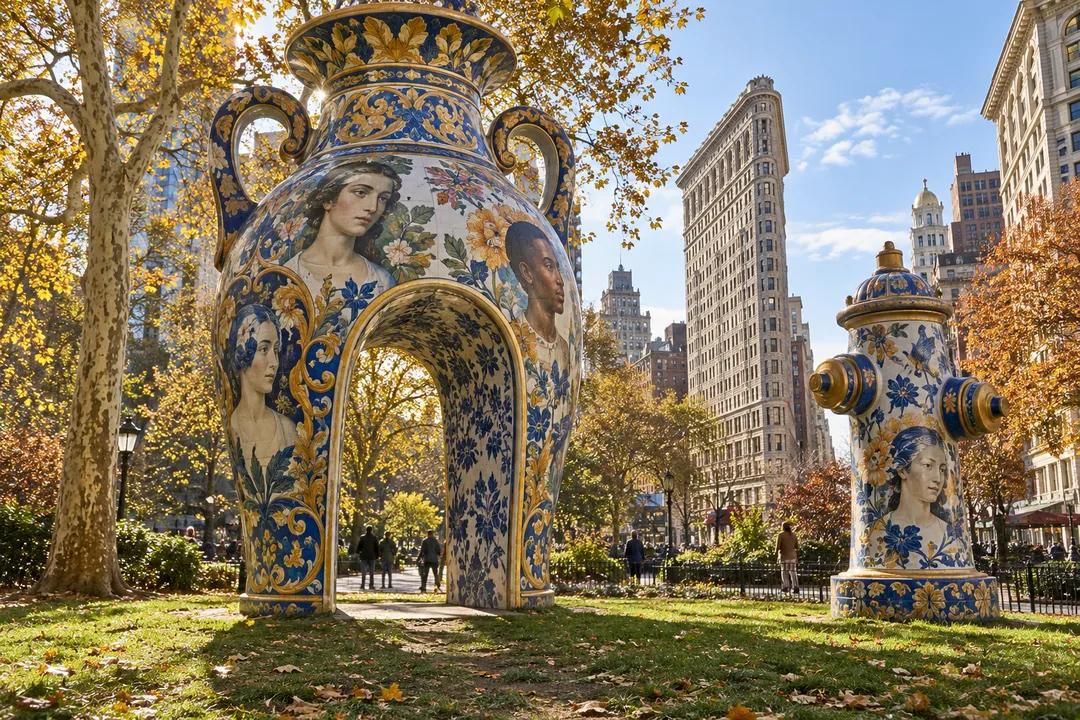
Madison Square Park's 2026 art commission, Roberto Lugo's Alfarero del Barrio, stays on view through December 6, 2026: a 20-foot painted urn you can walk through, a 15-foot fire hydrant and domino tables you can actually play on. The park is free, open 6 am to 11 pm from November, and sits between Fifth and Madison Avenues from 23rd to 26th Street.
Madison Square Park has no gate and no ticket, and through December 6, 2026 its lawns double as Manhattan's most playful outdoor sculpture garden. The 2026 commission from Madison Square Park Conservancy is Roberto Lugo's Alfarero del Barrio, Spanish for village potter: a twenty-foot painted urn you can walk through and a fifteen-foot fire hydrant, set in the seven-acre park bounded by Fifth and Madison Avenues and 23rd and 26th Streets. Park hours are 6 am to midnight through October 31, then 6 am to 11 pm from November 1.
Who Roberto Lugo Is and Why an Urn
Lugo is a Philadelphia-based ceramicist, poet and educator who grew up in North Philadelphia and paints classical vessel shapes with portraits drawn from Puerto Rican culture, hip-hop and graffiti. He holds a BFA from the Kansas City Art Institute and an MFA from Penn State, and his awards include a 2023 Heinz Award, a 2019 Pew Fellowship and a Rome Prize. His pots sit in the permanent collections of the Metropolitan Museum of Art, the Brooklyn Museum and the Philadelphia Museum of Art.
For Madison Square Park he scaled the pot up to public-art size. Both sculptures are hand-painted milled foam, not ceramic, fabricated with The Johnson Atelier in Hamilton, New Jersey, where Lugo has worked on large pieces since 2022. The urn recalls traditional porcelain. The hydrant is his tribute to city streets, the summer spray that every New York block knows. The project was first curated by Brooke Kamin Rapaport and is now organized by chief curator Denise Markonish with Tom Reidy and Tiera Ndlovu.
Reading the Faces on the Urn
Walk around the urn slowly before you step through its arch. Lugo painted his parents, Gilberto and Maribel, among the portraits, alongside Puerto Rican figures most visitors will recognize: Lin-Manuel Miranda, Supreme Court Justice Sonia Sotomayor and the baseball great Roberto Clemente. The arch at the base is meant to be used, so walk under it rather than photographing it from the path. Standing inside, the painted bands curve over your head the way a pattern wraps the belly of a real vase.
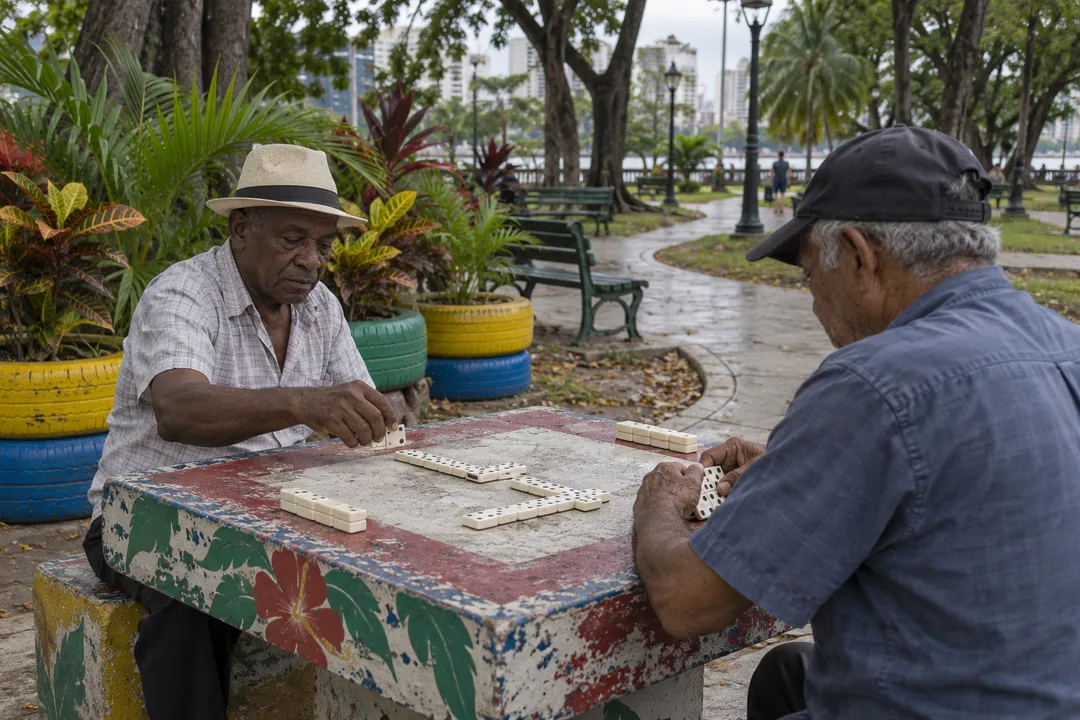
The quieter parts of the installation are easy to miss. Lugo also made a set of hand-painted tire planters filled with plants native to Puerto Rico, and a group of domino tables he designed with his father, which visitors are invited to sit at and play. Bring your own set of dominoes if you want a proper game. The tables are the friendliest way to spend twenty minutes in the park, and they turn the commission from something you look at into something you join.
Lawn Hours, Weather and the Best Light
The sculptures stand on lawns that open daily from 10 am to 5 pm, weather permitting. The lawns close on parade days, after heavy rain and for maintenance, and the Conservancy posts live lawn status in a widget on its website, so check it on a wet morning instead of walking over. The paths around the lawns stay open all day, which means you can still see the urn and hydrant from the edge at 8 am or after dark, just not touch the grass.
The best hour is late afternoon in October and November, when low sun comes across 23rd Street and lights the painted portraits from the side. Weekday mornings are quietest. At lunch the benches fill with office workers from the towers around the park, and the domino tables are most likely to be taken. Skip the urn on a parade day like Veterans Day, when Fifth Avenue fills and the lawns are closed anyway.
Park Rules Worth Knowing
There are no bathrooms inside the park. The nearest public toilet is a city DOT restroom on Madison Avenue between 23rd and 24th Streets, and water fountains sit near the main fountain, by the reflecting pool and in the playground. Bicycles are banned on park pathways, so lock up outside the fence. Dogs are welcome on leash but must stay on the paths, and you are asked not to feed the squirrels or birds.
Groups of 20 or more need a permit from NYC Parks, as does anyone bringing a table onto the lawn. A folding chair for your own use is fine. If you are planning a meetup around the domino tables, keep it small. Photographs for personal use are not restricted the way they are in a museum, but this is a working lawn with children and dogs nearby, so tripods on a crowded afternoon are a nuisance.
A Short History of Art on This Lawn
The Conservancy has managed the park since 2003 and raises its entire operating budget, and the park now draws an estimated 60,000 visitors a day, many of whom come for the rotating art. Recent commissions show the range: Martin Puryear's Big Bling in 2016, Abigail DeVille's Light of Freedom in 2020, Nicole Eisenman's Fixed Crane in 2024 and Larry Bell's glass cubes, Improvisations in the Park, which closed on March 29, 2026, just before Lugo's pieces went up.
Art on this ground goes back much further. From 1876 the Statue of Liberty's right arm and torch stood in the park for six years to raise money for the statue's pedestal, and visitors paid to climb it. The first public Christmas tree in the United States went up here in 1912, and the Eternal Light flagstaff at the north end was first lit on Armistice Day 1923. Lugo's urn joins a long line of oversized objects set on these lawns.
Getting There and Who Shows Up
The 23 St stations on the R and W at Broadway and on the 6 at Park Avenue South both let out within a block or two of the park. Expect a mix of Flatiron office workers on lunch, NoMad hotel guests, families heading to the Police Officer Moira Ann Smith Playground, and dog walkers making the morning loop. The original Shake Shack, which opened in the park in 2004 in a kiosk designed by architect James Wines, sits near the south end and often has a line.
If the Shake Shack line runs past the playground, skip it. The art is the reason to come, and the line moves slowly at lunchtime. A better plan is to see the sculptures first, then walk one block southwest to the Flatiron Building, completed in 1902, for the classic view up Fifth Avenue. If rain closes the lawns, the urn and hydrant are still visible from the paved paths, so a wet day costs you the domino tables, not the art.
Turning It Into a Two-Hour Walk
Start at the urn, cross to the Worth Square obelisk at Fifth Avenue and Broadway, which marks the grave of General William Jenkins Worth and is one of only two city monuments that double as a mausoleum, the other being Grant's Tomb. Then look up at the Met Life Tower at Madison Avenue and 23rd Street, the city's tallest skyscraper when it was completed in 1909. Finish on the Oval Lawn at the north end if it is open.
Practical Notes
Madison Square Park sits between Fifth Avenue and Madison Avenue from 23rd Street to 26th Street in Manhattan's Flatiron and NoMad districts. Admission is free. Park hours are 6 am to midnight from June 1 to October 31 and 6 am to 11 pm from November 1 to May 31. Lawns open 10 am to 5 pm, weather permitting. Roberto Lugo's Alfarero del Barrio is on view through December 6, 2026. Use the Conservancy's contact form for questions, since it lists no public phone line.
Ask Karpo for more information.
Keep reading
- Flatiron Holiday Window Walk Planner for Remote Teams
 SoHo Holiday Window Walk Planner for a Sketchbook Afternoon
 Upper East Side Holiday Window Walk Planner After a Museum