 Tribeca Bowling Group Night Planner for Wedding Guests
Sports Social
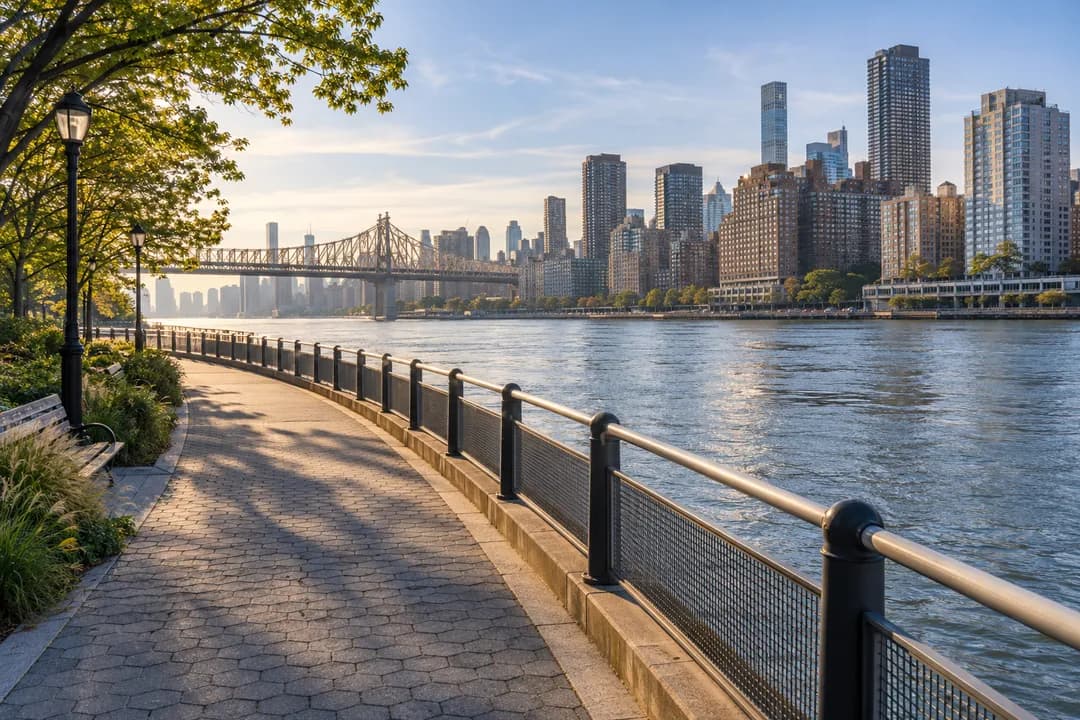
NYC Scenic Jogging Route: Free Roosevelt Island Loop Track
Jog the car-free Roosevelt Island waterfront promenade for sweeping East River skyline views, historic stone landmarks, and quiet riverside paths.
Starting your morning workout at the Roosevelt Island Tramway plaza at 591 Main Street brings you onto one of the most peaceful and uniquely isolated waterfront running circuits in New York City. Roosevelt Island rests like a slender two-mile granite sliver in the middle of the East River tidal channel, surrounded on all sides by flowing saltwater and historic stone masonry. Because personal automobiles are strictly restricted from the shoreline promenades, runners can jog three point eight continuous miles along the outer perimeter seawall without dodging delivery vans, crossing intersections, or stopping for traffic lights. The calm morning river water and uninterrupted skyline views of Manhattan's Upper East Side make this a true sanctuary for urban runners seeking peaceful, rhythmic miles away from city congestion.
Island Perimeter Circuit and Surface Conditions
The Roosevelt Island loop follows a wide asphalt and poured concrete promenade that tracks the exact granite seawall edge around the entire island. Runners typically jog in a counter-clockwise direction, heading south along the West Promenade toward the Franklin D. Roosevelt Four Freedoms State Park, rounding the granite southern point, and returning north along the East Promenade toward Lighthouse Park. The total unbroken loop measures approximately three point eight miles, with marked quarter-mile distance markers painted cleanly on the pavement to assist runners with interval pacing, tempo splits, and structured marathon training programs.
The running surface is remarkably level and smooth throughout, with elevation changes rarely exceeding ten vertical feet across the entire shoreline perimeter. Wide granite and concrete pavers on the southern promenades transition into smooth, shock-absorbing asphalt along the quieter eastern shoreline facing Long Island City. The complete absence of driveway drop-offs, construction curb cuts, and vehicular traffic ensures a uniform stride cadence that is especially beneficial for distance runners working on steady pace endurance, heart-rate zone management, or athletes recovering from lower-leg impact fatigue on unforgiving pavement.
Historic Landmarks and Shifting River Panoramas
Jogging south along the West Promenade offers a front-row view across the river channel toward the historic brownstones and luxury residential towers of Manhattan's East 60s and 70s. Halfway south, you pass beneath the monumental steel cantilever lattice of the Queensboro Bridge, where traffic rumbles harmlessly one hundred and thirty feet above your head while the tram cabin glides silently overhead. Further south, the trail skirts the modern glass academic buildings and landscaped sustainable hills of the Cornell Tech campus before approaching the picturesque, ivy-covered stone ruins of the 1856 Renwick Smallpox Hospital.
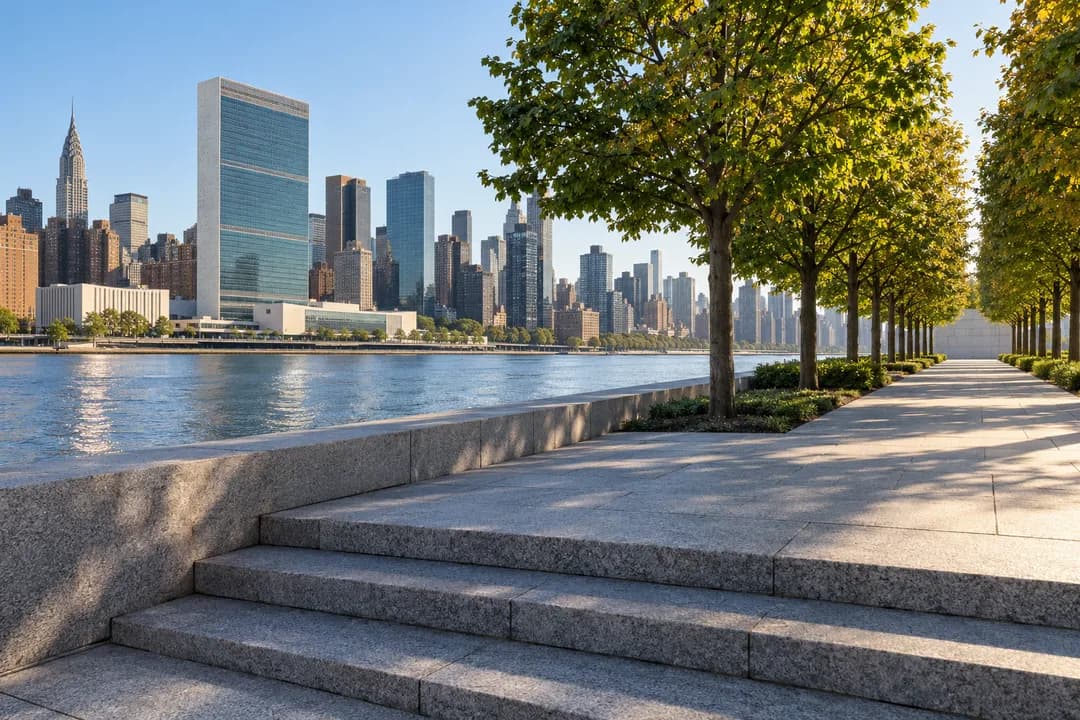
At the island's southern tip, the trail loops around the monumental white granite outdoor plaza of Franklin D. Roosevelt Four Freedoms State Park, framed by double rows of symmetrical linden trees planted in disciplined rows. Looking across the river from the granite prow reveals dramatic views of the United Nations Secretariat building and the iconic Midtown East skyline reflected in the morning river currents. Turning north along the East Promenade, the scenery shifts toward the former industrial waterfront, giant historic gantry cranes, and contemporary residential high-rises of Long Island City, culminating at the historic 1872 Blackwell Island Lighthouse standing tall on the northern rocky point.
Tidal Currents, Wind Dynamics, and Best Hours
Because the East River acts as a narrow tidal strait connecting Long Island Sound to New York Harbor, strong currents and brisk river breezes constantly sweep across the island promenades. On warm summer mornings, this constant airflow keeps the running loop three to five degrees cooler than inland city streets, providing welcome relief on hot humid days. In winter, however, wind speeds can accelerate sharply between the tall buildings of Manhattan and Queens, meaning runners should wear windproof outer jackets, thermal running beanies, and insulating gloves to maintain core warmth against biting river chill.
The ideal time to run Roosevelt Island is between 6:30 am and 9:00 am on weekday mornings. During dawn hours, the promenades are remarkably peaceful and populated predominantly by island residents, hospital medical staff, and dedicated long-distance runners who travel to the island specifically for its traffic-free continuity and clean air. On sunny weekend afternoons, leisure walkers, family strollers, and sightseers gather near the Tramway station and Southpoint Park, requiring joggers to moderate their speed when navigating narrow esplanade bottlenecks.
Water Fountains, Restrooms, and Trail Safety
Roosevelt Island provides dependable public amenities along its perimeter for fitness visitors. Clean, heated public restrooms are situated inside the Tramway Station terminal building, at the Sportspark athletic recreation center near 250 Main Street, and inside the Roosevelt Island Cultural Center at 540 Main Street. Filtered outdoor drinking fountains equipped with rapid water bottle refill stations are located at Lighthouse Park at the north end, at the Octagon park plaza, and near the entrance to Southpoint Park, offering cold water throughout the warm running season.
Trail safety on the island is enhanced by strict local regulations enforced by the Roosevelt Island Operating Corporation. Motorized vehicles, including gas mopeds and commercial delivery scooters, are strictly prohibited from the perimeter promenades. Pedestrians and runners share the path with occasional recreational cyclists, so maintaining right-side lane discipline is standard etiquette. The promenades are well lit by marine-grade fixtures after dusk, allowing for safe evening runs with sparkling views of the illuminated Manhattan skyline reflecting across the river surface.
Transit Access and Digital Route Navigation
Getting to Roosevelt Island is an iconic New York transit experience in its own right without ever needing a car. The Roosevelt Island Tramway departs every seven to fifteen minutes from Second Avenue and 59th Street in Manhattan, sweeping passengers across the East River in four scenic minutes using standard MetroCard or OMNY contactless fare. Alternatively, the F subway line stops directly in the island center at the Roosevelt Island Station, and the NYC Ferry docks at the East River landing near the Cornell Tech campus, making access easy from Queens and Brooklyn as well.
Karpo APP compiles peaceful running route overviews, perimeter distance details, and waterfront scenic highlights across Roosevelt Island. Whether you want to map out a steady 3.8-mile lap around the seawall promenade, plan an easy jog past Southpoint Park and the Octagon, or review neighborhood connectors leading toward neighboring Queensbridge Park across the bridge, Karpo APP helps you organize structured course candidates. Runners can compare route distance ideas and transit arrival points smoothly, while looking over island facility notices, seasonal tram schedules, and bridge footpath advisories directly through the Roosevelt Island Operating Corporation before starting their morning laps.
Ask Karpo for more information.
Keep reading
- Tribeca Bowling Group Night Planner for Wedding Guests
 Flushing Bowling Group Night Planner for Thanksgiving Break
 Bushwick Bowling Group Night Planner After Band Practice