 Fort Greene Holiday Market Browsing Guide for Young Shoppers
Weekend Plans
NYC Rainy Day Museum Planner: Three Stops by Bowling Green
Three museums sit within a few minutes of Bowling Green: the Custom House galleries, Fraunces Tavern and the harbor-facing Museum of Jewish Heritage.
Three museums cluster within a few minutes of Bowling Green, and that tight radius is the whole point of this rainy day museum planner for Lower Manhattan. The Smithsonian's National Museum of the American Indian fills the 1907 Alexander Hamilton U.S. Custom House, Fraunces Tavern Museum sits two blocks east on Pearl Street, and the Museum of Jewish Heritage faces the harbor at the edge of Battery Park City. You can do all three without a single long walk in the wet.
Start Under the Custom House Rotunda
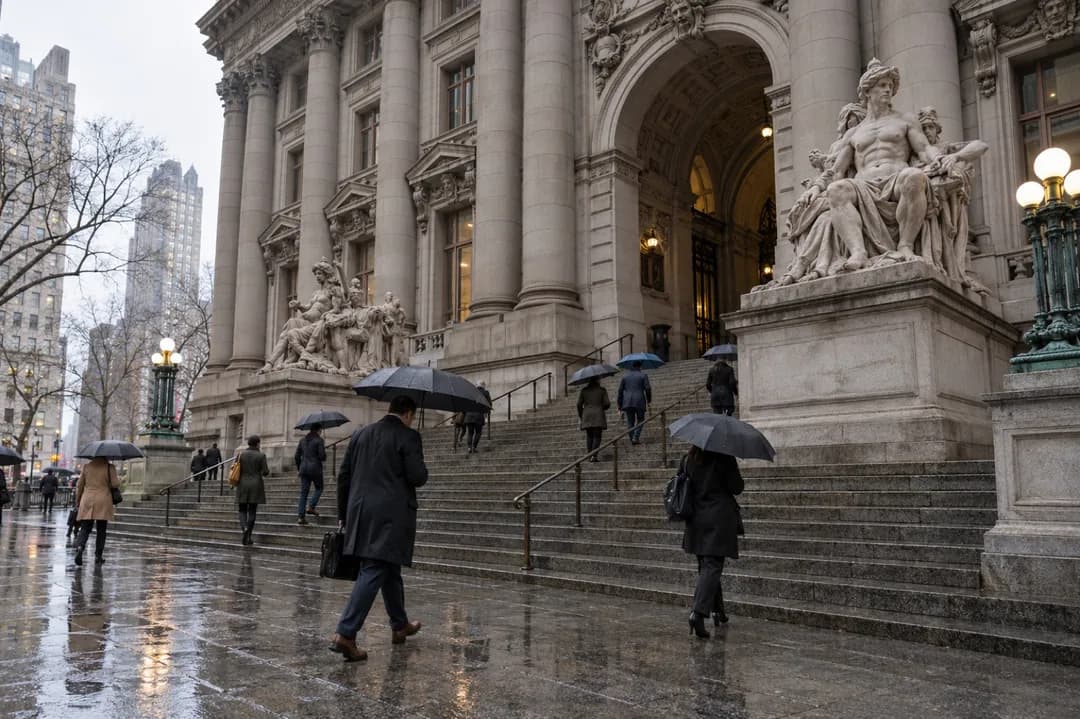
Come up out of the 4 or 5 train at Bowling Green and the Custom House is the first thing you see: Cass Gilbert's granite Beaux-Arts front, with Daniel Chester French's four seated figures representing the continents lined along the steps. On a grey morning the stone goes almost charcoal, and the bronze doors are a relief to reach. Inside, the George Gustav Heye Center has been the New York branch of the Smithsonian's Indigenous collection since 1994.
Look up once you reach the rotunda. The elliptical dome carries Reginald Marsh's 1937 murals of ships entering New York Harbor, painted under a Depression-era federal arts program, and the oval skylight keeps the room bright even when rain is hammering the copper roof. Benches ring the floor, and on wet weekdays this is where school groups regroup and older visitors sit out the worst of a downpour before heading into the side galleries.
The galleries off the rotunda hold beadwork, carved masks, textiles and contemporary Native art, and the exhibitions rotate, so the specific objects change from season to season. The ImagiNATIONS Activity Center on the ground floor is the stop for anyone traveling with children; it is built around hands-on stations rather than glass cases. If you only have an hour here, skip trying to see everything and pick one exhibition plus the rotunda.
Two Blocks East to Fraunces Tavern
Fraunces Tavern is the short hop of the day: from the Custom House steps it is a couple of blocks along Bridge or Pearl Street, under narrow streets where the older buildings throw a bit of cover. The museum occupies the upper floors of a brick building that dates its story to 1762, though most of what stands now is a careful 1907 reconstruction by the Sons of the Revolution, who still run the place.
The draw is the Long Room on the second floor, where George Washington said goodbye to his officers on December 4, 1783, before leaving New York at the end of the Revolutionary War. It is a low-ceilinged, wood-paneled room set up as a period tavern, and it rewards a slow look rather than a quick photo. Other rooms cover the Revolutionary-era city and rotating displays of flags and documents.
An honest note: Fraunces Tavern is a small museum, and visitors expecting a large institution sometimes leave within forty minutes. That suits a rainy loop well, because it breaks the day into a short indoor segment between two bigger stops. The ground-floor restaurant and bar share the building, so if you want a warm drink after the Long Room you do not have to go back outside to find one.
The Harbor Window at the Museum of Jewish Heritage
From Fraunces Tavern, the walk west through Battery Park toward Battery Place is the longest open stretch of the day, roughly ten minutes along the waterfront path. In real rain, a short cab ride around State Street beats crossing the open lawn on foot. The Museum of Jewish Heritage, which calls itself A Living Memorial to the Holocaust, opened in 1997 in a six-sided granite building with a six-tiered roof.
The six sides and six tiers refer to the six million Jews murdered in the Holocaust, and the core exhibition moves through Jewish life before the war, the Holocaust itself, and the communities rebuilt afterward. Expect personal objects, photographs and recorded testimony, and expect visitors to move quietly. This is not a stop to rush; give it at least ninety minutes, and plan it as the last major museum so the day does not feel crowded around it.
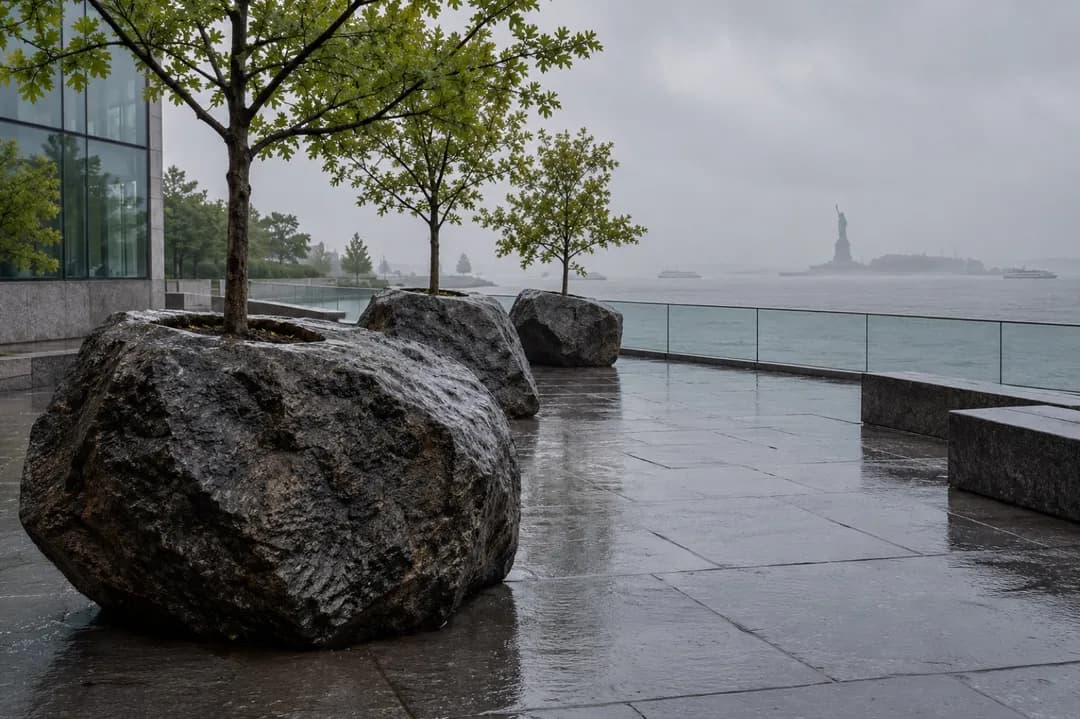
Andy Goldsworthy's Garden of Stones, installed in 2003, sits on the museum's upper terrace: eighteen hollowed boulders, each planted with a dwarf chinkapin oak meant to grow slowly out of the rock. Rain darkens the granite and makes the small trees stand out, and you can see the garden through the glass even if you would rather not step outside. The same windows look out toward the Statue of Liberty and Ellis Island.
Sequencing the Day Around the Weather
The order matters more than it looks. Starting at the Custom House puts you right on top of the subway exit, so the first stretch outdoors is the length of a staircase. Fraunces Tavern in the middle is short, and it sits next to food. The Museum of Jewish Heritage last means the longest walk, or the cab ride, happens once, and you finish beside the water with nothing more to cross.
If the forecast has the heaviest rain in the late morning, flip the plan: take the 1 train to South Ferry and do the Museum of Jewish Heritage first, then work back toward Bowling Green in the afternoon when the showers thin. Either way, three subway stations sit at the edges of this route: Bowling Green on the 4 and 5, South Ferry on the 1, and Whitehall Street on the R and W.
Practical Notes for a Wet Visit
All three museums run bag checks at the door, and dripping umbrellas are not welcome in galleries, so carry a plastic sleeve or a tote you do not mind getting wet. The Custom House is a federal building with airport-style screening at the entrance, so allow a few extra minutes there. Booking a timed ticket online for the Museum of Jewish Heritage saves a wait in its lobby.
Shoes with real grip are worth it here: the Custom House floors and the stone plazas around Battery Park turn slick fast. If a third museum feels like too much, cut Fraunces Tavern rather than shortening the Holocaust galleries. For a fuller day, the National Museum of the American Indian and the Museum of Jewish Heritage alone make a strong pair, with lunch somewhere along Stone Street between them.
Using Karpo for the Rest of the Afternoon
Once the museums are done, ask Karpo in the Karpo APP for a dry next step close to Battery Park, such as a warm bowl of soup nearby or a covered place to wait out a late shower before the ferry. Karpo works like a friend who knows the neighborhood: tell it where you are and what kind of evening you want, and it suggests a few options to choose from.
Ask Karpo for more information.
Keep reading
- Fort Greene Holiday Market Browsing Guide for Young Shoppers
 DUMBO Holiday Market Browsing Guide for Gifts to Mail Home
 Midtown East Holiday Market Browsing Guide for Commuters