Harlem confuses the phrase places to eat near me because the neighbourhood is organised vertically rather than in the tight clusters most Manhattan food maps assume. There is no single restaurant block here. There are three long avenues — Lenox, Frederick Douglass and Adam Clayton Powell — running north for forty streets, each with a different character, and a map radius of half a mile will cut across all three and tell you nothing about which one you are actually standing on.
Half a mile in Harlem crosses three avenues with three different price ranges. Ask Karpo what is open near you right now on the avenue you are actually on, at the number you actually want to spend.
The bottom of the ladder is a counter, not a table
Under fifteen dollars, Harlem is a counter neighbourhood, and the counters are genuinely good rather than merely cheap. This is the tier of fried chicken by the piece, jerk plates, West African rice, roti and Caribbean bakeries — a category the neighbourhood has been running at a high level for decades and which almost never appears in a citywide best-of list because it does not photograph like a restaurant.
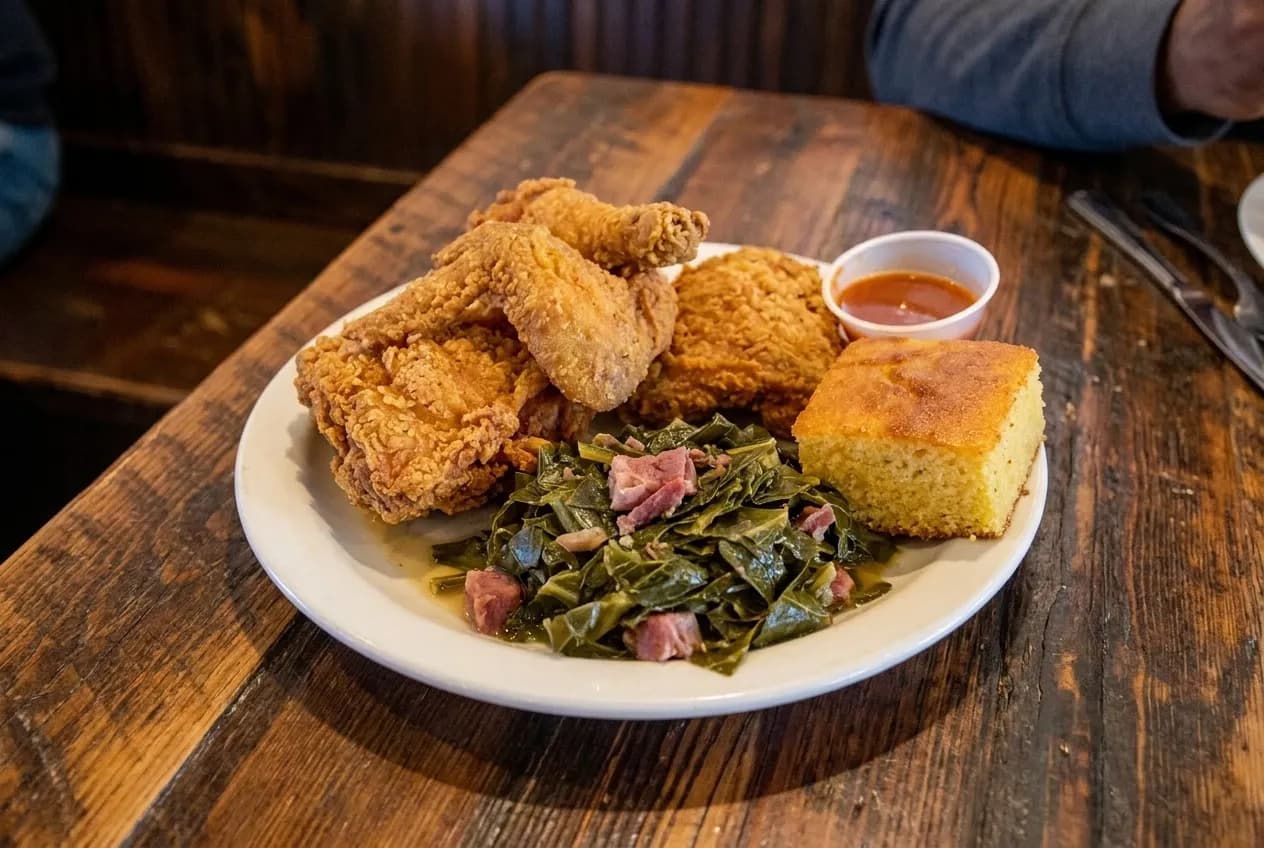
Charles' Country Pan Fried Chicken, on Frederick Douglass Boulevard, is the reference point for the format: pan-fried chicken and Southern sides, sold in a room with almost no design intent, at a price that has stayed stubbornly reasonable while everything around it has not. The general rule for this tier is that the room tells you nothing and the queue tells you everything. A counter with five people waiting at 6pm on a Tuesday in Harlem is a counter that has been feeding the same block for years.
The middle is where the neighbourhood actually eats
Between roughly twenty and forty dollars a head, Harlem has built out a genuine sit-down scene over the last fifteen years, concentrated most heavily on Frederick Douglass Boulevard in the low 110s and 120s. This is the tier that changed the neighbourhood's reputation: proper wine lists, kitchens with ambition, rooms that stay busy on a Wednesday.
Vinatería, on Frederick Douglass, is the clearest example — a Spanish-and-Italian-leaning room that runs a serious bar programme alongside the food, including oysters at happy hour prices that would be considered a mistake below 96th Street. Harlem Tavern, at 116th and Frederick Douglass, is the volume answer in the same tier: a large indoor-outdoor room with a long bar, a 4pm to 7pm happy hour and enough space that it works for a group of eight without a month of planning. Silvana, on 116th, folds a Middle Eastern menu, a café and a basement music room into one address, which makes it the most efficient single stop in the neighbourhood if you want dinner and a night out without moving.
The top of the ladder is about the room as much as the plate
Harlem's expensive tier is small, and both of its anchors sit on Lenox Avenue within a few hundred feet of each other. Sylvia's, at 328 Lenox, has been serving Southern food since 1962 and is the older institution by a wide margin — fried chicken, smothered pork chops, candied yams, collards, cornbread. Its Sunday gospel brunch, at around forty-two dollars a head with a live choir, is the single most requested table in the neighbourhood and needs to be treated as an event rather than a meal.
Red Rooster, at 310 Lenox, is the modern counterpart: Marcus Samuelsson's room, which brought a global-inflected menu and a downtown crowd onto the avenue in 2010 and has been the neighbourhood's most visible restaurant ever since. Lobster frites and pan-fried catfish are the dishes people order. It is worth being clear about what you are paying for at this tier — both rooms are as much about the occasion and the history as the cooking, and both are best treated as a planned evening rather than a default dinner.
How to choose an avenue
If you are deciding where to walk rather than where to eat, the avenues sort cleanly. Frederick Douglass Boulevard is the newest and densest restaurant strip, and the safest choice if you want options within two blocks — it is where the sit-down middle tier concentrated. Lenox Avenue is the institutional one: fewer rooms, bigger names, more history, more visitors. Adam Clayton Powell is the most local and the least curated, which means the best odds of a counter you have never heard of and the worst odds of getting a group of six seated.
Cross streets matter too. The blocks between 110th and 125th carry most of the newer restaurants; above 135th the density drops and the food shifts towards West African and Caribbean, particularly around the Little Senegal stretch of 116th, which is the most underrated eating in Harlem and consistently the best value in this article.
Practical notes
Sunday is the neighbourhood's busiest restaurant day rather than Saturday, because of church traffic and brunch, and the institutions on Lenox will have queues from late morning. Several of the counters are cash-preferred and a few are cash-only, so carry some. Reservations are genuinely useful in the middle tier from Thursday onwards and largely pointless below fifteen dollars a head, where nobody takes them. And if you are coming from downtown, the 2 and 3 trains put you on Lenox and the A, B, C and D put you on Frederick Douglass — which train you take effectively picks your price bracket before you have decided anything.
Tags: #PlacesToEatNearMe #Harlem #NYCRestaurants #NewYorkCity #LenoxAvenue #FrederickDouglassBlvd #UptownNYC #SoulFood #CheapEatsNYC #HarlemFood #ManhattanDining #NYCEats #NeighborhoodGuide #WhereToEat
All trademarks are the property of their respective owners.
Ask Karpo first
Want to know what is open around you in Harlem right now, on the avenue you are standing on, in the price range you actually had in mind? Ask Karpo for a short walking order that starts at a counter and ends somewhere with a bar, and it will tell you which ones are still serving.