The entrance you'll almost miss
You're walking east on 53rd Street, somewhere between the Fifth Avenue flags and the Madison Avenue lunch crowd, when a narrow opening appears between buildings. No sign announces it. No hostess checks your name. The gap is precisely forty-two feet wide—the exact dimension of two demolished brownstone lots—and through it you glimpse what looks like a stage set for a modernist play about water. This is Paley Park, and it has been performing the same acoustic magic trick since May 1967. The park occupies 4,200 square feet, roughly the size of a large Manhattan studio apartment, but it functions as something closer to a decompression chamber. You step off the sidewalk and into a space governed entirely by the physics of falling water.
The wall that erases Midtown
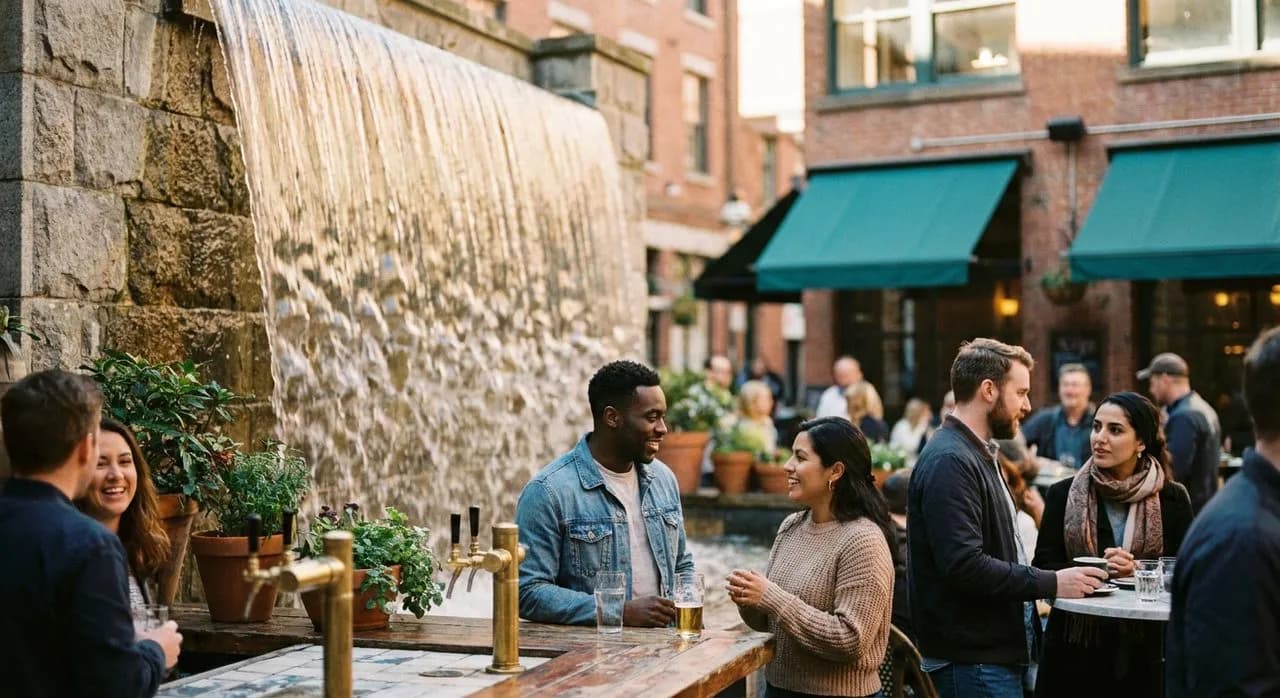
The waterfall announces itself before you see it fully—a low roar that builds as you move deeper into the park. Twenty feet high, the entire back wall cascades with water pumped at 1,800 gallons per minute. The designer, landscape architect Robert Zion, understood that masking urban noise requires not silence but a different frequency. The water falls over granite blocks in a deliberately irregular pattern, creating white noise that sits at exactly the right pitch to cancel out taxi horns, delivery trucks, and the general mechanical hum of Midtown. Sit in one of the movable wire chairs—there are seventeen of them, painted charcoal grey—and the city simply disappears. The waterfall's acoustic blanket is so effective that couples sitting ten feet apart can have private conversations. It's the closest thing Manhattan has to a cone of silence, and it costs nothing.
The morning advantage
The park opens at eight a.m., and if you arrive within the first thirty minutes, you'll have the space nearly to yourself. Early visitors know to claim the chairs closest to the waterfall's northern edge, where the spray creates a microclimate roughly five degrees cooler than the surrounding air. By noon, every seat fills with the lunch crowd—office workers from nearby towers, tourists who stumbled upon the entrance, occasional celebrities seeking twenty minutes of anonymity. The park reaches capacity around one-fifteen p.m. on weekdays, when standing room becomes the only option. But come at eight-thirty a.m. or after three-thirty p.m., and you can arrange the chairs however you like. The movability is the point: Zion wanted visitors to curate their own relationship to the space.
The honey locust canopy
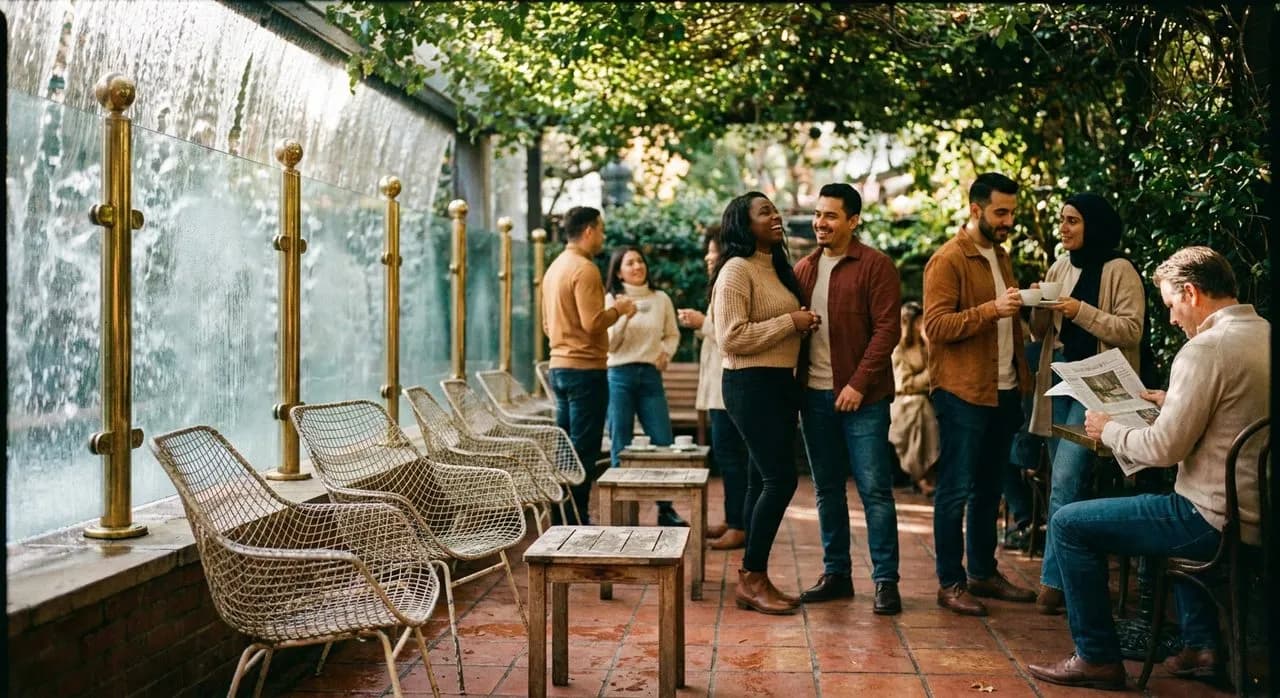
Seventeen honey locust trees frame the park's perimeter, chosen specifically because their small leaflets filter light without creating heavy shade. In summer, the canopy produces dappled patterns across the bluestone floor. In autumn, the leaves turn pale gold and fall in a single dramatic week, usually mid-November. The trees sit in raised planters filled with ivy and seasonal flowers—tulips in spring, impatiens in summer. A small kiosk near the entrance sells coffee and pastries from seven-thirty a.m. to four p.m., operated by the same family since 1989. The kiosk staff will tell you that the park's designer originally wanted the trees to remain unlit at night, but in 1972, uplighting was added after complaints about safety. The lights click on at dusk, turning the honey locusts into architectural sculptures.
The Paley family blueprint
William S. Paley, the CBS founder, commissioned the park as a memorial to his father, Samuel Paley. The family purchased the land for $1 million and spent an additional $1.3 million on construction—substantial sums in 1967. Paley handed the completed park to the city with a perpetual maintenance endowment, establishing the template for what New York would later call "privately owned public spaces." The park inspired dozens of similar projects, but none replicated its precise alchemy of proportion, water, and sound. Zion's design drawings, now archived at Cornell University, show obsessive attention to the waterfall's engineering: the pump system, the granite block arrangement, even the angle of water flow. The park was always meant to be a technical achievement disguised as a garden.
What the regulars know
The chairs near the kiosk stay dry even during rain—the honey locust canopy and building overhang create a protected zone roughly twelve feet deep. Regulars also know that the waterfall gets turned off exactly twice a year for maintenance: one day in March, one day in September, always on a Monday. On those days, the park feels oddly naked, its acoustic trick revealed as mechanical infrastructure. The kiosk sells a chocolate croissant that arrives fresh at eight a.m. and usually sells out by ten. If you visit in winter, the waterfall continues running until temperatures drop below twenty-eight degrees Fahrenheit, at which point the pumps shut down to prevent ice damage. But even without the water, the park functions—proof that Zion's spatial design works independent of its signature feature.
Practical notes
Paley Park occupies 3 East 53rd Street, between Fifth and Madison Avenues. The entrance is mid-block on the north side of 53rd Street. Open daily from eight a.m. to dusk (roughly eight p.m. in summer, six p.m. in winter). Admission is free. No reservations, no tickets, no membership required. The park has no restrooms. The kiosk accepts cash and cards. Nearest subway stations: Fifth Avenue/53rd Street (E, M trains) or 51st Street (6 train), both three blocks away. Seating is first-come, first-served—all seventeen chairs are movable. The park rarely closes except for private events, typically fewer than five days per year. No alcohol permitted. The waterfall operates from April through November, weather permitting. For current hours and seasonal closures, check the Paley Park Conservancy website. The park is fully accessible from street level.
Tags: #PaleyPark #MidtownManhattan #PocketPark #NYCParks #FifthAvenue #FreeNYC #HiddenManhattan #UrbanDesign #WaterfallNYC #53rdStreet #MidtownOasis #NYCArchitecture #FreeAndFine #RobertZion #PublicSpace
Sources consulted: Time Out New York · NYC Parks · Atlas Obscura
All trademarks are the property of their respective owners.