 Chelsea Consignment Shop Crawl Planner for Your First Studio
Hidden Gems & Odd Finds
Oddities Museum Near Me: New York Transit Museum Underground
New York Transit Museum turns a decommissioned Brooklyn subway station into an unusually hands-on archive of trains, signs, tools, and city movement.
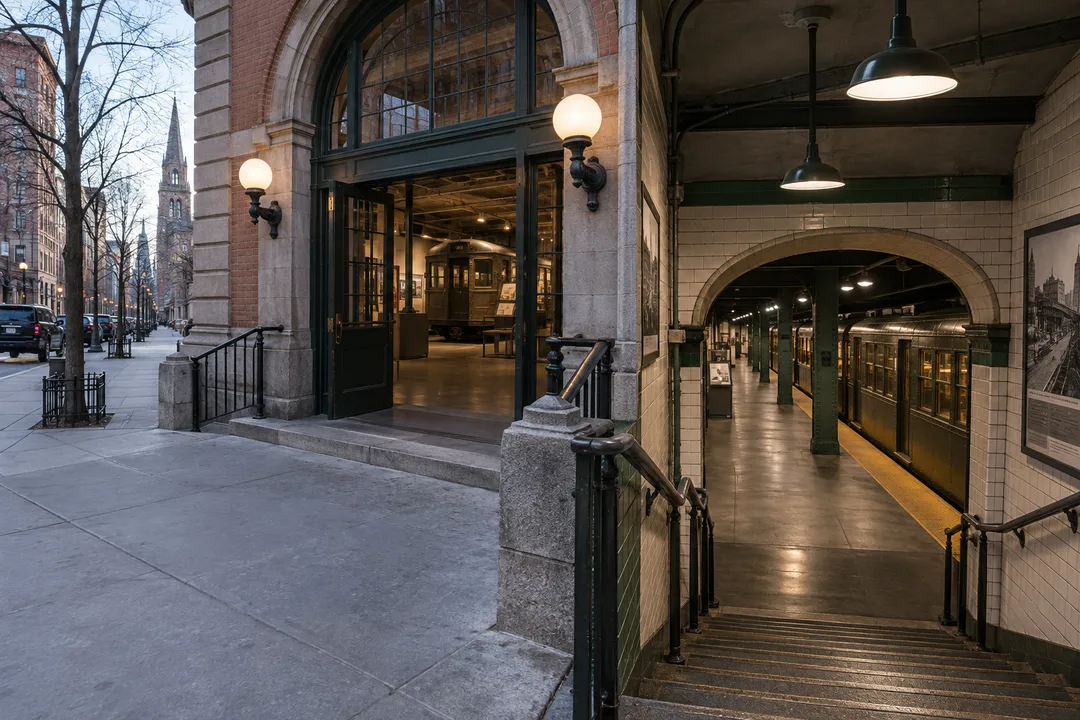
An oddities museum near me search in New York becomes much more literal at the New York Transit Museum, where the entrance drops you into a decommissioned subway station at 99 Schermerhorn Street. The museum is full of objects people normally ignore while commuting: turnstiles, route signs, conductor tools, signal equipment, fare media, and complete historic cars. Put together underground, those ordinary pieces reveal how much engineering and ritual it takes to make a city move.
Downtown Brooklyn makes the museum easy to fold into a day. The entrance is close to Borough Hall, Court Street, and several subway lines, including the A, C, F, G, 2, 3, 4, 5, N, R, and W through nearby stations. The main entry involves two flights of stairs, with an accessible entrance at Schermerhorn and Court Streets. Reserve ahead when possible because on-site ticket supply is limited, especially on weekends. A little planning also keeps the station visit from competing with a bridge walk or courthouse stop.
The first oddity is the building. This was once Court Street station, a working part of the subway system that later became a museum platform. The tracks and tiled spaces make the exhibition feel like a preserved layer beneath Brooklyn rather than a gallery imitating transit. You can stand where passengers once waited and then turn toward a train that has not carried a regular crowd for decades. That physical contradiction gives the museum its memorable rhythm.
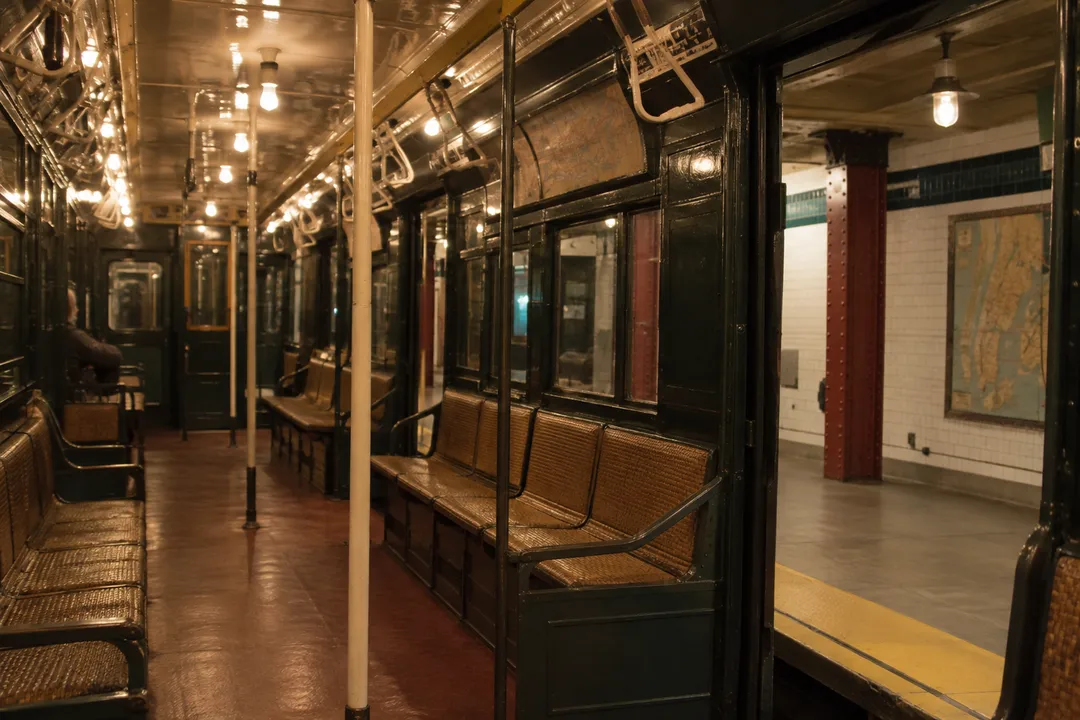
Begin with the vintage subway cars. Walk through several generations and compare the materials: wood benches, rattan seats, ceiling fans, metal straps, route maps, and hand-operated doors. A train car is a large artifact, but its details are intimate. Look at the advertisements, grab poles, window frames, and floor patterns. They show how design, class, safety, and maintenance changed together. The cars make transportation history legible at the scale of a daily commute.
The signage displays deserve a slower look. New York's subway symbols feel obvious because they are everywhere, yet the museum shows how lettering, color, route names, and station information were developed and revised. A sign is not just decoration; it is a promise that a stranger can navigate an enormous network. Compare older enamel signs with later graphic systems and notice how small changes make a complex city feel more or less readable.
The museum also keeps the less glamorous tools of transit visible. Signal equipment, track work, maintenance objects, and fare-control hardware explain the labor behind a system that is often judged only by whether a train arrives. These pieces look industrial, but they carry human stories about night shifts, inspections, repairs, and emergency decisions. The collection is odd because it treats infrastructure as culture, preserving the machinery that usually disappears behind walls.
Visiting rules are straightforward but worth respecting. Children 15 and younger must stay with an adult, groups of eight or more need a reserved staff-led program, and photography or video must follow the museum's policy. The strongest queue strategy is to reserve a timed entry and arrive no more than five minutes early; the museum gives a 30-minute entry window. If you walk in without a reservation, a limited number of same-day tickets are sold first come, first served.
Adult admission is $15, while children ages 2 to 17 and seniors 62 and older pay $10. Members and MTA employees enter free with the appropriate code or membership. The ticket covers the Brooklyn museum, including the historic station and train collection, so it is a strong value for visitors who want a substantial indoor stop. The museum is open Wednesday through Sunday from 10am to 4pm, with holiday closures listed online.
The atmosphere shifts between technical and nostalgic. One platform feels like an engineering classroom, then a restored car turns the next section into a memory machine for anyone who grew up with older subway interiors. The museum does not tell visitors what to feel about New York transit. Instead, it lets sound, scale, and repeated details do the work. Even people who dislike trains tend to find the ordinary objects unexpectedly beautiful.
The larger story is urban compromise. New York's subway has connected neighborhoods, carried millions of workers, shaped real-estate patterns, and absorbed constant repairs while remaining a public system used by every kind of passenger. The museum preserves that messy history rather than reducing it to a logo. Its collection includes successes, experiments, failures, and objects that look obsolete until you understand the problem they were designed to solve.
Afterward, walk through Downtown Brooklyn to Borough Hall and Cadman Plaza, then continue toward Brooklyn Heights for brownstones and the Promenade. A different route leads to the Brooklyn Bridge, the Dumbo waterfront, and Jane's Carousel. Start the walk after the museum so the street-level network feels newly visible: station entrances, bus lanes, elevated signs, and platform announcements become part of the same story. A museum cafe is unnecessary; nearby food options are plentiful.
Practical Notes: New York Transit Museum is at 99 Schermerhorn Street, Brooklyn, NY 11201. Hours are Wednesday through Sunday, 10am to 4pm. Admission is $15 for adults and $10 for children ages 2 to 17 and seniors 62 and older. The main entrance uses stairs, an accessible entrance is available, and some galleries are not climate-controlled, so dress for the weather.
Choose this oddities museum near me when your idea of unusual means seeing a working city's hidden anatomy. It suits transit fans, families, design students, photographers, architecture visitors, and anyone curious about how public systems become part of personal memory. It is less about one sensational object than a whole underground environment. You leave with a sharper sense that a subway car, a fare gate, and a sign can each be a piece of New York biography.
Ask Karpo for more information.
Keep reading
- Chelsea Consignment Shop Crawl Planner for Your First Studio
 East Village Consignment Shop Crawl Planner: Leather Jackets
 Harlem Consignment Shop Crawl Planner for a Jazz Night Look