 Chelsea Consignment Shop Crawl Planner for Your First Studio
Hidden Gems & Odd Finds
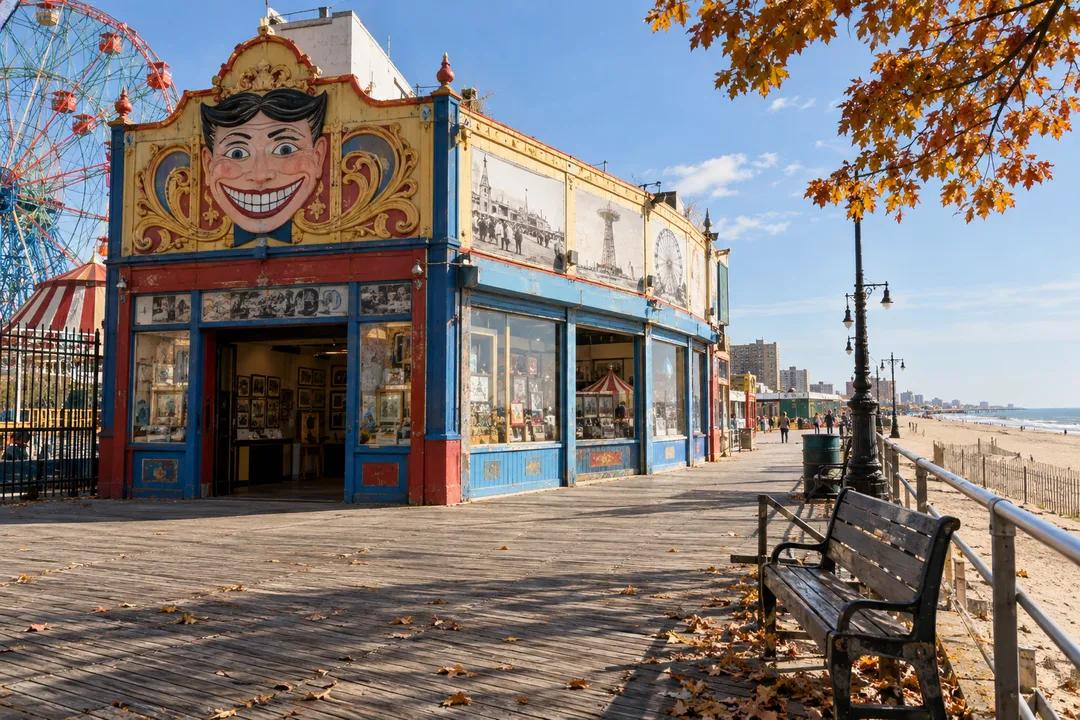
Oddities Museum Near Me: Coney Island Museum's Boardwalk Curiosities
Coney Island Museum preserves the strange machines, showmanship, and seaside history that made the boardwalk one of New York's most curious places.
An oddities museum near me search in New York often leads people toward polished downtown attractions, but Coney Island Museum offers something more specific: the strange, theatrical history of the boardwalk itself. At 1208 Surf Avenue, the museum collects the stories behind amusement rides, sideshow traditions, parade culture, and the people who turned a strip of beach into a global shorthand for entertainment. It is a small stop, but it explains why Coney Island still feels unlike any other neighborhood in the city.
The easiest arrival is by subway. Take the D, F, N, or Q to Coney Island-Stillwell Avenue, then walk toward the boardwalk and Surf Avenue. The museum is close to the action, so you can pair it with the beach, the Wonder Wheel area, or a longer ride along the Riegelmann Boardwalk. On a hot day, visit before the sand and crowds peak. On a cool October afternoon, the museum makes a useful indoor anchor for a much calmer version of the peninsula.
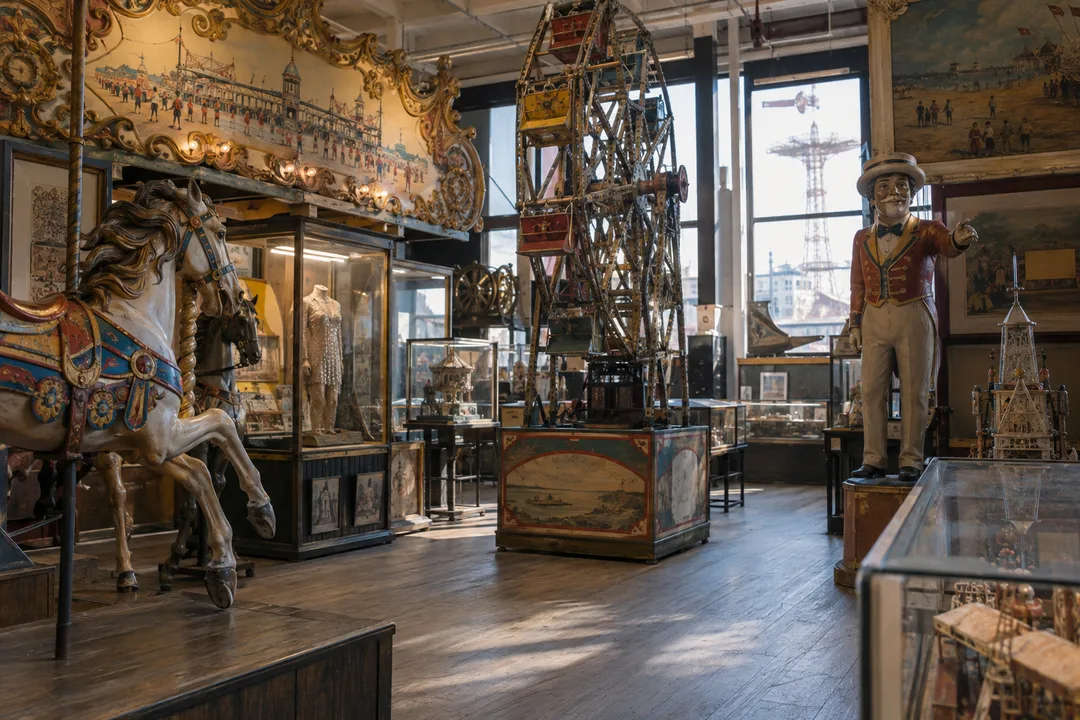
What sets Coney Island Museum apart is the way it treats entertainment as history. The displays are not only about famous rides. They show how spectacle was built, advertised, performed, and remembered. Painted signs, mechanical parts, photographs, costumes, and artifacts from the amusement world reveal the labor behind the fantasy. Even the most playful object has a practical backstory, and that backstory helps explain why Coney Island became a place where ordinary visitors expected the improbable.
Start with the ride material and look for the engineering clues. Old amusement devices can seem like pure decoration when seen from the boardwalk, but their gears, restraints, control systems, and hand-painted surfaces reveal an era when attractions were assembled through a mix of mechanics and theatrical design. The museum lets you see those ingredients up close. Children often notice the colors first. Adults tend to study the mechanisms and the clever ways operators made a short ride feel like a complete story.
The sideshow history is the museum's most obvious oddity, but it deserves a thoughtful reading. Coney Island's freak-show tradition involved exploitation, self-invention, disability, celebrity, and changing ideas about what audiences considered normal. The displays preserve that complicated world without reducing it to a Halloween prop. Read the captions, notice the difference between publicity language and lived reality, and let the museum's historical distance do some work. The most valuable lesson is that spectacle always reflects the values of the crowd watching it.
Another highlight is the collection of small boardwalk artifacts. Ticket stubs, promotional pieces, photographs, and souvenirs show how the resort sold memory as much as it sold rides. These objects are useful because they bridge the gap between a place's legendary image and its daily operation. A boardwalk is made from thousands of transactions, jokes, queues, maintenance jobs, and repeat visits. The museum gives those overlooked details a home, turning nostalgia into something more tangible than a postcard.
The museum is compact, and that shapes the best visiting strategy. Give yourself 30 to 60 minutes instead of planning a half-day gallery crawl. Keep moving slowly through the cases, but avoid blocking the narrow passages while reading. The museum has a simple, intimate rhythm, so the quietest experience comes early in the listed visiting window. There is no need to queue hours ahead. The larger crowds are generally outside on the boardwalk, not waiting at the museum door.
Admission is $5 for adults and $3 for children and seniors, which makes this one of the easiest low-cost additions to a Coney Island day. The museum lists Friday through Sunday, noon to 5pm hours, and the phone is (718) 372-5159. A good October plan is to arrive shortly after opening, read the exhibits, then walk the boardwalk while the light changes. That order also keeps the beach portion flexible if wind picks up later.
Inside, expect a deliberately old-school museum rather than a heavily immersive installation. Objects sit close together, the labels carry much of the narrative, and the collection assumes that visitors are willing to make connections. This is a strength for anyone who likes local history. The room does not try to recreate a full amusement park; it gives you the fragments needed to imagine one. The contrast between the small interior and the huge mythology of Coney Island is part of the charm.
Coney Island's history is a story of reinvention. Fires, storms, redevelopment, changing tastes, and new amusement technologies repeatedly altered the district, yet the appetite for spectacle kept returning. The museum holds onto those layers instead of presenting one frozen golden age. That makes the visit useful even for people who already know the boardwalk. You start to see the surviving rides, storefronts, and public spaces as evidence of a long negotiation between memory, business, and the sea.
After the museum, walk west along the boardwalk toward the quieter stretches near Brighton Beach, or head east toward the rides and the Wonder Wheel for the full sensory version of the neighborhood. The New York Aquarium is nearby for a separate ticketed stop, while the beach itself gives you the simplest transition from exhibits to open horizon. For food, choose a classic boardwalk snack or continue toward Brighton's restaurants. The museum is best used as the historical first chapter of that route.
Practical Notes: the museum is at 1208 Surf Avenue, Brooklyn, NY 11224, and the listed phone is (718) 372-5159. Admission is $5 general, $3 for children and seniors. Listed hours are Friday through Sunday, noon to 5pm. Wear shoes that can handle sand, boardwalk planks, and a few miles of walking. The museum itself is not a restaurant or a long-rest stop, so place lunch and restrooms into the wider Coney Island plan.
Choose Coney Island Museum when the phrase oddities museum near me means odd history, mechanical amusement, and a real sense of place. It works for families, visitors interested in carnival culture, photographers looking for texture, and anyone who wants the boardwalk to feel more layered than a quick ride-and-snack outing. It is not the right match for a giant collection of rare objects. Its value is concentrated: a short, affordable visit that makes the entire peninsula more legible.
Ask Karpo for more information.
Keep reading
- Chelsea Consignment Shop Crawl Planner for Your First Studio
 East Village Consignment Shop Crawl Planner: Leather Jackets
 Harlem Consignment Shop Crawl Planner for a Jazz Night Look