The meteorology of urban renewal
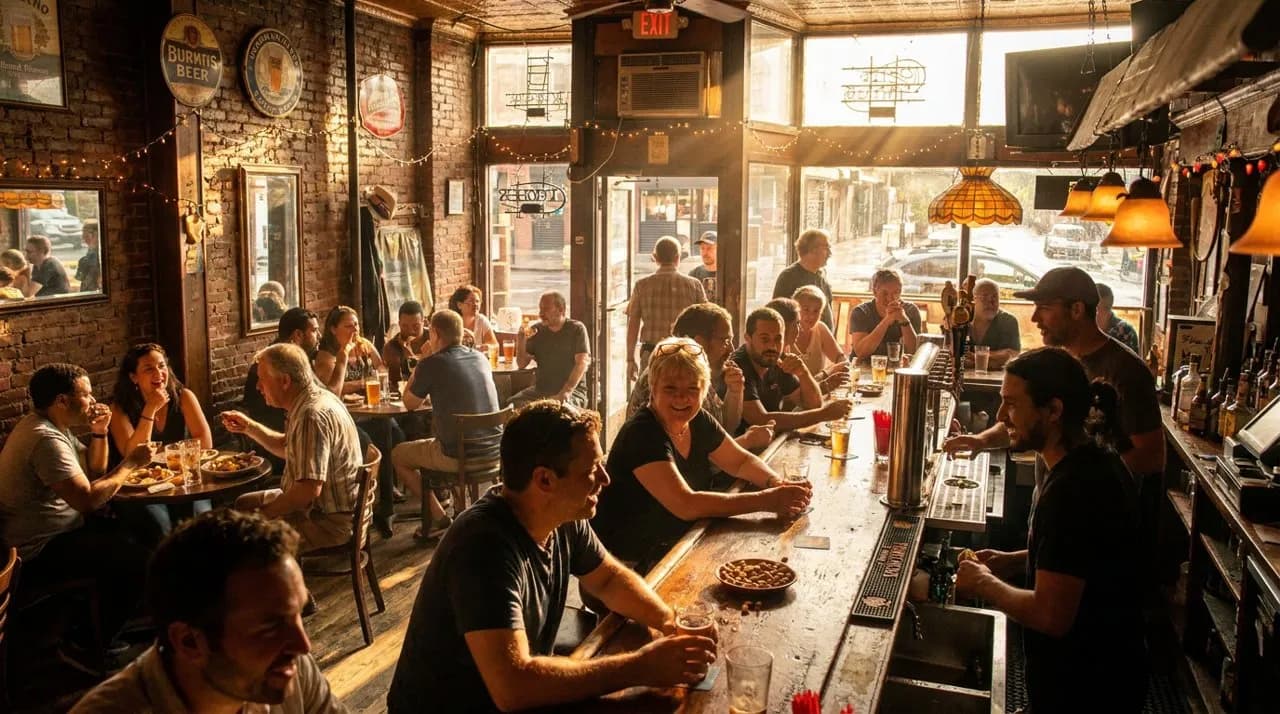
New York City experiences an average of twenty to twenty-five thunderstorms annually, most concentrated between May and September. The passage of a summer storm system—typically lasting thirty to ninety minutes—creates a distinctive atmospheric condition that transforms the urban walking experience. Temperatures can drop ten to fifteen degrees within minutes. Barometric pressure shifts. The particular quality of light that filters through departing clouds, combined with wet surfaces amplifying ambient illumination, renders the streetscape temporarily cinematic. This isn't poetic license; it's documented phenomenon. Urban meteorologists note that post-storm air quality improves measurably as particulates are precipitated out, creating that characteristic crisp-edged clarity. For the walker, this window—usually lasting one to three hours before normal humidity reasserts itself—offers the city at its most legible and least oppressive.
Lower East Side to East Village: the grid, rinsed
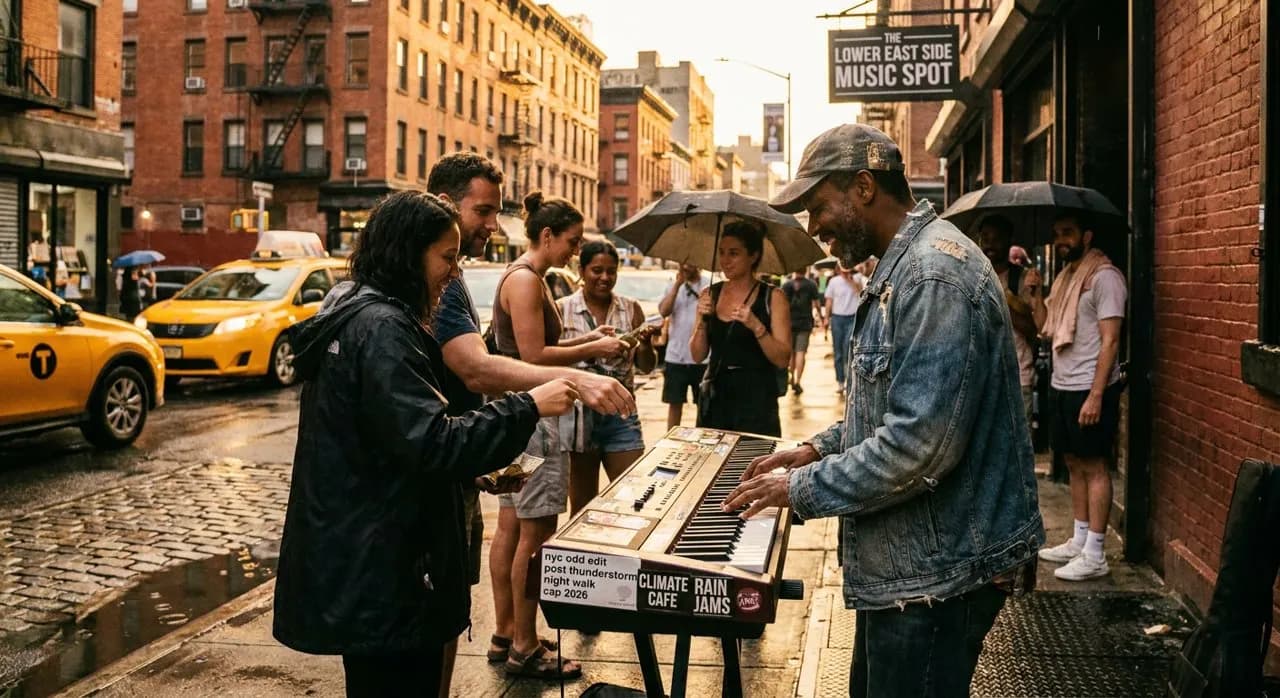
Begin on Orchard Street south of Delancey, where the narrow nineteenth-century thoroughfare channels runoff into temporary rivulets along the curbs. The tenement architecture here—iron fire escapes, carved lintels, shop awnings dripping in syncopated rhythm—becomes particularly graphic when wet. Walk north through Sara D. Roosevelt Park, where the basketball courts at Chrystie Street often resume play within twenty minutes of rain stopping, sneakers squeaking on damp asphalt. The stretch between Houston and Fourth Streets passes long-established businesses: Economy Candy at 108 Rivington Street (typically open until 9 p.m. on weekdays, though verify closer to your visit), Russ & Daughters at 179 East Houston Street, Katz's Delicatessen at 205 East Houston. These aren't recommendations so much as landmarks—fixed points in a neighborhood that has transformed repeatedly while retaining certain continuities. Post-storm, their neon signage reflects in pooled water with particular vividness. Continue north on First Avenue into the East Village, where the density of small bars, late-night pierogi counters, and community gardens creates a textured streetscape that benefits from the clarifying wash.
Midtown's reflected towers
The corporate canyon between Fifth and Park Avenues, from Forty-Second to Fifty-Seventh Streets, becomes a different proposition entirely after rainfall. Glass curtain walls—Lever House at 390 Park Avenue, Seagram Building at 375 Park Avenue—double themselves in wet granite plazas. The reflecting pools at the Seagram, designed by Philip Johnson, become redundant; the entire streetscape turns temporarily aquatic. This is not conventionally beautiful walking territory, but post-storm it reveals its geometries with unusual precision. The Modernist architecture that can feel oppressive in summer humidity gains a certain cold clarity. Street-level visibility extends significantly—you can see twenty blocks up Park Avenue rather than the usual hazy ten. The few pedestrians out immediately after rain tend to move purposefully, creating a rhythm distinct from the usual Midtown shuffle. For photographers and architecture observers, this timing offers the district at its most graphically coherent.
Brooklyn Heights Promenade: the view, clarified
The elevated pedestrian walkway along the East River between Remsen and Middagh Streets provides what is arguably New York's most dramatic post-storm vantage point. The Promenade sits approximately fifteen feet above the Brooklyn-Queens Expressway, offering unobstructed views across to Lower Manhattan. After thunderstorms, atmospheric visibility can extend to twenty-five or thirty miles—far beyond the usual range. The Financial District towers appear unusually defined. One World Trade Center, typically softened by distance and haze, gains its full 1,776-foot presence. The Brooklyn Bridge cables, still dripping, catch light from both boroughs. Benches along the third-mile walkway are usually wet for thirty to forty-five minutes after rain stops, but the stone balustrade remains usable for leaning. This is not a route for moving quickly; it's for standing still while the city reassembles itself across the water. Access points include Montague Street, Remsen Street, and Orange Street from the residential blocks of Brooklyn Heights.
Central Park's Ramble after downpour
The thirty-eight-acre woodland section between Seventy-Third and Seventy-Ninth Streets, mid-park, transforms more completely after rain than any manicured lawn or formal garden. The deliberately irregular paths—designed by Frederick Law Olmsted and Calvert Vaux to create an immersive forest experience within the city—become temporarily muddied, requiring attention to footing. This is the point. The network of streams that feed the Lake (the park's largest water body) runs visibly for hours after significant rainfall, creating temporary waterfalls at the stone bridges. Bird activity increases notably in the hour following storms; warblers and thrushes emerge to hunt insects driven from cover. The western portion near the Lake offers the most dramatic water features, while the eastern section around the Point provides views back toward the Midtown skyline, framed by dripping oak and maple canopy. The Ramble has no formal lighting; plan to exit by dusk. Enter from the paths near Belvedere Castle (Seventy-Ninth Street) or Bow Bridge (Seventy-Fourth Street mid-park). The Central Park Conservancy maintains current path conditions on their website.
West Village corners and Washington Square
The irregular street grid west of Sixth Avenue—where Greenwich Village's pre-existing road network resisted Manhattan's 1811 grid plan—creates complex geometries that rainfall emphasizes. Corners like West Fourth and West Tenth Streets don't meet at right angles; they create oblique intersections where water pools unpredictably. Bleecker Street between Bank and Christopher Streets passes long-standing businesses: Murray's Cheese at 254 Bleecker (verify current hours), Faicco's Italian Specialties at 260 Bleecker, which has occupied the same storefront since 1900. The brownstones along these blocks have stoops that drip onto sidewalks for hours, creating rhythmic patterns of water drops. Washington Square Park at the grid's eastern edge—officially at the foot of Fifth Avenue—offers the neighborhood's gathering point. The fountain, often filled during summer months, overflows slightly after heavy rain. The arch, designed by Stanford White and completed in 1892, frames the Empire State Building to the north with unusual clarity once the air clears. This is not undiscovered territory; it's heavily walked. But timing it to the post-storm window changes the population density and the quality of attention people bring to their surroundings.
Practical notes
Weather radar apps (Weather Underground, NOAA's radar sites) provide fifteen-to-thirty-minute advance notice of storm passage and clearing. Plan to step out thirty to forty-five minutes after rain stops for optimal conditions—wet surfaces, cleared air, reduced pedestrian traffic. Wear shoes with tread; New York's sidewalk materials (concrete, granite, Belgian block, metal cellar doors) become variably slippery. Marble thresholds at building entrances present particular hazard. The post-storm window typically lasts ninety minutes to two hours in summer before humidity returns. Evening storms (between 5 and 9 p.m.) offer the best combination of clearing weather and remaining daylight or early-evening illumination. The National Weather Service's New York forecast office provides detailed storm tracking. Public restroom access in New York remains limited; Starbucks locations, though ubiquitous, are not guaranteed facilities. Plan accordingly. Many establishments close early during severe weather; don't depend on specific shops being open immediately after storms. The city's 311 system provides real-time information on street flooding, though most surface water drains within twenty minutes on the main avenues. Carry identification and a phone with adequate battery. These walks require no special equipment or expertise—just timing and willingness to move through familiar territory at its most temporarily transformed.
#NYCwalking #ThunderstormWalks #PostRainNYC #UrbanExploration #NewYorkCity #RainyDayNYC #NYCstreets #ManhattanWalks #BrooklynHeights #CentralParkRamble #WestVillage #SummerStorms #TheOddEdit #NYCnights #AtmosphericWalking
Sources consulted: Central Park — Wikipedia · National Weather Service New York · Central Park — NYC Parks · NYC Department of Environmental Protection · Gothamist NYC News
All trademarks are the property of their respective owners.


