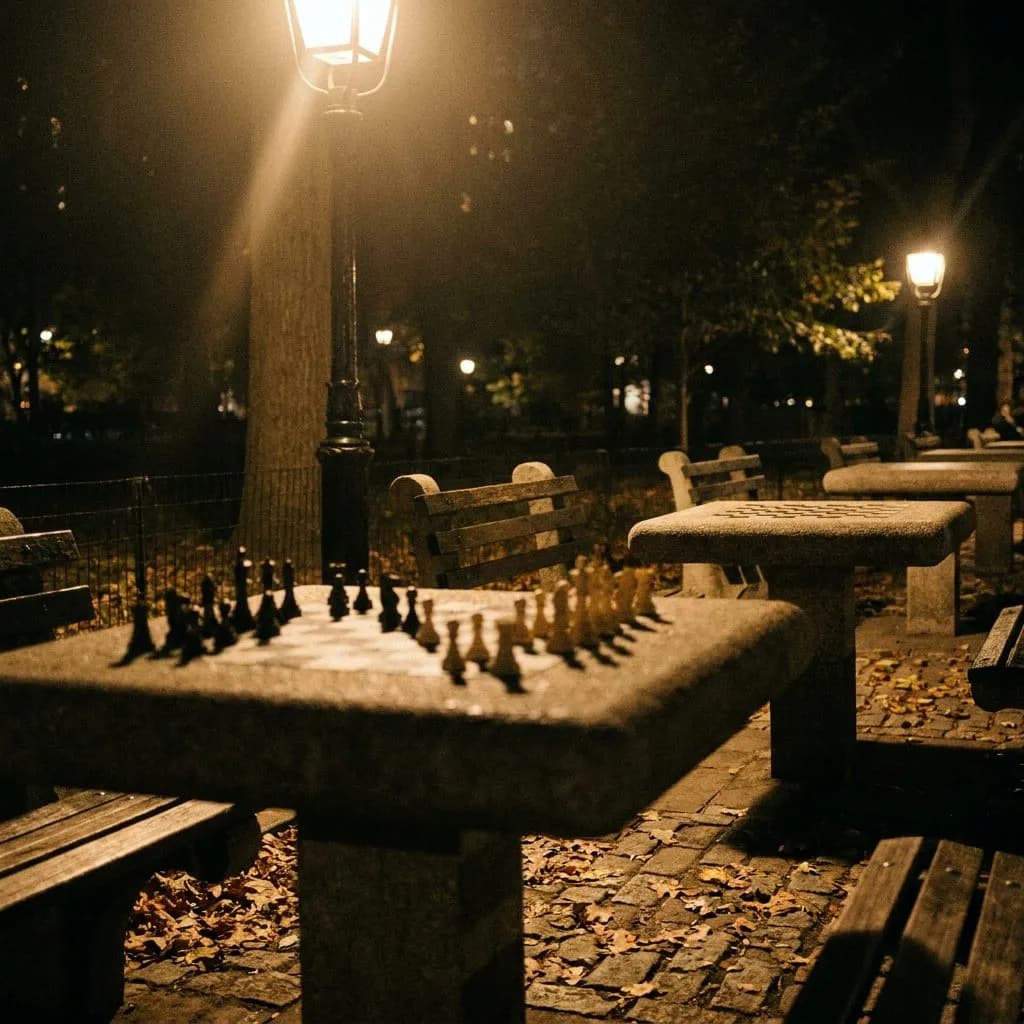
Most New Yorkers know Washington Square Park is open all night. Most New Yorkers are wrong—or at least, they haven't wandered to the southwest corner on a warm Friday in late May, when the stone chess tables stay crowded until two, sometimes three in the morning. The players arrive around dusk, unfolding battered vinyl boards, setting timers with the practiced snap of a deck shuffle. By eleven the real regulars have claimed their spots, and the speed games begin in earnest: three-minute blitz rounds punctuated by trash talk, groans, and the unmistakable crack of pieces slamming down in triumph.
Updated August 2026: hours, prices, reservations, event dates, transit details, and venue policies can change. Use the linked official venue, city, or operator sources in the Sources section as the final reference before you go.
The corner that never sleeps
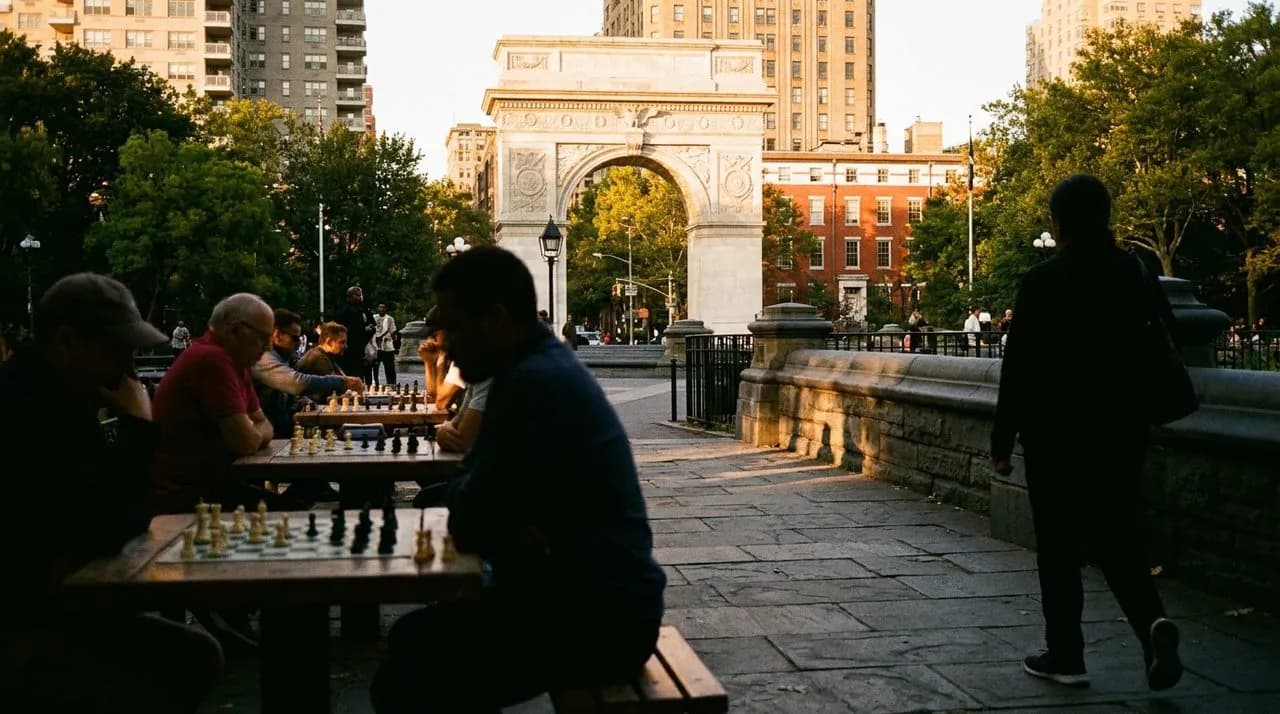
The chess tables occupy a wedge of pavement where West Fourth Street meets the park's southern boundary, close enough to West 4th Street that you can see the arch's floodlit marble glow through the sycamores. A dozen permanent stone tables ringed by low concrete stools form the arena. The surfaces are scarred with decades of scratches, initials, and the ghostly outlines of long-lost graffiti tags. By day they host retirees and NYU students working through openings; by night they belong to a rotating cast of speed merchants who can spot a gambit three moves out and a tourist wallet from thirty feet.
Park lamps throw amber pools across the boards, bright enough that no one fumbles for bishops in the dark. The surrounding benches fill with kibitzers—some silent and intent, others offering unsolicited commentary that ranges from genuinely helpful to deliberately misleading. It's a theater as much as a competition, and the audience knows its role. On a busy Saturday near Memorial Day the crowd can swell to fifty or sixty people, a shifting constellation of players waiting their turn, friends passing through, and the simply curious drawn by the sound of clocks ticking and voices rising in mock outrage.
Stakes, etiquette, and the house rules
Money changes hands, but the economy here is more nuanced than a simple hustle. Some tables operate on a clear $5-per-game basis: you sit down, you pay, you play until checkmated or the clock runs out. Others work on tips—the regular sets up the board, teaches you a few tricks if you're green, and accepts whatever you think the lesson was worth. A handful of players will run free games if you bring your own clock or if they like your energy. The unspoken rule: agree on terms before the first move, and don't argue about it afterward.
Skill levels span an absurd range. You'll find former tournament players who can dismantle a casual opponent in under two minutes, and you'll find patient teachers who'll slow down and explain why that pawn push just cost you the game. The hustlers—and yes, they embrace the term—survive on volume and speed, cycling through opponents, reading who's got game and who's got rent money they're willing to lose. It's not a scam if you know what you're buying: a few rounds of fast chess, some sharp banter, and the thrill of playing in a park at midnight with strangers who take the game as seriously as any grandmaster.
The social fabric of the board
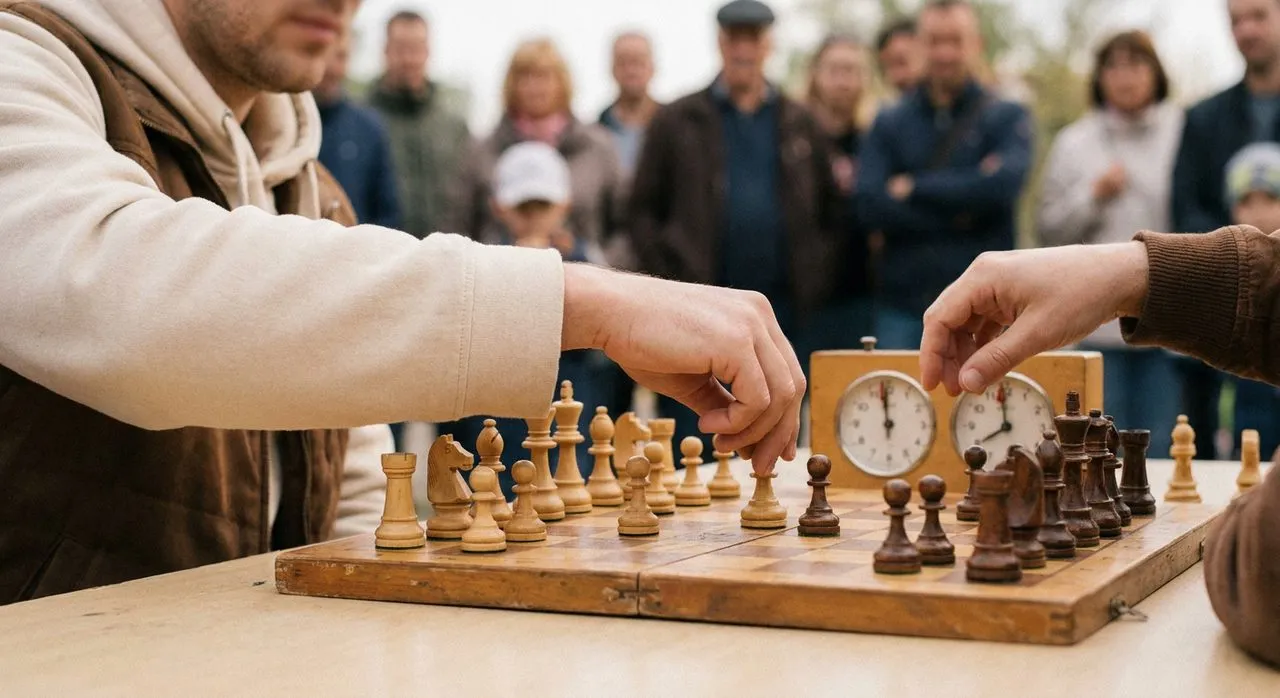
What sets this scene apart from a quiet chess club or an online blitz platform is the relentless sociability. Games here are never silent. Players talk through their moves—"That's bold," "You sure about that?"—and onlookers chime in the moment a piece is committed. Trash talk is currency: witty, profane, occasionally cutting, but almost never mean. Lose gracefully and you're invited back. Sulk or accuse someone of cheating and the crowd turns cold fast. The culture self-regulates through ridicule and respect in equal measure.
Regulars know each other by nickname or board style rather than given names. Friendships form over weeks of rematches; rivalries simmer and flare. A newcomer who shows promise gets absorbed into the rotation, offered tips, teased for blunders, eventually trusted with a borrowed clock or a spare set. It's a meritocracy softened by camaraderie, where your last game matters more than your day job. The lack of formal structure—no membership, no entry fee beyond what you agree to—keeps the gate wide open, even as the skill ceiling stretches high.
Late May and the seasonal sweet spot
Timing matters. The all-night sessions really hit their stride in late spring, when the air温度 hovers in the mid-sixties even after midnight and jackets can be tossed onto benches without worry. By Memorial Day weekend 2026 the sycamores have filled in overhead, their leaves filtering the streetlight into dappled shadow. The scent is pure New York late May: warm pavement, a faint drift of honeysuckle from the planted beds near the fountain, the occasional waft of someone's takeout or a joint passed discreetly at the periphery. Summer will bring stickier nights and larger crowds; deep winter thins the ranks to only the most devoted. But right now, the season sits in perfect balance.
The park itself feels safest during these hours precisely because it stays busy. Foot traffic streams along the paths—bar-hoppers heading home, night-shift workers cutting through, insomniacs walking dogs. NYPD community officers loop past every hour or so, usually nodding to the regulars. The chess corner benefits from its visibility: it's open, lit, and populated enough that trouble rarely lands here. That doesn't mean it's Disneyland—this is still a city park after dark—but the vibe stays convivial rather than edgy.
What to expect as a visitor
If you've never played speed chess in public, the pace will jolt you. Three-minute games mean you've got ninety seconds on your clock, maybe less if you dawdle on the opening. Hesitate and you'll hear about it. Blunder and the board gets reset for the next challenger before you've fully processed your mistake. It's exhilarating if you embrace the chaos, frustrating if you prefer slow contemplation. Watching a few rounds before sitting down is wise—you'll get a feel for who's teaching, who's hunting, and who just wants a good match.
Bring small bills. Singles and fives simplify transactions and tip etiquette. A small bottle of water isn't a bad idea either; the park has fountains but they're hit or miss in late night hours. Don't bring anything you can't keep an eye on—the scene is generally honest, but a bag left unattended is an invitation. If you have your own travel chess set or clock, some players appreciate the gesture; if not, boards are plentiful. Phones come out for timers and Venmo splits, but the old-school players still prefer analog clocks, the kind that tick audibly and add a mechanical heartbeat to the match.
Who comes, and why
The demographic mix defies easy summary. You'll see older men who've held the same table for twenty years alongside college students pulling all-nighters for fun instead of exams. Regulars from the surrounding neighborhoods—West Village, SoHo, the NYU dorms—mingle with visitors from Brooklyn, Queens, and beyond who make the pilgrimage because they've heard the games here are real. Skill and hustle trump age or background; a sixty-year-old retiree and a nineteen-year-old chess prodigy can sit across from each other as equals, united by the board.

Some come for the chess. Others come for the scene—the chance to be part of a New York subculture that predates smartphones and survives despite them. There's a romance to it, the idea that in an algorithmically sorted world you can still wander into a park at one in the morning and find a game, a conversation, a glimpse of the city's stranger, more human layers. It's not nostalgia, exactly; the scene evolves, younger players cycle in, the trash talk updates its references. But the core—stone tables, ticking clocks, the shared intensity of sixty-four squares—holds steady.
Practical notes
The chess tables sit at the southwest corner of Washington Square Park, where West Fourth Street meets the park boundary, near the intersection with MacDougal Street. The closest subway stops include West Fourth Street–Washington Square (A, C, E, B, D, F, M) and nearby 1/2/3 service, E, B, D, F, M lines) and Eighth Street–NYU (N, R, W lines), both about a three-minute walk. Street parking in the Village is notoriously scarce; if you're driving, budget extra time to hunt for a metered spot on side streets or consider a garage on Bleecker or LaGuardia Place. The tables themselves are outdoors and wheelchair accessible via paved paths, though the fixed concrete stools may not suit all visitors—folding chairs sometimes appear but aren't guaranteed. Games ramp up around dusk (roughly 8 p.m. in late May) and can run past 3 a.m. on Friday and Saturday nights, quieter but still active on weeknights. Expect to pay $5 per game at some tables, tips or donations at others, or free play if you arrange it in advance. Bring small bills, water, and a sense of humor. Check current park rules and hours before heading out, as policies and enforcement can shift.
Tags: #WashingtonSquarePark #NYCChess #TheOddEdit #LateNightNYC #SpeedChess #WestVillage #ChessHustlers #NYCAfterDark #GreenwichVillage #UrbanChess #NYCNightlife #ChessCulture #May2026 #CityLife #ManhattanNights
Sources consulted: Washington Square Park - Wikipedia · Washington Square Park - NYC Parks · Time Out New York · NY Times - New York Region
All trademarks are the property of their respective owners.


