 SoHo Tailor Alteration Shop Finder for Sample Sale Finds
Neighborhood Guides
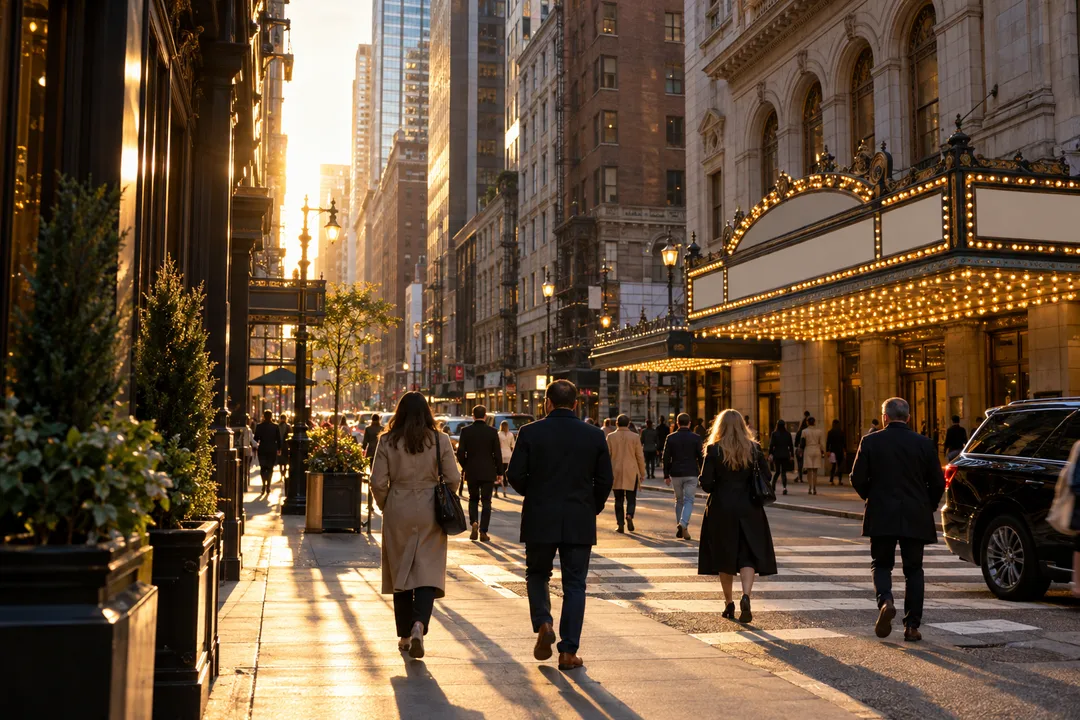
NYC Neighborhood Itinerary Builder: 3 Stops Before Your Show
Build an NYC neighborhood outing backward from a fixed appointment, keeping the final approach simple and giving each optional stop a clear time limit.
Plan the final approach to your NYC appointment before choosing anything to do beforehand. A neighborhood itinerary builder is most useful here when you supply the place you must reach, the arrival time, and how much of the earlier afternoon can disappear without regret. Ask the Karpo APP for up to three optional stops in a manageable area. The point is a pleasant lead-in to your show, not a sightseeing schedule that leaves you watching the clock.
Put the arrival deadline before the curtain time
A ticket's performance time and your own arrival target serve different purposes. Use the arrival instructions attached to your booking when setting the non-negotiable part of the evening. This article does not supply a theater's admission policy or a standard late-seating rule. Your planning request needs the time you intend to reach the entrance, plus the actual entrance location, so every earlier suggestion can be judged against the same endpoint rather than a vague district name.
For a hypothetical example, imagine wanting to arrive at your appointment by 6 pm, with the earlier afternoon free from 3 pm. Those are chosen planning inputs. They do not describe any particular performance schedule. Give both to Karpo, along with where you will start and whether you want food or simply a browse. A finish expressed this clearly is more helpful than “something fun before the show,” which leaves the most consequential constraint unstated.
Three stops are a ceiling, not a target
Assign the possible stops different priorities. One might be a light meal you actually need, one a browse you would enjoy, and one a short outdoor detour you can drop. If you already ate, the meal can disappear too. Asking for three ideas does not oblige you to use all of them. A good response gives you enough information to choose the pieces that fit the available window without making an unnecessary stop feel mandatory.
Tell Karpo which activity is essential and which is expendable: “Prioritize a seated bite. Suggest one browsing idea and a short walk only if they fit comfortably before my arrival target.” This creates a useful comparison between alternatives rather than a three-stop checklist. The request is conversational. It does not mean that the app has reserved a table, calculated a guaranteed walking duration, or secured admission to anything mentioned in the resulting suggestions.
Spend the spare time close to the finish
The final optional activity should not pull you away from your appointment. Look at the proposed sequence as a set of directions, not just a set of attractive places. A modest stop near the finish can be more useful than a celebrated place in the opposite direction. If two ideas require crossing the same ground twice, ask whether one can be removed. The saved transition is often more valuable than squeezing another experience into the afternoon.
Compare a forward sequence with a plan that returns toward the starting point. The forward version makes sense when the show is the destination. A loop might be useful if you must collect a bag or meet someone back where you began. Explain that obligation rather than letting it appear at the end. The shape should follow the actual evening, including what happens after the show, instead of an abstract preference for covering a particular neighborhood thoroughly.
Put a decision point after the meal
Food is the part of a pre-show plan most likely to deserve unhurried attention. Do not start a second activity while still deciding whether everyone has eaten enough. Once the meal is finished, compare the time left with the next optional idea. You can continue directly toward the appointment if the group prefers. Having one clear decision point keeps the itinerary understandable and prevents every small delay from triggering a fresh debate about the entire evening.
If a restaurant has a visible queue that does not suit your remaining window, choose a different meal format rather than trying to recover the same experience at any cost. Ask for an alternative that solves the need to eat, such as something simpler and closer to the finish. No universal queue cutoff applies to every venue. Decide your own limit based on the appointment, the meal you need, and how much uncertainty you are willing to accept.
Describe the group before comparing places
A solo visitor can make a quick choice that would be awkward for a group arriving separately. Tell Karpo how many people are involved and whether everyone will join for the same portion. If one friend arrives shortly before the show, decide whether the earlier outing should proceed without them or whether the meal is the shared event. That social decision matters more than adding another destination. Keep a single meeting instruction that can be repeated without interpretation.
Also distinguish a snack from dinner. One person may want enough food to last through the evening, while another only wants a drink and conversation. Include dietary preferences and whether you want to remain alcohol-free, without turning the planning request into a promise about any establishment's menu. Read specific suggestions for how well they answer your stated needs. You are choosing the format of the lead-in, not accepting a generic list of nightlife recommendations.
Remove the detour that competes with the main event
Skip the distant “must-see” that adds a second journey. If your reason for going out is the performance, an optional neighborhood visit should support that evening. It should not demand so much travel or attention that you arrive depleted. Ask Karpo to rank the earlier ideas by usefulness to your actual window. A place can be excellent and still belong on a different day's plan. Leaving it out is a considered choice, not a failure of curiosity.
Keep purchases similarly modest. Shopping bags, a large takeaway order, or a fragile object can complicate the main appointment. This is a practical consideration, not a bag policy attributed to a theater. If you intend to buy something, use the booking's own entry terms for what can come with you. Otherwise, browsing without purchases may be a better activity before the show. Say so in the initial request so the recommendations reflect the whole evening.
Practical Notes: a backward planning brief
Send the date, starting area, exact destination, and target arrival time. Identify the one thing you need beforehand, the most you want to spend, and what can be dropped. Ask for a short order of activities with the optional parts clearly identified. Use your own travel allowance and the booking's instructions when making the final decision. The suggested sequence is a way to compare ideas, while your appointment remains the fixed point around which the earlier outing is arranged.
A useful final message is: “Keep the meal and remove the extra browse. Suggest an easy way to spend any time left near my finish.” Open the Karpo APP with that specific request once you know your appointment details. You should come away able to name the essential stop, the optional stop, and the place you are heading afterward. That clarity gives you permission to enjoy the neighborhood without turning every spare minute into another obligation.
Ask Karpo for more information.
Keep reading
- SoHo Tailor Alteration Shop Finder for Sample Sale Finds
 Williamsburg Tailor Alteration Shop Finder for Bike Riders
 Upper West Side Tailor Alteration Shop Finder for Kids