 SoHo Tailor Alteration Shop Finder for Sample Sale Finds
Neighborhood Guides
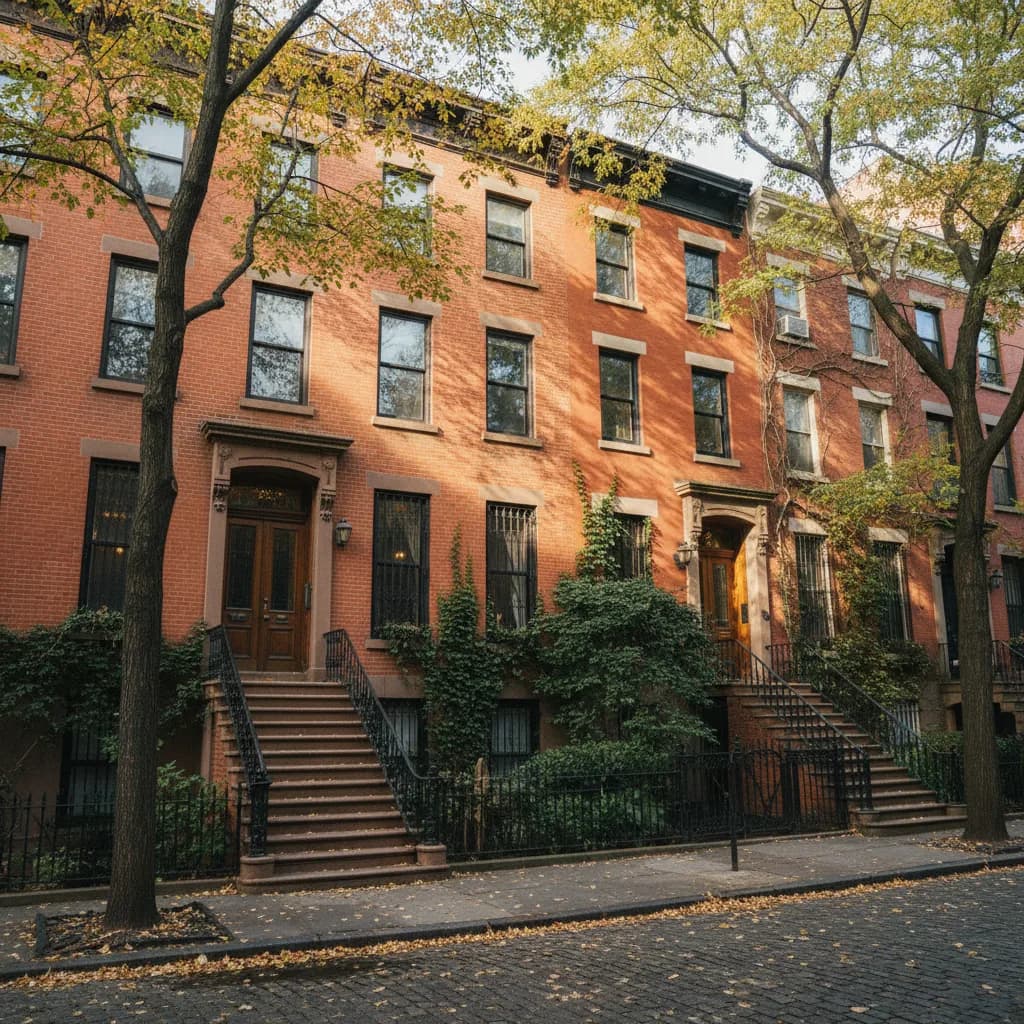
West Village NYC Neighborhood Historical Walking Tour Guide
Walk the West Village historical route from Jefferson Market Library to Grove Street, Bedford Street, and Hudson Street landmarks on Karpo APP.
Where West 4th Street unexpectedly intersects West 10th, West 11th, and West 12th Streets, the crooked colonial farm lanes of the West Village defy the 1811 Commissioners' Grid and invite a 1.3-mile neighborhood historical walking tour. Protected within the Greenwich Village Historic District—designated by the New York City Landmarks Preservation Commission in April 1969 across sixty-five blocks—these tree-shaded streets preserve 1820s Federal brick townhouses, Victorian Gothic civic towers, and tucked-away carriage mews. Starting at Avenue of the Americas and winding west toward Hudson Street takes roughly 75 minutes at an unhurried stroll across bluestone flags and Belgian block roadways.
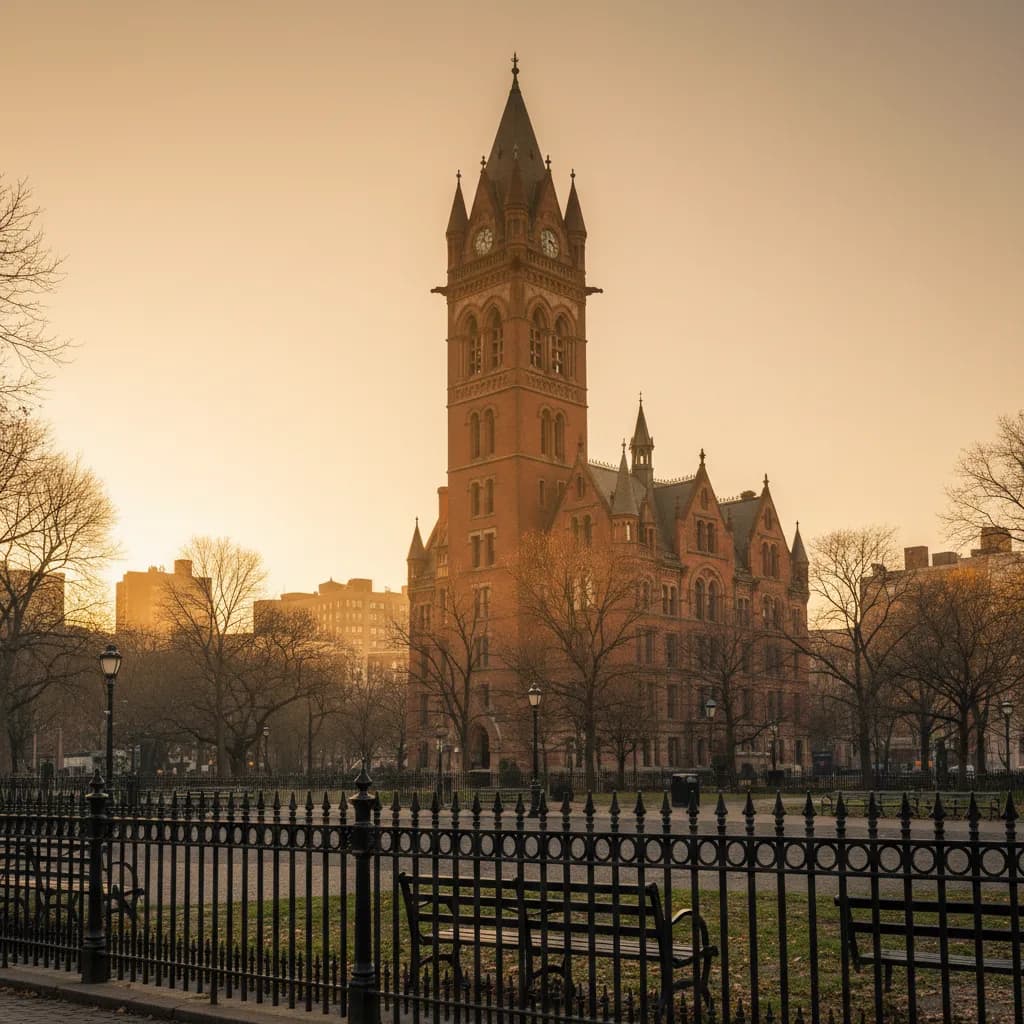
Victorian Gothic Gables at 425 Avenue of the Americas
Step out of the West 4th Street-Washington Square subway hub and walk north to 425 Avenue of the Americas at West 10th Street, where the Jefferson Market Library rises 172 feet above the street corner. Designed by architects Frederick Clarke Withers and Calvert Vaux and constructed between 1874 and 1877 as the Third Judicial District Courthouse, this Victorian Gothic landmark combines pressed red brick, banded Ohio sandstone, and a polychrome slate roof with a four-faced clock and fire-watch bell tower. When the courthouse faced demolition in the late 1950s, Village residents led by preservationist Margot Gayle campaigned to convert the building into a New York Public Library branch, which opened in 1967 and earned National Historic Landmark status in 1977.
Walk west along West 10th Street beside the wrought-iron fence of Jefferson Market Garden, cultivated by neighborhood volunteers since 1975 on the footprint of the former Women's House of Detention. Look up at the courthouse's western gable and spiral stair turret from the garden path, where carved stone gargoyles and stained-glass lancet windows stand clear of Sixth Avenue bus traffic.
Civil Rights History at Christopher Park and Gay Street
Head south on Greenwich Avenue and turn west into Christopher Street to reach Christopher Park and 53 Christopher Street, centerpiece of the Stonewall National Monument. Designated a New York City Individual Landmark in 2015 and proclaimed the first United States National Monument dedicated to LGBTQ+ civil rights in June 2016, the brick tavern facade and triangular park commemorate the June 1969 uprising that transformed modern civil rights organizing. Inside the park's iron gates, sculptor George Segal's white-patinated bronze figures sit and stand among London plane trees.
Just east of Christopher Park, duck into the one-block curve of Gay Street between Christopher Street and Waverly Place. Following the boundary of an 18th-century estate driveway, the narrow lane preserves a row of 1826 to 1833 Federal brick townhouses with original Flemish-bond brickwork, paneled wooden doorways, and iron boot scrapers anchored into the bottom stoop steps.
Federal Clapboard Houses and Narrow Alleys on Grove and Bedford
Walk west on Christopher Street and turn south onto Bedford Street toward its intersection with Grove Street, one of the most architecturally layered corners in Lower Manhattan. At 17 Grove Street stands an 1822 wood-frame clapboard house built by window sash maker William Hyde during the summer yellow fever epidemic that drove thousands of families north from Lower Manhattan into rural Greenwich. Right next door at 10 Grove Street, peer through the wrought-iron gate into Grove Court, an 1854 enclave of six three-story brick houses built by Samuel C. Mott that inspired O. Henry's 1907 story The Last Leaf.
Turn the corner onto Bedford Street to compare two contrasting curiosities within half a block. At 75 Bedford Street rises a nine-and-a-half-foot-wide three-story red-brick house built in 1873 inside a former carriage passage, famous as Manhattan's narrowest townhouse and home to Pulitzer Prize-winning poet Edna St. Vincent Millay in 1923. Across the roadway at 102 Bedford Street stands Twin Peaks, an 1835 townhouse remodeled in 1925 by architect Clifford Reed Daily with steeply pitched Arts and Crafts gables, half-timbered stucco walls, and casement windows designed to house working artists and writers.
Commerce Street Theater History and 487 Hudson Street
Follow Bedford Street south to the dogleg bend of Commerce Street, where 38 Commerce Street houses the historic Cherry Lane Theatre. Constructed in 1836 as a farm silo and later used as a tobacco warehouse and box factory, the brick structure was converted into an experimental playhouse in 1924 by Edna St. Vincent Millay and scenic designer Cleon Throckmorton. Neighboring 39 and 41 Commerce Street—known as the Twin Sisters—display identical 1831 Greek Revival brick facades standing side by side around a shared garden courtyard.
Continue two blocks west to 487 Hudson Street between Barrow and Christopher Streets, where the Church of St. Luke in the Fields anchors a tranquil full-block close. Built in 1821 and 1822 of hand-molded salmon brick, it remains the oldest surviving structure on Hudson Street. Residents reading on garden benches, quiet architectural sketchers, and dog walkers observe strict residential courtesy along Grove, Commerce, and Barrow Streets: never sit on private brownstone stoops or lean against wrought-iron parlor railings while photographing doorways.
Walk two final blocks west toward the Hudson River waterfront to discover the one-block Weehawken Street Historic District between Christopher and West 10th Streets, designated by the Landmarks Preservation Commission in May 2006. Laid out in 1829 as the site of Greenwich Village's municipal market and Hudson River ferry landing, the tiny street still preserves an 1834 adapted timber market shed at 6 Weehawken Street alongside late 19th-century brick maritime boardinghouses that once served oyster sloops and transatlantic steamship crews.
Navigation Strategy, Quiet Streets, and Rainy-Day Plan B
Skip walking down Bleecker Street between Seventh Avenue South and Bank Street at midday on weekends if you want to study 1830s Federal dormers and lintels; bakery lines and boutique crowds choke the narrow sidewalks, whereas parallel Hudson Street and Bedford Street let you examine period ironwork in peace. Because the West Village street grid bends at forty-five-degree angles along old property lines, checking landmark points on the Karpo APP helps walkers connect Grove Street, Commerce Street, and St. Luke's Place without losing their bearings.
If a sudden rainstorm sweeps across the Hudson River piers, step inside the vaulted 1877 Victorian Gothic reading rooms of the NYPL Jefferson Market Library at 425 Avenue of the Americas to inspect original brick archways and carved stone capitals indoors. From there, walkers can board the A, B, C, D, E, F, or M trains at West 4th Street or the 1 train at Christopher Street-Stonewall station with a $3.00 OMNY tap.
Ask Karpo for more information.
Keep reading
- SoHo Tailor Alteration Shop Finder for Sample Sale Finds
 Williamsburg Tailor Alteration Shop Finder for Bike Riders
 Upper West Side Tailor Alteration Shop Finder for Kids