 SoHo Tailor Alteration Shop Finder for Sample Sale Finds
Neighborhood Guides
NYC Neighborhood Audio Walk: Free Financial District Route
Take this self-guided Financial District neighborhood audio walk through historic canyon corridors, colonial taverns, and iconic landmark monuments.
Starting this Financial District neighborhood audio walk at Bowling Green Park positions you at the very birthplace of European settlement on Manhattan Island. While modern Lower Manhattan is celebrated worldwide for towering glass financial towers, its subterranean foundations and street contours preserve the seventeenth-century footprint of Dutch Nieuw Amsterdam. By starting your audio narration beneath the mature oak trees of New York oldest public park, you peel back layers of international banking and global commerce to discover colonial trading posts, Revolutionary battles, and architectural monuments carved from native granite and limestone.
Bowling Green and the Customs House of Bowling Green
Bowling Green was officially designated as a public park by the New York City Common Council in 1733, having previously served as a Dutch cattle market and military parade ground. The historic 1771 cast-iron fence surrounding the green is one of the few physical artifacts surviving from colonial British rule. As your audio guide explains, rebellious Sons of Liberty gathered here on July 9, 1776, following a public reading of the Declaration of Independence, pulling down the equestrian statue of King George III and hacking off the ornamental royal crowns from the fence posts, the saw marks of which remain visible on the iron finials today.
Dominating the southern terminus of the park stands the monumental Alexander Hamilton U.S. Custom House, designed by Cass Gilbert in the Beaux-Arts style and completed in 1907. Daniel Chester French four monumental limestone sculptures on the front portico represent the four continents of world commerce: Asia, America, Europe, and Africa. Pausing on the sweeping granite stairs, the audio commentary explains how federal customs duties collected in this single rotunda funded the vast majority of the United States federal government throughout the nineteenth century.
The Cobblestones and Colonial Taverns of Stone Street
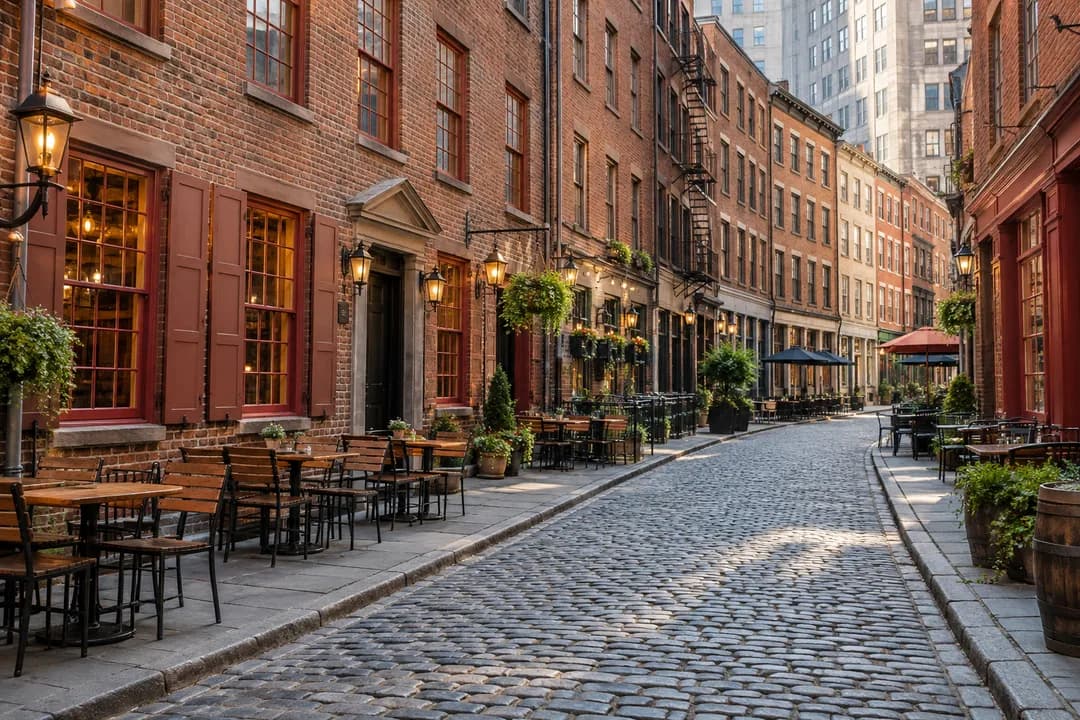
Following the curved route northeast toward Hanover Square leads you into Stone Street, one of the oldest paved thoroughfares in North America. Originally called Hoogh Straet by Dutch settlers, it was paved with round cobblestones in 1658 after local residents complained of muddy cart ruts fouling their doorsteps. The Stone Street Historic District preserves a dense, intimate row of post-fire merchant warehouses constructed in the Dutch Revival and Greek Revival styles following the devastating Great Fire of 1835.
At the corner of Pearl and Broad Streets stands Fraunces Tavern, an iconic 1719 yellow-brick structure that served as a central organizing hub for colonial patriots and the Sons of Liberty. In December 1783, following the British evacuation of New York City, General George Washington gathered his senior Continental Army officers in the tavern Long Room to deliver his emotional emotional farewell address before resigning his commission. The audio walk pauses here to describe how the tavern later housed the newly formed nation early Department of Foreign Affairs and Treasury under the Articles of Confederation.
The Skyscraper Canyon of Wall Street
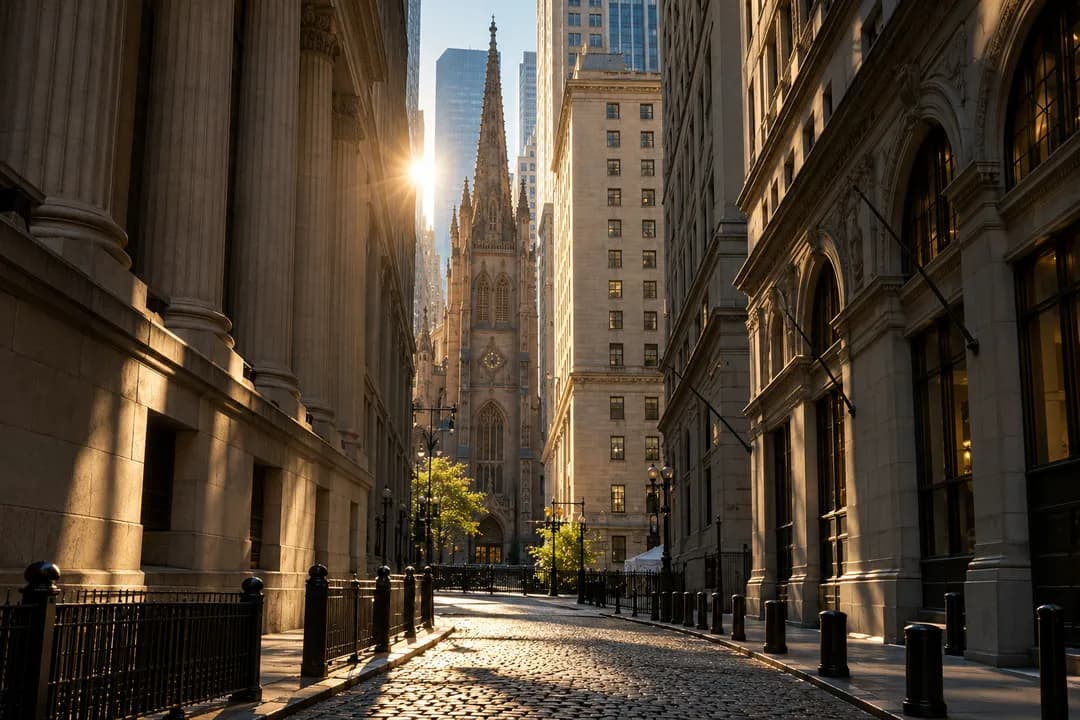
Turning northwest brings you onto Wall Street itself, where towering limestone and granite facades create the famous urban canyon effect. Wall Street derived its name from the wooden stockade barrier erected by Dutch Governor Peter Stuyvesant in 1653 across the northern boundary of Nieuw Amsterdam to guard against potential English attacks and indigenous incursions. The physical wall was dismantled before 1700, but its alignment permanently fixed the axis of global capital.
Standing outside Federal Hall National Memorial at 26 Wall Street, your audio narration highlights the heroic bronze statue of George Washington marking the site where he took the oath of office as the first President of the United States on April 30, 1789. The current Greek Revival temple, completed in 1842 as the United States Sub-Treasury, features massive Doric columns quarried in Massachusetts and a dramatic rotunda that once held millions in gold bullion vaults.
Gothic Grandeur at Trinity Church and Graveyard
Terminating Wall Street at the intersection with Broadway is Trinity Church, designed in the English Perpendicular Gothic style by architect Richard Upjohn and consecrated in 1846. For decades after its completion, Trinity Church 281-foot brownstone spire made it the tallest man-made structure in the United States, welcoming ocean liners entering New York Harbor long before skyscrapers rose to dwarf it.
Passing through the heavy bronze doors sculpted by Karl Bitter, the audio walk leads you into the historic churchyard, where weathered sandstone markers date back to the late seventeenth century. Visitors gather silently beside the white marble pyramid monument marking the final resting place of Alexander Hamilton, his wife Elizabeth Schuyler Hamilton, and inventor Robert Fulton. Surrounded by the towering financial headquarters of Broadway and Trinity Place, this green sacred oasis provides profound historical perspective.
Pacing Your Walk and Navigating Peak Financial Hours
The Financial District possesses two entirely different personalities depending on the time of day and week. Weekdays between 8:00 am and 9:30 am witness intense tides of commuters streaming from subway stations toward office towers, while weekend mornings offer almost cathedral-like quietude among the towering concrete and stone corridors. Early Sunday mornings between 8:30 am and 11:00 am provide the ideal window for uninterrupted audio listening and wide-angle architectural photography.
Because high-rise canyon walls can make street identification tricky from afar, Karpo APP provides clear street-level landmark cues and prominent corner references for each walking segment. If you need a quiet indoor respite during inclement weather, the soaring indoor atrium of the nearby Oculus transportation hub provides spacious, climate-controlled seating and public facilities.
Transit Access and Practical Walking Tips
Lower Manhattan is among the most densely connected transit nodes on earth. The Bowling Green station on the 4 and 5 lines, the Wall Street stations on the 2, 3, 4, and 5 trains, and the Rector Street stations on the 1 and R lines all place you within seconds of the walking route. The Staten Island Ferry Terminal at Whitehall also provides convenient access for visitors crossing from the southern borough.
Wear supportive, cushioned walking shoes capable of handling hard stone pavers and granite steps. Because towering skyscrapers block direct low-angle sunlight for much of the day, street canyons can feel noticeably cooler and windier than open parks, so carrying a light windbreaker is advisable. Keep your listening volume balanced to maintain awareness of delivery traffic and city crosswalks.
Ask Karpo for more information.
Keep reading
- SoHo Tailor Alteration Shop Finder for Sample Sale Finds
 Williamsburg Tailor Alteration Shop Finder for Bike Riders
 Upper West Side Tailor Alteration Shop Finder for Kids