 Chelsea Consignment Shop Crawl Planner for Your First Studio
Hidden Gems & Odd Finds
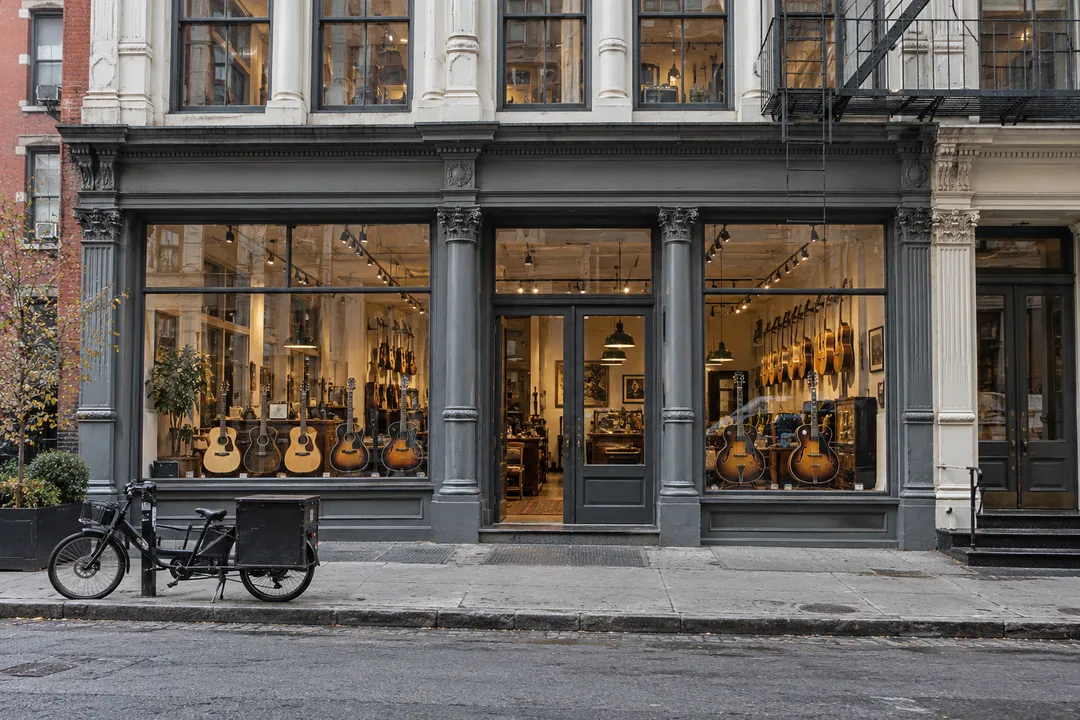
Musical Instrument Store Near Me in SoHo: Rudy's Music
Rudy's Music at 461 Broome Street in SoHo pairs a Taylor showroom and Martin custom desk with a walk-in repair bench and Pensa guitars built in New York.
Rudy's Music sits at 461 Broome Street in SoHo, a guitar shop where a used Taylor and a vintage Gibson flat-top can hang a few feet apart. For anyone typing musical instrument store near me from downtown Manhattan, it answers with more than strings and picks: a dedicated Taylor showroom, a Martin custom-order desk, a walk-in repair bench, and the Pensa electrics that Rudy Pensa has been designing in this city since the 1980s.
From a 48th Street Walk-Up to a SoHo Loft
The story begins in Argentina, where Rudy Pensa started studying classical guitar at the age of seven. On his first trip to New York in 1974, the shop's own history says, he went straight from JFK with his suitcase in tow to 48th Street, then the city's music row. Four years later, in 1978, Rudy and his wife Fran opened Rudy's Music Stop on that block, in a tiny shop on the second floor of an old tenement.
In 2014 the family closed the Midtown room and moved the entire operation downtown. The spot was chosen on purpose: the store says Rudy wanted to be close to the former Kenmare Street workshop of the luthier John D'Angelico and to the site of the original Martin guitar factory. A second shop opened in Scarsdale in 2018, while Broome Street keeps the repair bench and the custom work under one roof.
Pensa Guitars, Built a Few Floors From the Sales Floor
What separates this store from a catalog retailer is the Pensa line. Rudy built his first R Custom in 1984, and in 1985 he and Mark Knopfler sketched the blueprint for what became the Pensa MK on a napkin over coffee. Those instruments are still made in New York, and the shop's site says Pensa custom guitars have been built right here for over 30 years. A Pensa Soho Classic with a ziricote top was listed at $8,695 this October.
You do not need to be shopping in that bracket to enjoy seeing them. A Pensa hanging next to a factory Stratocaster makes the difference in carving, finish and fretwork easy to spot. If you are curious about a build of your own, ask how the custom shop works and what a deposit involves; deposits on custom orders are non-refundable, so it pays to settle the spec before you commit.
The Taylor Room and the Martin Custom Desk
Acoustic players get two reasons to linger. The SoHo store has a Taylor showroom designed in collaboration with Taylor Guitars, humidity controlled, which lets the shop carry nearly every Taylor model in one place. That matters when you are torn between body shapes: a Grand Auditorium and a Dreadnought sound different in a quiet room, and here you can hear them back to back instead of guessing from videos. The Taylor page names Nate as the person who runs that showroom.
Martin fans have a parallel option. Rudy's is a Martin Custom Shop Expert Dealer, so you can sit down and spec a guitar from tonewoods to inlays, and the store says quotes are free with no obligation to purchase. For players drawn to archtops, sales expert Rob Nuovo, at the shop since 2011, is the person the team points to and Dave Polakoff has been with Rudy's since 2018.
What Was on the Walls This October
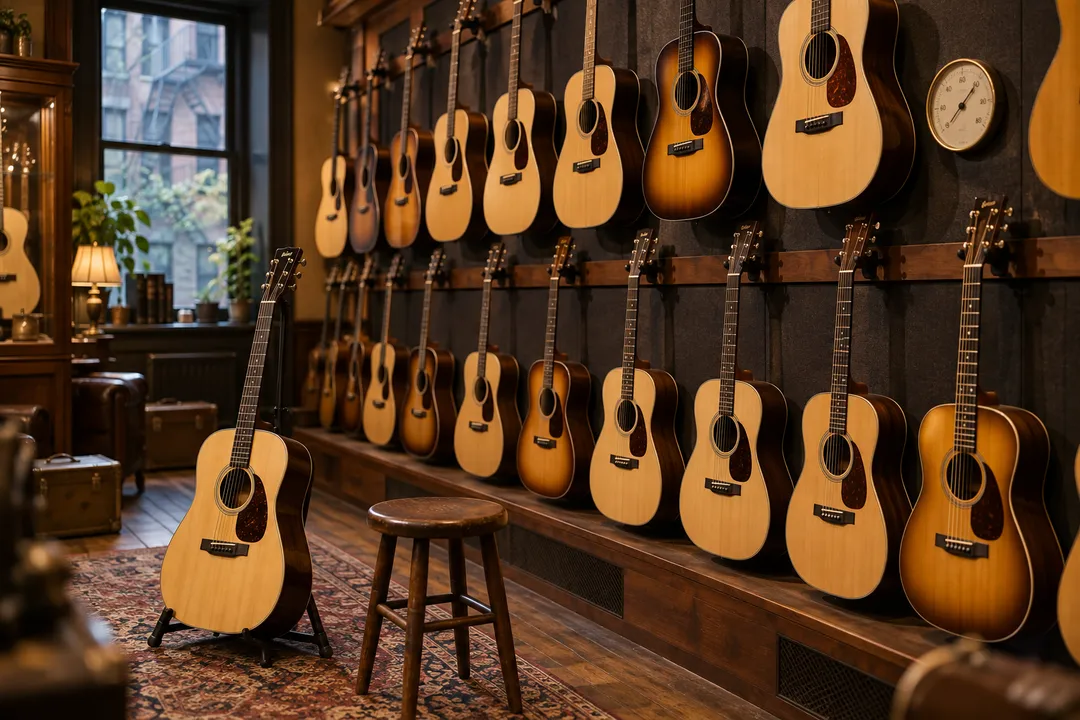
Beyond guitars, the menu runs through basses, mandolins and ukuleles, plus amplifiers, effect pedals, cases, straps and pickups. Stock turns over constantly because so much of it is used or vintage. In October 2026 the shop listed a used Taylor 112ce in honeyburst at $595, a Fender American Professional Stratocaster in black with a maple fingerboard at $1,799.99, and a 1994 Martin HD-28 at $2,795.
Further up the wall sat a 1963 Gibson J-45ADJ in cherry sunburst at $6,295, the sort of flat-top that makes more sense in your hands than on a screen. Vintage pieces are one of a kind, so the instrument you spotted online on Tuesday may have a new owner by Saturday. Each listing on the shop's site names the location that holds the guitar, which helps when one particular instrument is the reason for the trip.
Demo Etiquette When the Room Gets Crowded
Rudy's is honest about its own popularity. The store warns that the shop can get extremely crowded, and at peak moments it may be too busy to demo an instrument or pedal; staff might ask you to wait until things calm down or keep your demo short. The practical answer is timing. The store opens Tuesday through Saturday, so plan around a Sunday and Monday closure.
When you do get a guitar in your lap, ask before plugging in, keep the volume at conversation level, and play the passages you actually use rather than a showcase solo. Mention your budget and style early, since the team can steer you to a short list faster than you can scan the walls. Belt buckles and zippers scratch finishes, so lay a strap or cloth across your lap with vintage pieces.
Repairs Without an Appointment
The repair shop handles everything from basic setups to expert jobs such as refrets and neck resets, and no appointment is necessary. The SoHo location is the store's exclusive installer of the Evertune bridge system and is certified for Taylor warranty repairs. Bring your instrument in a case or gig bag; the shop asks for that in capital letters, and the subway will thank you for it too.
Repair prices are not posted, so describe the problem clearly at the counter and ask for an estimate before you leave the guitar. If you are buying and repairing on the same visit, mention it; it is easier for the bench to plan a setup on a new purchase than to squeeze it in later. Seasonal changes in New York humidity are the classic reason for a fall setup, when necks shift after a damp summer.
Hours, Returns and Getting There
The SoHo store is open Tuesday through Saturday from 11 am to 6 pm and closed on Sunday and Monday, so plan weekend visits for Saturday. In-store purchases can be exchanged or turned into store credit within seven days with the original receipt; custom orders, special orders, amps, pickups, speakers, pedals, tubes and closeout items are final sale, and deposits are non-refundable, so try those carefully before paying.
Several lines land within a few blocks. The C and E trains stop at Spring Street, the Lexington Avenue local also stops at its own Spring Street station, the N and R stop at Prince Street, and the A, Q and Seventh Avenue local all serve Canal Street. From Canal it is a short walk north along Broadway or Mercer to Broome, inside the SoHo cast-iron historic district.
Turning the Visit Into a SoHo Afternoon
Once the guitar is chosen, or politely put back, walk a few blocks north to Fanelli Cafe on Prince Street at the corner of Mercer, a corner that has held a grocery and then a saloon since the 1800s. It is a fitting place to argue about necks and pickups over a beer, and it keeps the conversation in the same historic grid of streets the store chose for its move.
If you would rather browse than drink, Housing Works Bookstore Cafe on Crosby Street is a short stroll east, a used bookshop with a cafe whose proceeds support the nonprofit's work. Between the two, Mercer and Greene Streets show off SoHo's cast-iron architecture, the same loft buildings that once held workshops and factories, a quiet reminder of why a luthier-minded guitar store wanted to set up here.
Ask Karpo for more information.
Keep reading
- Chelsea Consignment Shop Crawl Planner for Your First Studio
 East Village Consignment Shop Crawl Planner: Leather Jackets
 Harlem Consignment Shop Crawl Planner for a Jazz Night Look