 Chelsea Consignment Shop Crawl Planner for Your First Studio
Hidden Gems & Odd Finds
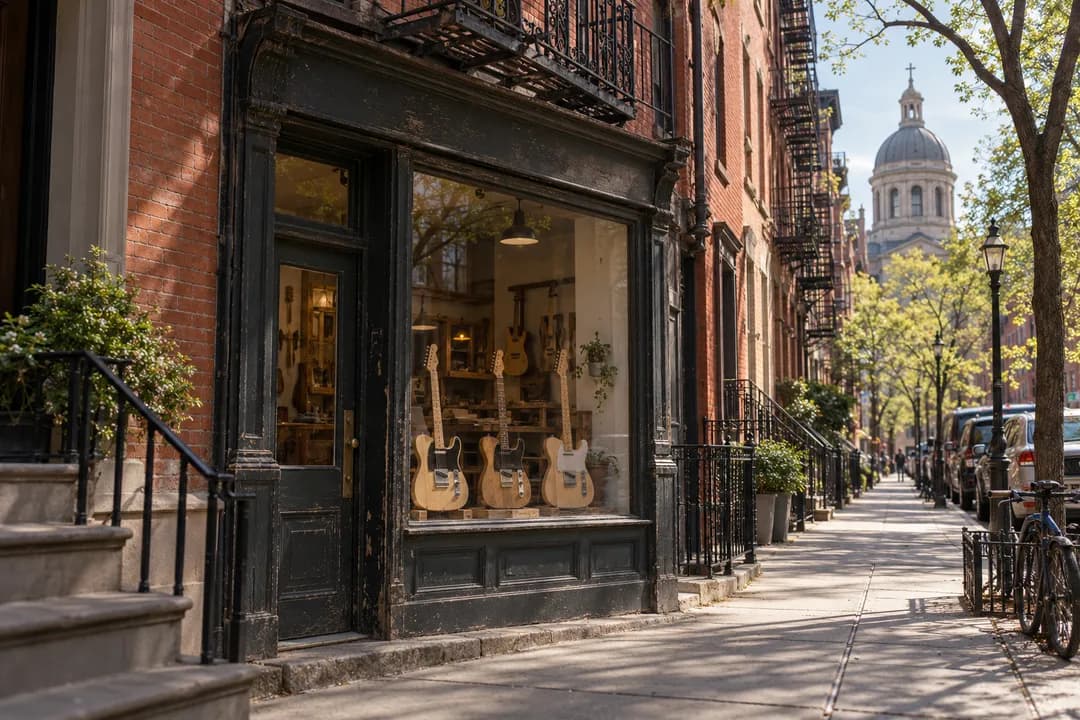
Musical Instrument Store Near Me in the Village: Carmine Street Guitars
Carmine Street Guitars at 42 Carmine Street is Rick Kelly's Greenwich Village workshop, where guitars are built from reclaimed pine pulled out of old New York buildings.
Carmine Street Guitars at 42 Carmine Street is less a store than a workshop with a door to the sidewalk. Luthier Rick Kelly builds electric guitars here out of reclaimed lumber from old New York buildings, hotels, bars and churches, and the sawdust, clamps and half-carved bodies are part of the visit. Anyone searching for a musical instrument store near me in Greenwich Village will find strings and picks, but the real draw is watching a guitar take shape.
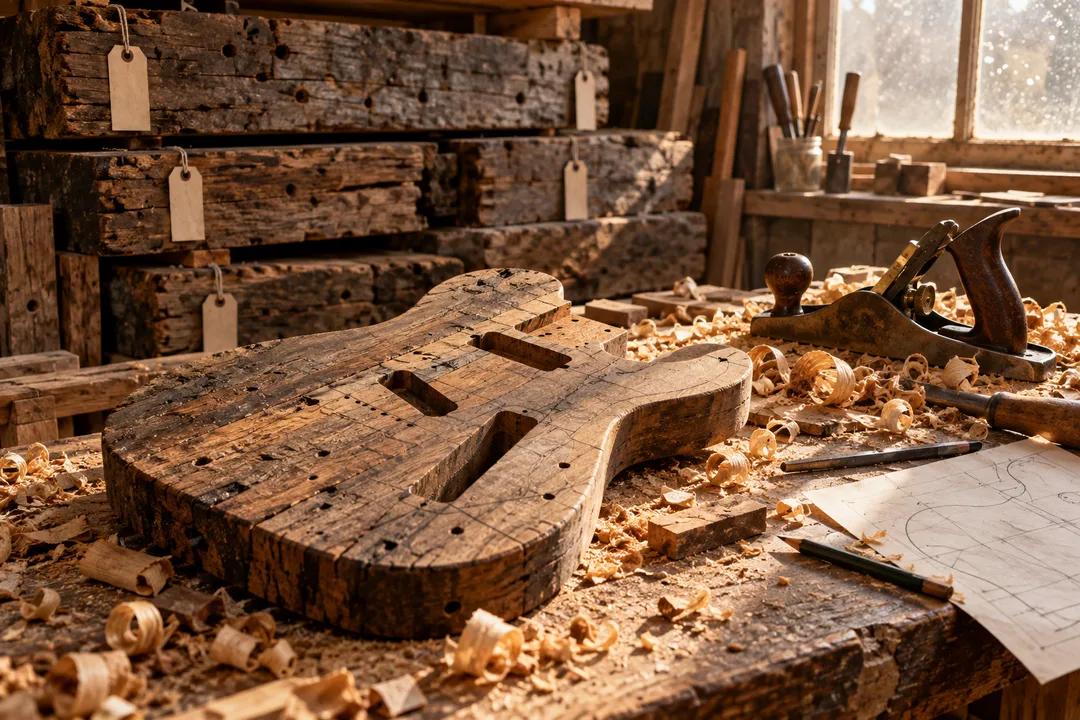
Rick Kelly and the Bones of Old New York
Kelly calls his raw material the bones of old New York City. The shop's page on its Bowery pine guitars explains that the white pine timbers were barged down the Hudson River about 200 years ago to frame the city's buildings, and every Kelly guitar is made from one hundred percent reclaimed lumber. When a tenement is gutted or a bar renovates, the beams can end up on his bench instead of in a dumpster.
He keeps track of where each board came from. A 2023 profile in Village View describes Kelly labeling pieces with their source, whether that is McSorley's Old Ale House or a Bowery address, so a finished guitar carries its building's story. The best-known batch came out of the Chelsea Hotel, the bohemian landmark which gave him old pine that now turns up as guitar bodies, picks and small signs sold at the counter.
From Downing Street to an 1827 Row House
According to Village View, Kelly first opened a store on Downing Street in the late 1970s and moved into the Carmine Street space in 1990, when it became available. The building itself is older than most of the wood he uses: an ABC7 New York feature from June 2026 describes it as an 1827 structure, one of the three oldest on the block, with a back room that served as a speakeasy during Prohibition.
That same feature captured what visitors notice first: the smell of fresh wood, the sound of saws and the strum of guitars being tested. The workshop starred in a documentary, also called Carmine Street Guitars, which follows five days in the life of the shop as musicians drop by. The film notes that Kelly's guitars have been embraced by Bob Dylan, Lou Reed, Patti Smith and the director Jim Jarmusch.
Cindy Hulej and the Next Generation
Kelly does not work alone. His apprentice Cindy Hulej appears throughout the documentary and has grown into a builder with her own line, Cindy Guitars, which she takes orders for through an online form. She is also behind many of the smaller pieces sold in the shop, made with a colleague named Jonny from scraps left over after the guitars are cut. Ask who is at the bench when you visit; the answer tells you what is being made that week.
Patience is part of the deal. Village View reported in 2023 that custom orders could take up to two years, and Cindy's own site now lists a three-year waitlist, so a commission is a long-term relationship, not an impulse buy. Kelly guitars are not priced online, and Cindy Guitars lists a minimum starting price of $5,000, so the real price conversation happens in person, at the bench, with the wood in front of you and the builder describing the building it came from.
Small Souvenirs Cut From Famous Buildings
You do not need to commission an instrument to leave with a piece of the shop. The house string pack, a 10 to 38 gauge DR Pure Blues set made as Carmine Street Guitars' signature gauge, costs $15. An oversized pick cut from Chelsea Hotel scraps is $25, and a small sign made from 200-year-old Chelsea Hotel pine, roughly seven by two inches, is $100.
The most poignant item is a handmade mini guitar made from leftover scraps of the house John Lennon and Yoko Ono lived in on Bank Street, priced at $150. These pieces are made to order and ship within two to three weeks, with standard shipping starting at $10, and all sales are final.
How to Visit Without Getting in the Way
The shop is open Monday through Friday from 10 am to 6 pm and Saturday from 11 am to 3 pm, so Saturday visits need to happen early. The room is small and doubles as a working shop, so treat it the way you would treat someone's studio. Say hello, ask before handling a guitar on the wall, and keep a respectful distance from the table saw and the router when they are running.
Because the weekday schedule is the longer one, a weekday visit gives you the best chance of an unhurried talk with Kelly or Hulej about a build. Come with a sense of what you want, whether that is a Telecaster-style body or a particular building's wood, and the conversation will be more useful for both sides. Leave space in your bag for a string pack; it is the easiest way to take the shop's sound home.
Getting to Carmine Street
Carmine Street angles off Bleecker Street in the heart of the West Village. The closest subway is West Fourth Street–Washington Square, served by the A, B, C, D, E, F and M trains, a few minutes' walk east. The Seventh Avenue local stops at Houston Street to the south and at Christopher Street–Stonewall to the north, both within easy walking distance.
The block is lined with older walk-ups, and the Church of Our Lady of Pompeii stands at the Bleecker Street end, and the neighborhood rewards a slow pace. Instead of rushing straight back to the train after your visit, follow Bleecker Street and Bedford Street for a few blocks; this is the same Village grid that produced the folk and punk scenes whose musicians later played Kelly's guitars.
A Slice on Either End of the Block
Food is close. Joe's Pizza on Carmine Street is the home base of the famous New York slice shop, a counter-service spot where a plain cheese slice on a paper plate makes the right snack after an hour of looking at guitars. Eat it standing on the sidewalk like everyone else, and you will be back on the block in a few minutes.
For a sit-down meal, John's of Bleecker Street, a Bleecker Street institution founded in 1915, bakes coal-oven pizzas in a room covered with carved initials and old photographs. Whole pies only, no slices, so bring a friend. Between Kelly's reclaimed wood and John's carved booths, the afternoon becomes a lesson in how much of old New York still survives in the Village.
Ask Karpo for more information.
Keep reading
- Chelsea Consignment Shop Crawl Planner for Your First Studio
 East Village Consignment Shop Crawl Planner: Leather Jackets
 Harlem Consignment Shop Crawl Planner for a Jazz Night Look