 Chelsea Consignment Shop Crawl Planner for Your First Studio
Hidden Gems & Odd Finds
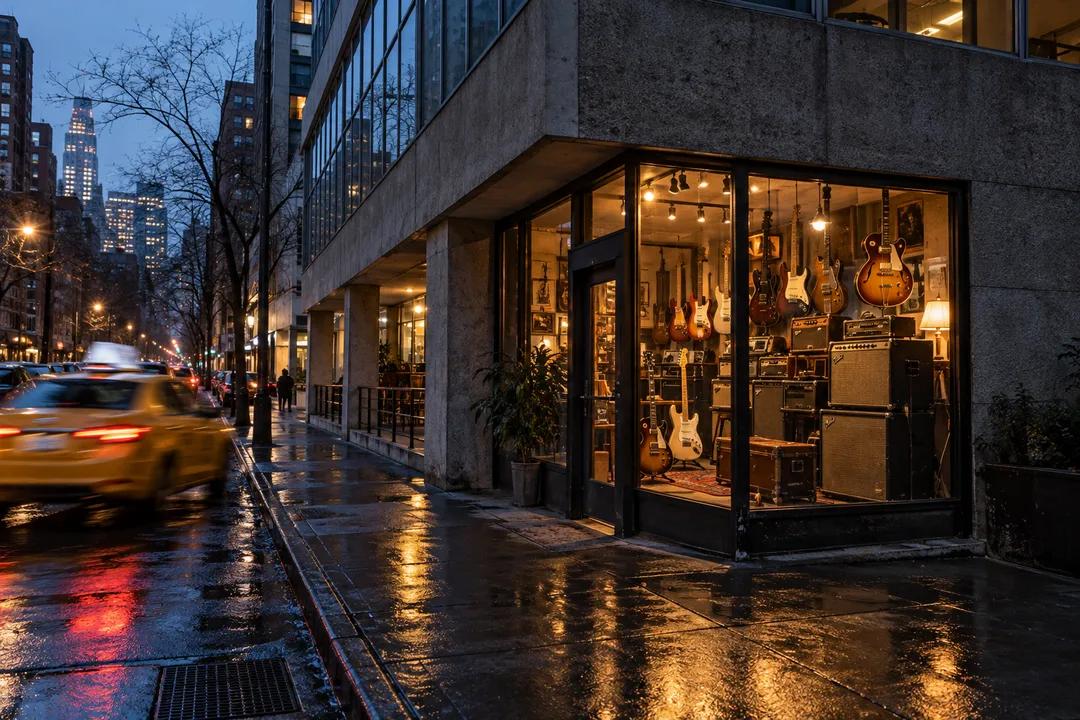
Musical Instrument Store Near Me in Chelsea: 30th Street Guitars
30th Street Guitars at 234 West 27th Street in Chelsea is a luthier-run shop for vintage guitars, boutique pedals, walk-in fretwork and pedalboard builds.
The name is a decoy. 30th Street Guitars has not been on 30th Street since November 2015, when it moved to 234 West 27th Street in Chelsea, tucked into the ground floor of the Fashion Institute of Technology. Owner Matt Brewster kept the old name anyway, and the shop kept its crowd: Broadway pit musicians and working guitarists who need a refret, a wiring fix or a strange fuzz pedal in the middle of a working week.
Matt Brewster and a Shop Born in the Studio District
Brewster founded the store in 1995 in what the shop calls the heart of New York's studio and rehearsal district, the cluster of rehearsal rooms and recording spaces around West 30th Street. It began in a smaller space on that block before growing into a larger room, and over three decades it turned into an institution for local players as well as a stop for collectors who fly in and plan a day around it.
The 2015 move to West 27th Street put the shop on a block Brewster has jokingly called the safest street in Manhattan, a nod to the college security that watches over the campus. He decided against renaming, admitting it confuses first-timers. If your map app sends you to 30th Street, walk three blocks south and look for the guitars glowing in a storefront set into the base of the FIT building.
Fretwork and Wiring Are the House Specialty
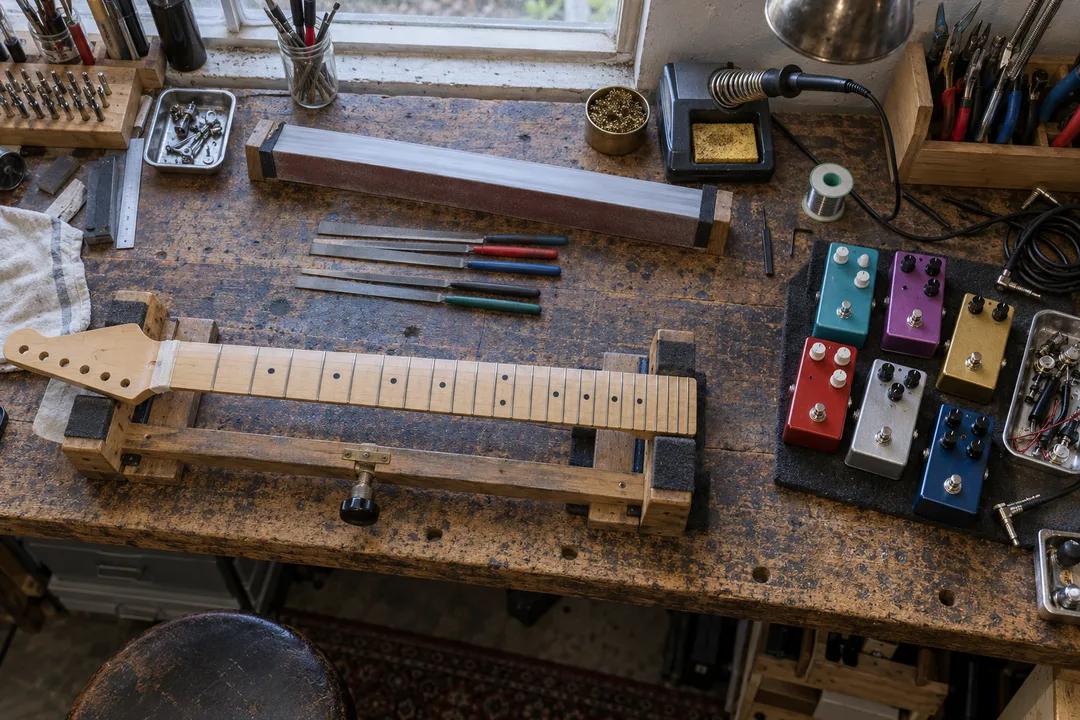
The repair counter is the reason many regulars first walked in. The shop specializes in fretwork and electrical work, and no appointment is necessary. Brewster, a luthier with more than 30 years of experience, leads a bench known for setups, custom wiring, fret jobs, woodwork and custom builds. The services list covers electric and acoustic guitars, basses, banjos and ukuleles, from fret leveling to full refrets.
Headstock breaks and acoustic cracks are on the menu too, along with electronics work and pickup installation. If you are swapping pickups, bring the set you want installed or ask what the counter recommends from the brands on the wall, such as Ron Ellis pickups. Describe the symptom precisely, whether that means a buzz on the third fret or a crackling output jack, because a clear description helps the luthier find the problem quickly.
A Pedal Wall for People Who Read Schematics
The shop stocks a large assortment of new effects, and the selection leans boutique. Recent brands on the shelf include Keeley, Strymon, Catalinbread, JAM Pedals, Old Blood Noise Endeavors and Death By Audio. In October 2026 a Keeley Tube Drive was listed at $399 and a Strömer Mutroniks Anniversary Fuzz at $210, the sort of pedals that are hard to audition in a big-box store.
Pedalboard builds are a separate service, and the shop asks players to call or email to discuss one. It is worth doing if your board has turned into a nest of patch cables: describe your signal chain, the power supply you use and the case you carry, and let the bench design something that survives a subway ride to a gig. Boutique builders such as Browne Amplification and Benson are represented by pedals, and the About page notes an assortment of new and used amps as well.
Vintage Pieces With a Story Attached
The used and vintage racks are where the shop's history shows. This October the website listed a 1956 Gretsch Jet Firebird at $9,850, a Gretsch solid-body from the mid-fifties, and a 1992 Pensa Classic once owned by guitarist Wayne Krantz at $15,000. Even if you are not buying in that range, a shop that can tell you who played a guitar before you is a different experience from a showroom of identical new stock.
Brewster also builds his own instruments under the RUST name, which he describes as vintage formula with modern playability. A RUST T-style model nicknamed The Roach was listed at $2,350 before it sold out. The custom work is part of the shop's identity, and if you want something built rather than bought off the wall, the conversation begins at the same counter where the repairs are dropped off.
House Rules Before You Hand Over a Card
The shop's policies are blunt, so read them before buying. All sales are final, returns are not accepted on effect pedals, refunds are not offered and credit is store credit only, and select items carry a 15 percent restocking fee. The store also does not ship internationally or to APO addresses. In practice, that means you should play a pedal through an amp you trust and decide in the room, not at home.
Plan your visit around the posted schedule: the store is open Monday through Friday from 11 am to 6 pm and on Saturday from 11 am to 5 pm. Because Sunday is not on that schedule, weekend players should aim for Saturday, and anyone with a long repair conversation in mind is better off arriving soon after the doors open than at the end of the day.
Getting to West 27th Street
The Seventh Avenue local stops at Twenty-Eighth Street a short walk away, and the C and E trains stop at Twenty-Third Street on Eighth Avenue, four blocks south and one avenue west. Penn Station, with the express lines and the Long Island Rail Road, is a short walk north, which makes the store an easy errand for commuters who carry a guitar in from the suburbs.
If you are bringing an instrument in for repair, use a hard case or a padded gig bag; Chelsea sidewalks are busy at rush hour, and the walk from Penn Station runs past crowded corners. A soft case leaning against a subway pole is how headstocks get cracked, and a cracked headstock is exactly the kind of job you would rather not add to the ticket.
Fashion History Across the Street
Your next stop is on the same block. The Museum at FIT, run by the college whose building houses the shop, mounts rotating exhibitions on fashion history and design, and admission to the museum is free. It is a natural pairing for anyone interested in craft: guitars made by hand on one side of the street, garments and textiles on the other, both tied to the same campus and the same tradition of skilled work.
Head north afterward and the blocks change quickly. Madison Square Garden sits above Penn Station a few minutes away, so a repair drop-off can turn into a night at a concert or a Knicks game. If you have a guitar waiting on the bench, the walk back along Seventh Avenue gives you one last chance to rehearse how you will describe that buzz to the person fixing it.
Ask Karpo for more information.
Keep reading
- Chelsea Consignment Shop Crawl Planner for Your First Studio
 East Village Consignment Shop Crawl Planner: Leather Jackets
 Harlem Consignment Shop Crawl Planner for a Jazz Night Look