 Forest Hills Matzo Ball Soup Deli Crawl: Austin St Stops
Restaurants
Lower East Side Matzo Ball Soup Deli Crawl: Two-Stop Broth
Plan a Lower East Side matzo ball soup deli crawl across Houston and Orchard streets. Compare floater and sinker kneidlach without heavy deli overload.
Stepping up from the Delancey and Essex subway stairs into a brisk November headwind off the Williamsburg Bridge, my sister and our visiting Montreal cousin had one strict rule for our Sunday Lower East Side matzo ball soup deli crawl: nobody was allowed to order a full pastrami sandwich before tasting at least two broths. Anyone who has watched weekend crowds jam the turnstiles along East Houston Street knows how quickly a single oversized platter of meat and rye bread ends a neighborhood food walk before it even begins. By treating the afternoon as a focused soup-and-pickle route, we could move from the bustling paper-ticket halls along the northern edge of the neighborhood down into the narrower tenement blocks of Orchard, Ludlow, and Grand streets. Instead of debating family recipes in theory, putting two steaming bowls side by side within a forty-minute stroll lets you taste the real textural divide between feather-light seltzer floaters and dense, schmaltz-bound sinkers.
Decoding Floaters Versus Sinkers Across Houston and Orchard Counters
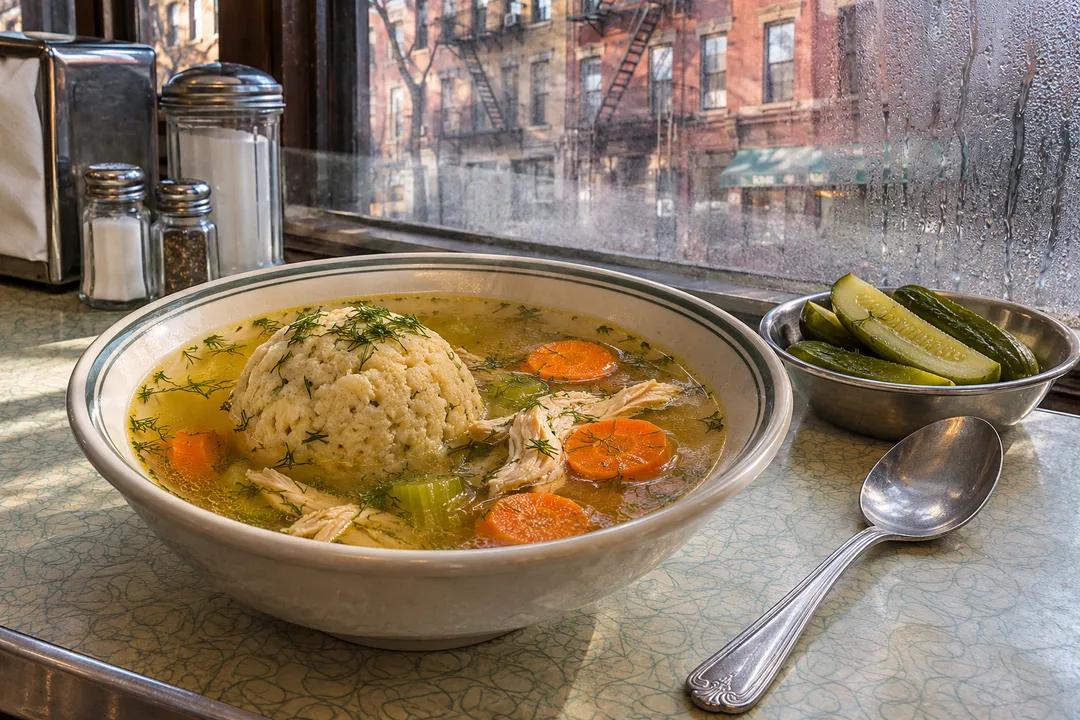
Every serious Lower East Side soup comparison starts with the structural physics of the kneidlach sitting in the center of the bowl. Along the wide, high-ceilinged delicatessen halls near East Houston Street, kitchen crews usually shape mammoth single spheres that rise high above the broth line like pale golden buoys. Those airy floaters get their lift from beaten eggs and carbonated water or baking powder folded gently into coarse matzo meal, creating a porous interior that drinks up hot chicken stock the moment your spoon breaks the surface. When you press the edge of a soup spoon against a classic Houston Street floater, it yields without crumbling and releases a fragrant wave of rendered poultry fat and white pepper.
Walk ten minutes south into the tighter storefronts lining Orchard Street and Grand Street, and the texture often shifts toward smaller, firmer two-ball servings anchored near the bottom of the porcelain dish. Cooks who favor the sinker tradition work extra schmaltz, finely minced yellow onion, and a heavier hand of cracked black pepper into the batter before chilling the mixture thoroughly. Because the dough contains no leavening shortcut, each dumpling simmers into a chewy, savory core that holds its shape even after fifteen minutes in boiling broth. Tasting a fluffy Houston Street cloud immediately before a dense Orchard Street sinker reveals how much the surrounding stock has to adapt: airy balls thrive in clear, delicate golden consomme, while heavy sinkers demand a deeply reduced, collagen-rich pot.
Pay careful attention to the garnish and vegetable cut as well, since those small visual signals tell you how a kitchen treats its stockpot. Traditional countermen ladle broth straight from deep stainless cauldrons where whole hens, parsnips, dill stems, and unpeeled yellow onions have simmered together for hours to create an amber sheen. Some rooms strain the liquid completely clean before dropping in fresh coins of sweet carrot and finely snipped dill fronds at the pass, while others serve a rustic ladleful swimming with tender celery ribs and shredded chicken breast. Watching the counter line for sixty seconds before ordering shows you whether the kitchen keeps the matzo balls warming in a separate pan of weak broth or poaches them directly in the main soup kettle.
Pacing a Two-Stop Soup Route Without Deli Fatigue
Running a multi-stop deli crawl fails the moment someone lets the counter staff talk the table into a mountain of corned beef, potato pancakes, and rye bread at stop number one. To keep your appetite sharp across two or three Lower East Side stops, establish a strict sharing rhythm before you step through the first glass door. For a group of two or three walkers, ordering one large bowl of matzo ball soup with two extra spoons—or asking the server to split a single order into two small cups—delivers the full flavor profile without leaving everyone sluggish from sodium and starch.
Know how the ordering mechanics differ between the neighborhood's old-world ticket halls and its compact modern soup counters. In the cavernous ticket-system rooms, every person crossing the threshold receives a numbered paper slip from a uniformed guard at the door; hang onto that slip even if you only walk up to the soup-and-carving station for a shared bowl and a side of pickles, because you cannot exit without handing every ticket back to the cashier. If your group wants tableside waiter service along the side wall rather than standing at the self-service counter, head straight for the dining rows where servers bring complimentary dishes of briny half-sour and garlicky full-sour pickles the moment you sit down.
Use those crunchy green half-sour pickles and a sip of plain seltzer as your palate reset between stops. Rich poultry broth coats the tongue with rendered schmaltz, which can make your second bowl taste muted if you walk straight from one storefront to the next. Eating a crisp, cold cucumber spear fermented in salt brine without vinegar cuts right through the richness of the chicken fat. If you crave a savory bite alongside your second bowl, skip the full sandwich and split a single square baked potato knish with grainy deli mustard or a small saucer of kasha varnishkes—toasted buckwheat groats tossed with bowtie noodles—so the soup remains the centerpiece of the afternoon.

Walking from Tenement Stoops to Seward Park With Takeout Quart Tubs
What makes the Lower East Side such a rewarding neighborhood for a cold-weather soup walk is the dense architectural narrative connecting the northern and southern stops. After finishing your first hot bowl near the wide avenues around Houston Street, button your coat and turn south down Orchard Street or Allen Street. The wide brick median of Allen Street gives you an open view of the neighborhood's layered immigrant history, while Orchard Street narrows into a canyon of five-story brick tenements crowned with ornate cast-iron fire escapes and cornices. Fifteen minutes of brisk walking past vintage clothing racks, fabric remnants, and narrow synagogue facades warms your hands and builds just enough room for a second round.
If the indoor dining booths look packed during the midday rush, pivot to a smart takeout strategy aimed at the neighborhood's southern green spaces. Seasoned deli regulars never let a counter worker pack hot matzo balls directly inside the liquid broth for a walk longer than five minutes, because the porous matzo meal will sponge up half the stock and turn soft before you reach a bench. Always ask the counter crew to ladle the steaming chicken broth and carrots into the tall plastic quart container while packing the matzo balls dry inside a separate paper pint tub or aluminum tin.
Carry that two-part package down toward the southern end of Orchard and Essex streets, where the grid opens into Straus Square and the historic wrought-iron gates of Seward Park. Resting your bag on one of the wooden benches near the library pavilion or beside the stone fountain lets you drop the matzo ball into the hot broth right before eating, preserving the contrast between the firm outer skin and tender center. Before choosing whether to loop west toward Sara D. Roosevelt Park or head back toward the F, J, M, and Z subway platforms, open the Karpo APP to compare nearby soup counters, check neighborhood walking loops, and line up a final bialy or rugelach stop on your route home.
Ask Karpo for more information.
Keep reading
- Forest Hills Matzo Ball Soup Deli Crawl: Austin St Stops
 Midwood Matzo Ball Soup Deli Crawl: Avenue J Broth Route
 Riverdale Matzo Ball Soup Deli Crawl: Hilltop Broth Walk