The mathematics of avoidance
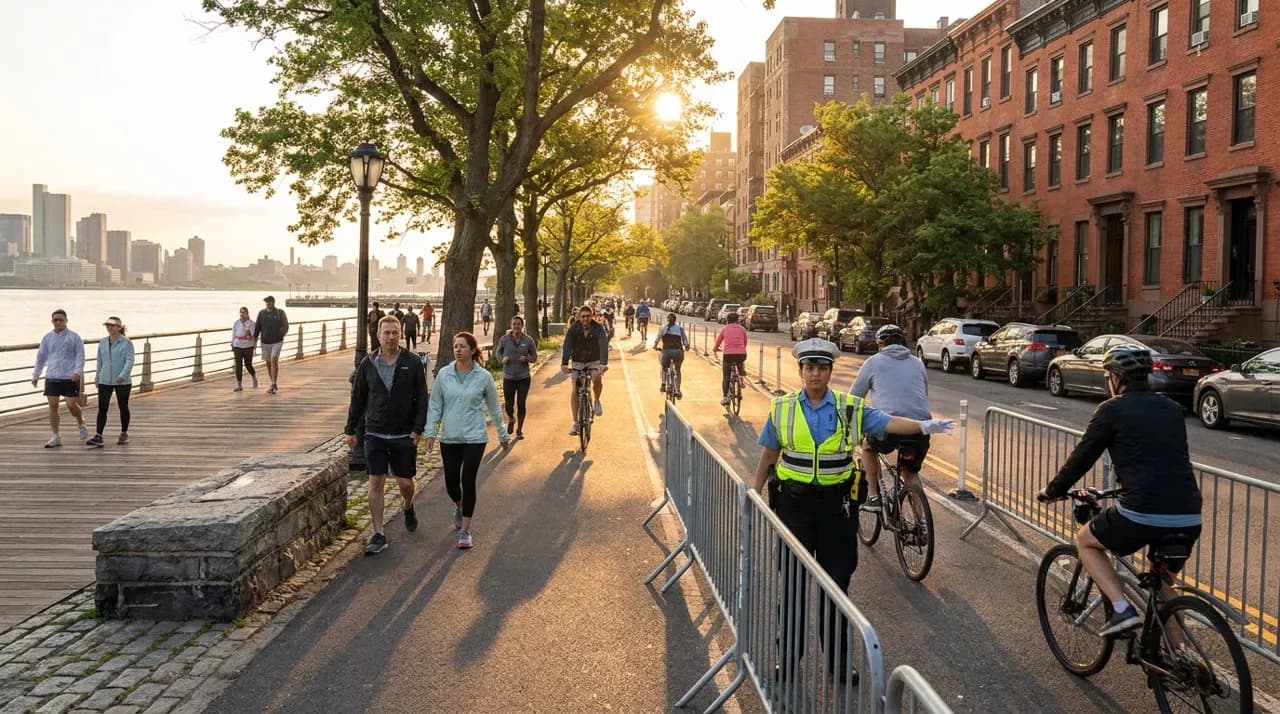
The subway ride from wherever you've been takes twenty-two minutes. The walk through Riverside Park, from the 59th Street entrance near the West Side Highway up to the 103rd Street overlook and back down through the interior pathways, takes roughly ninety. By early June 2026, when sunrise in New York City arrives around 5:25 AM, this arithmetic stops being about efficiency and becomes something closer to emotional calculus. You're not avoiding home exactly—you're postponing the moment when the night officially ends and you have to account for where you've been.
What four miles of Hudson River shoreline provides
Riverside Park stretches from 59th Street to 155th Street along Manhattan's western edge, designed by Frederick Law Olmsted in the 1870s and expanded multiple times since. In early June, the park occupies that perfect weather window—warm enough at dawn that you don't need more than a light jacket, cool enough that the air still has weight and substance. The northern sections, particularly between 96th and 110th Streets, retain elements of Olmsted's original vision: winding paths that deliberately obscure sightlines, creating the illusion of wilderness despite being hemmed in by Riverside Drive traffic above and the Amtrak rails below. The southern stretches, rebuilt in the 1990s and again in the 2010s, offer wider promenades and clearer views across the Hudson toward New Jersey's Palisades cliffs. What matters at dawn is the emptiness. The joggers won't arrive in force until six-thirty. The dog walkers cluster closer to seven. For now, the park belongs to whoever needs it most.
The infrastructure of lingering
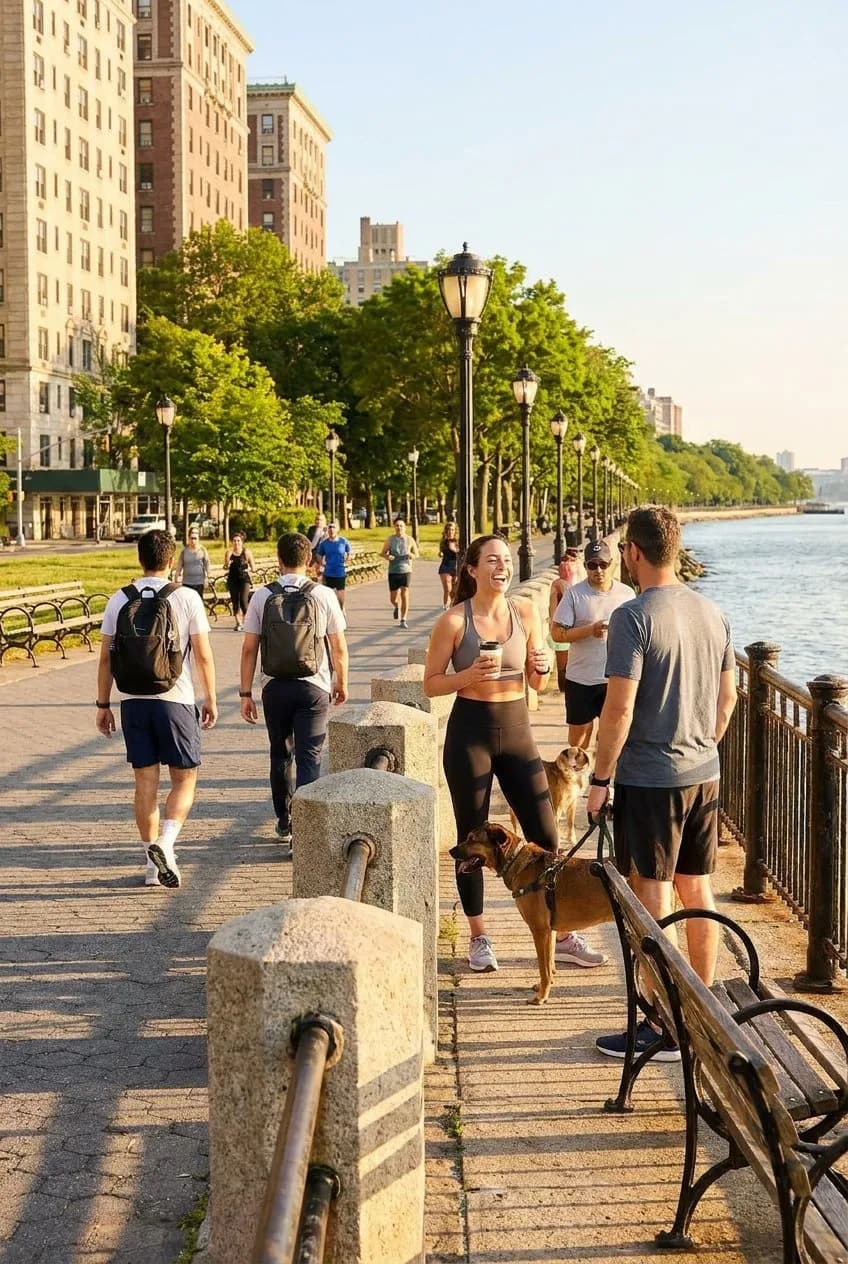
The park offers several legitimate reasons to slow down that don't require explaining yourself. The 79th Street Boat Basin, a rare inland marina on the Hudson, provides a natural waypoint—the floating docks and tethered houseboats create a self-contained village that's been operating since 1937. The Boat Basin Café reopens seasonally, typically in April or May, though dawn arrivals will find it closed; check their current schedule closer to your visit. Further north, the Soldiers' and Sailors' Monument at 89th Street sits atop a small hill, its white marble columned rotunda visible from blocks away. The climb takes four minutes and offers panoramic views south toward Midtown's skyline, particularly striking when early light hits the glass towers. These are socially acceptable pause points—places where sitting on a bench doesn't require justification.
Cherry Walk and the problem of beauty
Between 100th and 125th Streets, Cherry Walk runs along the waterfront, planted with ornamental cherry trees that bloom spectacularly in late April but by early June have settled into anonymous green. This section of the park underwent major renovation completed in phases through 2019, adding wider paths, improved lighting, and better river access. The benches here face west, which means watching dawn requires turning your back to the river and looking east toward the apartment buildings along Riverside Drive. This orientation feels wrong initially—you came to the water, after all—but it's where you'll actually see the light change, catching the moment when the sun clears the buildings and drops golden parallelograms across the pathway. The Japanese flowering cherry cultivars still provide excellent shade canopy regardless of bloom status. Beauty at dawn has a particular problem: it insists on being noticed, which makes it harder to pretend you're just walking through rather than actively hiding.
The practical question of coffee
A ninety-minute park walk generates legitimate caffeine need. Hungarian Pastry Shop on Amsterdam Avenue at 111th Street typically opens at seven-thirty on weekdays, earlier on weekends, serving as the traditional endpoint for morning park walks—verify current hours before counting on it. Alternatively, the stretch of Broadway between 100th and 110th Streets includes several early-opening cafés serving Columbia University students and staff; Floridita Restaurant & Lounge and Le Monde have historically offered early service, though specific hours vary seasonally. The chain locations along Broadway (Starbucks, Dunkin') provide reliable if unremarkable six AM openings. The decision of where to surface from the park back into the city's grid carries weight—it determines whether you're having coffee near home or still maintaining distance, whether you're ready to go back or need another hour. Sometimes the coffee isn't about caffeine at all.
What you can't postpone indefinitely
By seven AM in early June, Riverside Park begins its transformation into a functional urban amenity. The basketball courts near 76th Street fill with morning players. The playgrounds attract early-rising families. The paths accumulate cyclists, runners, people walking with purpose toward actual destinations. The window of anonymity closes. Eventually the long way home delivers you to the same door the subway would have reached ninety minutes earlier, except now you're carrying a different set of variables: the specific angle of light through cherry trees, the temperature gradient between river breeze and city heat, the way perspective shifts when you give yourself permission to take the inefficient route. The apartment looks the same. The keys work the same way. But you've added something to the night that wasn't there before—not an answer exactly, but a better quality of question. Sometimes that's enough reason to take the long way. Sometimes it's the only reason that matters.
Practical notes
Riverside Park is accessible 24 hours, with major entry points at 59th, 72nd, 79th, 91st, 96th, 103rd, 110th, 116th, and 125th Streets from Riverside Drive or via staircases from the Henry Hudson Parkway level. Dawn in early June 2026 occurs between 5:20-5:30 AM; nautical twilight begins forty minutes earlier, providing adequate light for navigation. The park is generally well-maintained and safe, though standard urban awareness applies; the more populated southern sections (below 96th Street) see earlier morning activity. Restroom facilities are limited and seasonally available—the 79th Street Boat Basin and 103rd Street areas have public facilities that may not open until later morning; plan accordingly. The Hudson River Greenway bike path runs through the park; pedestrians should stay alert for cyclists, especially after six AM when bicycle traffic increases. Current weather for June 2026 cannot be predicted—check forecasts closer to your visit. No park entry fee required.
#TheLongWayHome #RiversidePark #NYCParks #DawnWalk #HudsonRiver #ManhattanMornings #UrbanSolitude #CherryWalk #BoatBasin #OlmstedParks #EarlyJune #SunriseWalk #NYCWalking #SlowTravel #MeanderingWithPurpose
Sources consulted: Riverside Park — Wikipedia · Riverside Park — NYC Parks · Frederick Law Olmsted — Wikipedia · Sunrise times — Time and Date · New York region — New York Times
All trademarks are the property of their respective owners.


