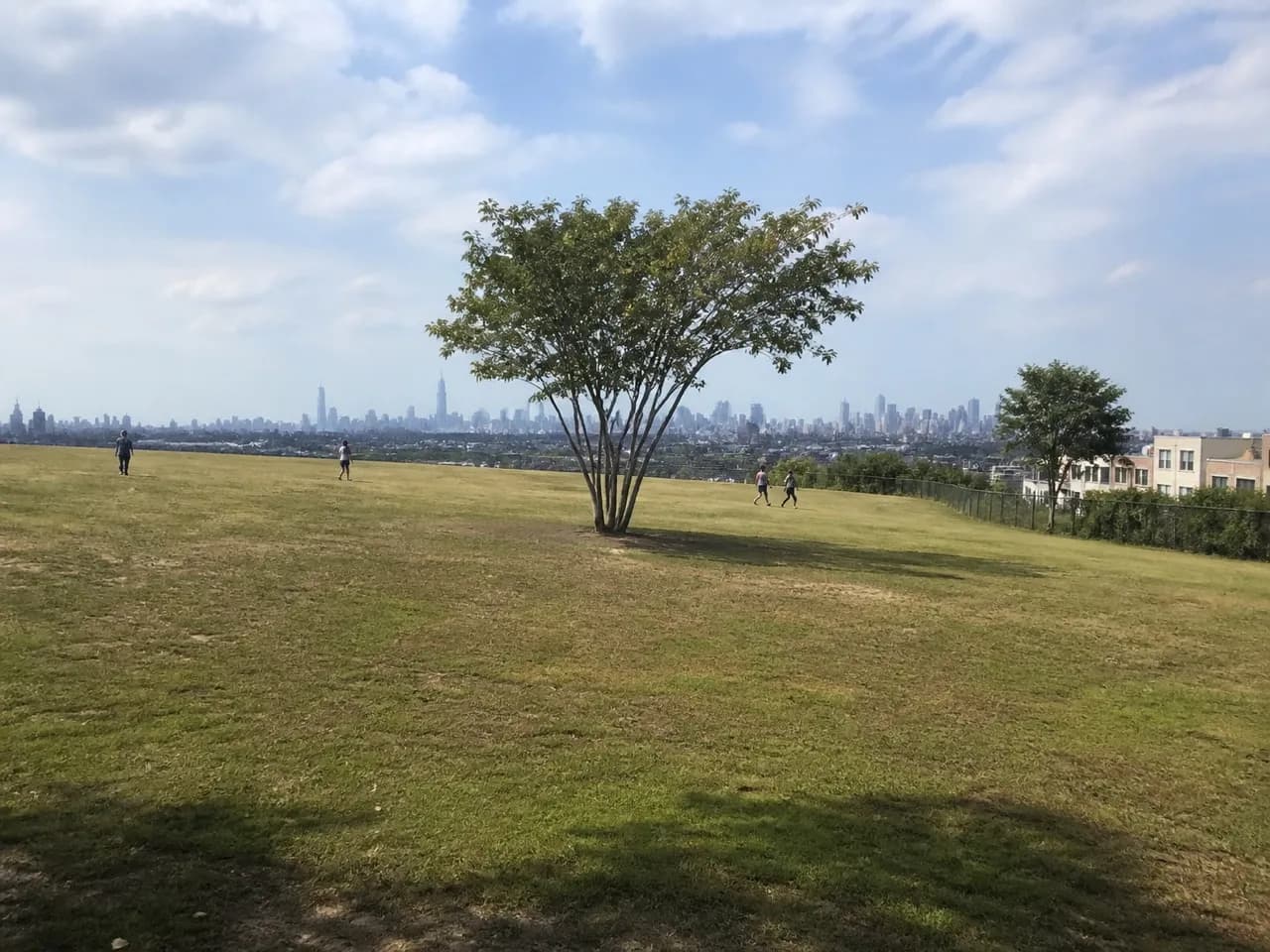
Queens Plaza feels like a place you pass through, not a place you start. The subway station spills you out into a knot of asphalt and overpasses, trucks idling at stoplights, the air thick with diesel and impatience. But if you orient yourself toward the river and head north along Vernon Boulevard, something shifts. The industrial bones remain—warehouses, body shops, storage yards—but the light opens up. By late afternoon in spring, when the sun slants low and softens the corrugated metal and chain-link, the walk becomes a study in contrasts: old Queens and new Queens, grit and glass, the working waterfront and the condo towers that now frame it.
Leaving the Plaza
The first few blocks are pure utility. Vernon Boulevard runs north under the rumble of the Queensboro Bridge, flanked by auto-repair garages and industrial suppliers. The sidewalks are narrow, sometimes cracked, and the traffic moves fast. This is not the picturesque start. But that's the point of the long way home: you earn the view. The neighborhood here is still working—trucks backing into loading bays, welders behind chain-link, the faint smell of machine oil mixing with exhaust.
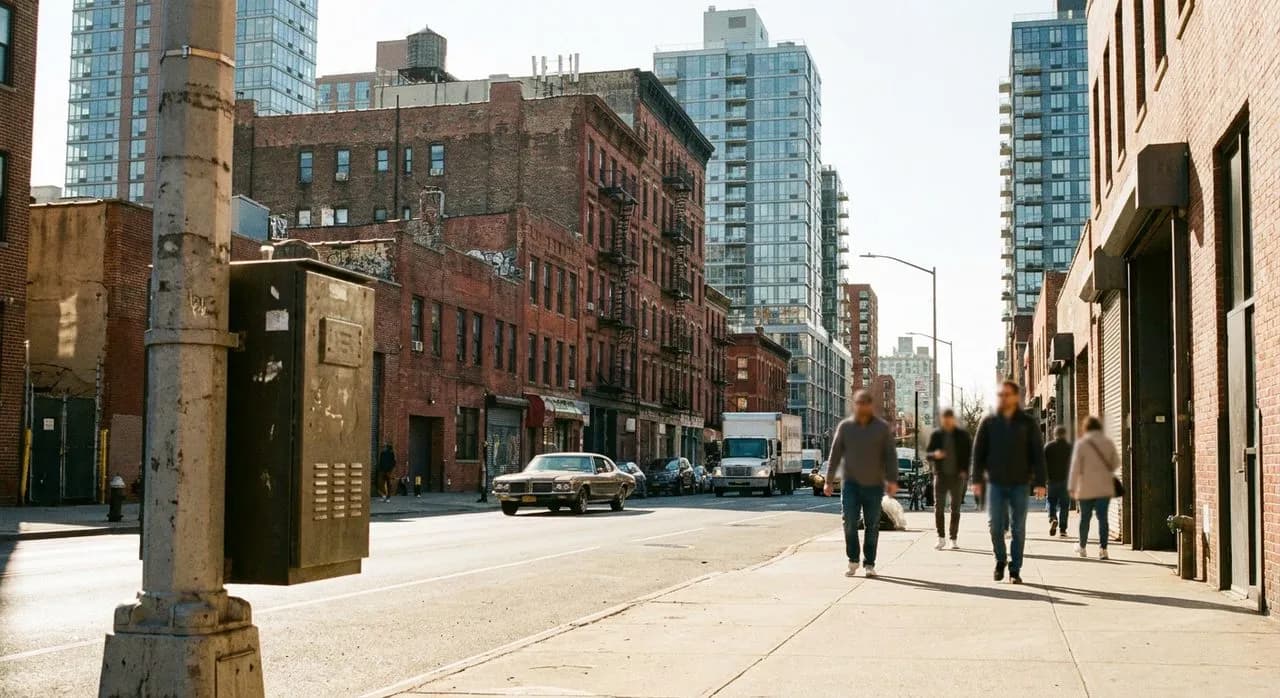
Around 45th Avenue, the streetscape begins to fracture. A new condo tower rises next to a one-story tire shop. A wine bar occupies a ground-floor corner where a locksmith used to be. The sidewalk widens slightly, and you catch your first glimpse of the river between buildings—a sliver of gray-blue water, a suggestion of open space ahead. The rhythm changes. You're no longer just walking away from the subway; you're walking toward something.
Vernon Boulevard's Middle Miles
Between 45th and 30th Avenues, Vernon settles into an uneasy truce between industrial holdouts and residential newcomers. The condo towers multiply—brick and glass mid-rises with names that promise waterfront living, ground-floor retail still half-empty. But the garages persist, and so do the corner bodegas and the occasional diner with Formica booths visible through streaked windows. The sidewalk is yours, mostly. A few dog-walkers, a cyclist weaving around parked trucks, someone wheeling a grocery cart home.
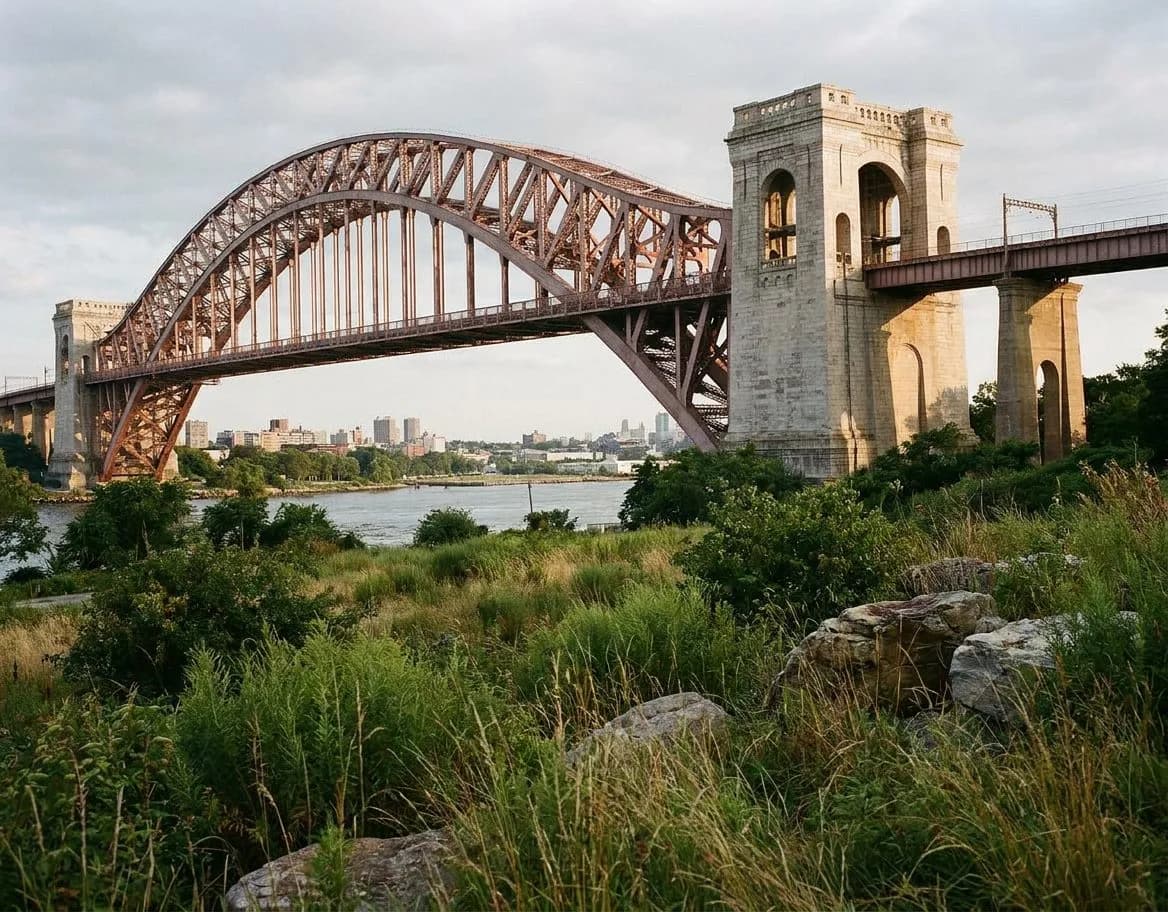
The river stays intermittent, appearing in narrow sightlines where side streets dead-end at the water. You glimpse the Manhattan skyline across the East River, the Midtown towers catching the late-afternoon sun. Closer, on Randall's Island, you can make out the Hell Gate Bridge's steel arch, rust-red and massive, a relic of an earlier industrial era that somehow looks more permanent than anything built since. The views are partial, interrupted—this isn't a waterfront promenade yet, just a city street that happens to run near water.
The Turn Toward Astoria Park
Around 30th Avenue, Vernon Boulevard curves slightly west, and the park begins to announce itself. The buildings pull back. Trees appear—London planes and oaks, their May leaves still bright green and glossy. The traffic noise recedes, replaced by the softer sounds of the park: kids on bikes, the distant thwack of a tennis ball, the low hum of conversation from benches facing the water. The air feels different here, cooler, touched by the river breeze.
Astoria Park unfolds gradually. You enter along its southern edge, where the athletic fields stretch out behind chain-link fencing and the WPA-era swimming pool—a massive public complex from the 1930s—sits closed until summer. The pool is a neighborhood landmark, all Art Deco lines and pale tile, big enough to host serious swim meets and summer throngs. In late May it's still empty, but you can feel its presence, the promise of what's coming. The park is waking up after a long winter.
The Waterfront Benches
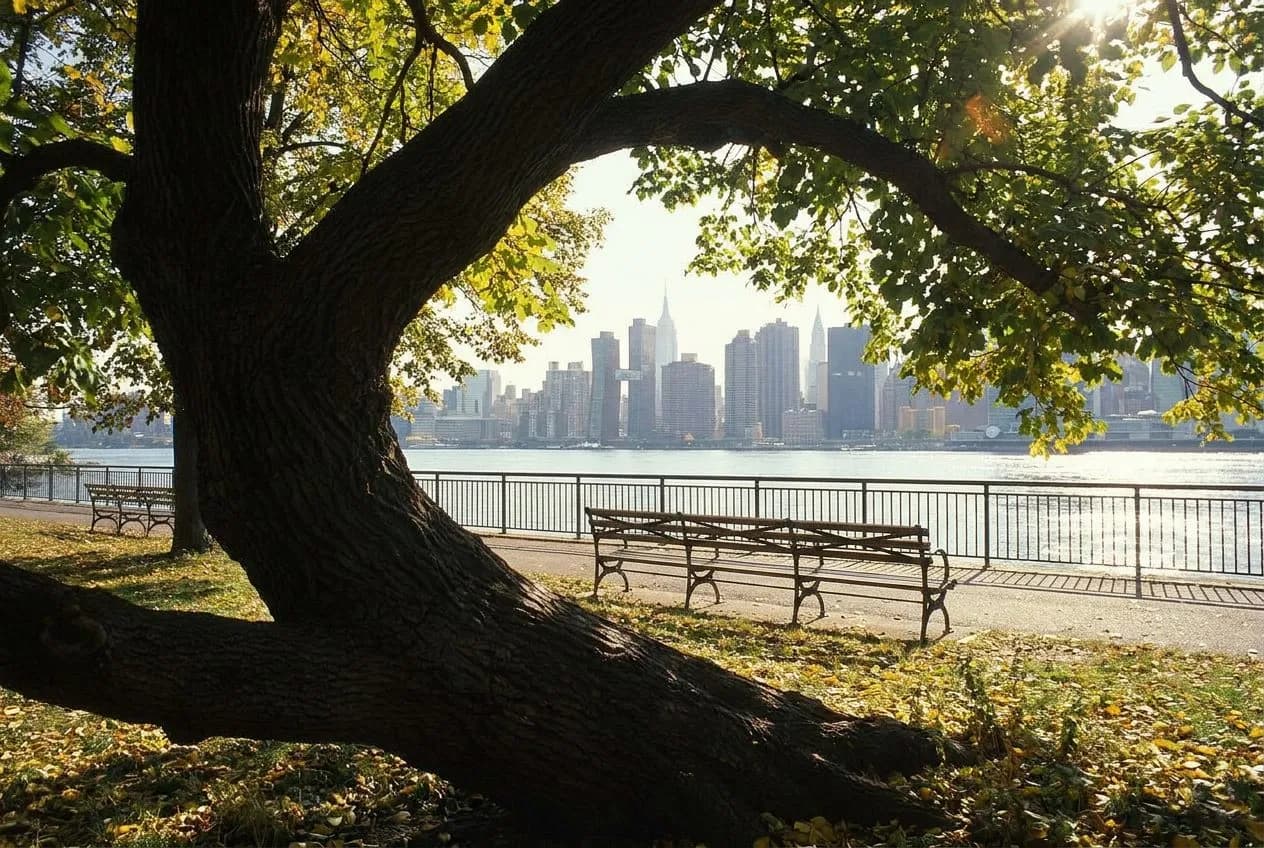
The park's real gift is its western edge, where a paved path runs along the East River and a long line of benches faces the water. This is where the walk pays off. The Hell Gate Bridge dominates the view to the north, its span so wide and heavy it seems to bend the sky around it. Trains cross it periodically, freight mostly, their slow rattle audible even from the benches. Below the bridge, Randall's Island sits green and oddly remote, separated from the city by a narrow channel that feels wider than it is.
The Manhattan skyline spreads south, a familiar silhouette softened by distance and the haze that rises off the water in warm weather. The light in late afternoon is forgiving, blurring the industrial remnants on both shores—the power plants, the old warehouses—into something almost picturesque. People claim benches and settle in: runners cooling down, mothers with strollers, older men reading newspapers in languages other than English. Everyone faces west, watching the light change.
The Loop Back via 31st Street
When you're ready to leave, exit the park at its southern end and head east on Ditmars Boulevard or 31st Street. This is Astoria proper, dense and lived-in, the sidewalks crowded with Greek bakeries, cafés, and corner tavernas that have been here for decades. The neighborhood smells like coffee and charcoal and something sweet from the pastry shops. You can stop for a coffee, or a slice of baklava, or a cold beer at one of the old-school spots where the décor hasn't changed since the 1980s.
The walk back is shorter, more direct, but it completes the circuit. You've gone from the hard edges of Queens Plaza to the open water of Astoria Park and back into the dense fabric of the neighborhood. It's a route that shows you the layers—industrial, residential, recreational—all pressed together in a way that only makes sense on foot. The train is always close, waiting to carry you back, but there's no reason to rush. This is Queens at its best: unshowy, functional, and quietly generous with its views.
Practical notes
Start at Queens Plaza station (E, M, R trains) at Queens Plaza and Queens Boulevard; walk north on Vernon Boulevard for roughly two miles. Astoria Park fronts the East River and is generally bordered by 19th Street, Ditmars Boulevard, and adjacent neighborhood streets. The walk takes forty-five minutes at a steady pace, longer if you stop for photos or benches. The park is open dawn to dusk year-round; the public pool operates seasonally in summer; confirm current opening dates and hours with NYC Parks—confirm hours with NYC Parks. Sidewalks are mostly level but narrow in industrial stretches; some curb cuts are uneven. Bring water, comfortable shoes, and sunscreen. Street parking is available but competitive; bike racks are scattered throughout the park. For the return loop, head east on Ditmars or 31st Street to reach the N, W trains at Astoria–Ditmars Boulevard station.
Tags: #TheLongWayHome #AstoriaQueens #QueensWaterfront #EastRiverWalk #NYCWalking #AstoriaPark #QueensPlaza #HellGateBridge #NYCParks #UrbanHiking #SpringInNYC #QueensNeighborhoods #WalkableNYC #CityWalks #NYCSpring2026
Sources consulted: Astoria Park - Wikipedia · Hell Gate Bridge - Wikipedia · Astoria Park - NYC Parks · Queens Borough President · Astoria - Time Out New York
All trademarks are the property of their respective owners.