Start at the corner of Orchard and Houston just as the sun drops behind the old tenements. The light at this hour turns everything warm and forgiving—even the graffiti-tagged shutters and the crooked fire escapes look like they're posing for a postcard. This is the beginning of a walk that covers barely a mile but moves through decades of New York in thirty minutes. You'll cross from the vintage-shop stretch of Orchard into the narrow arteries of Chinatown, watching the language on the awnings change from English to Cantonese, the smell of coffee giving way to roast duck and incense. Late May means the humidity is just arriving, the kind that makes the air feel close and alive, and by the time you reach Doyers Street the restaurant signs will be glowing against a purple sky.
Orchard Street at the Golden Hour
Head south on Orchard and let the rhythm settle in. The storefronts here toggle between the carefully curated and the delightfully scruffy—vintage denim boutiques next to luggage wholesalers that haven't changed their window displays since 1987. The sidewalk is narrow, so you'll be dodging other pedestrians and the occasional produce crate parked outside a corner grocer. This stretch has been gentrifying in slow motion for two decades, but it still holds onto enough grit to feel real.
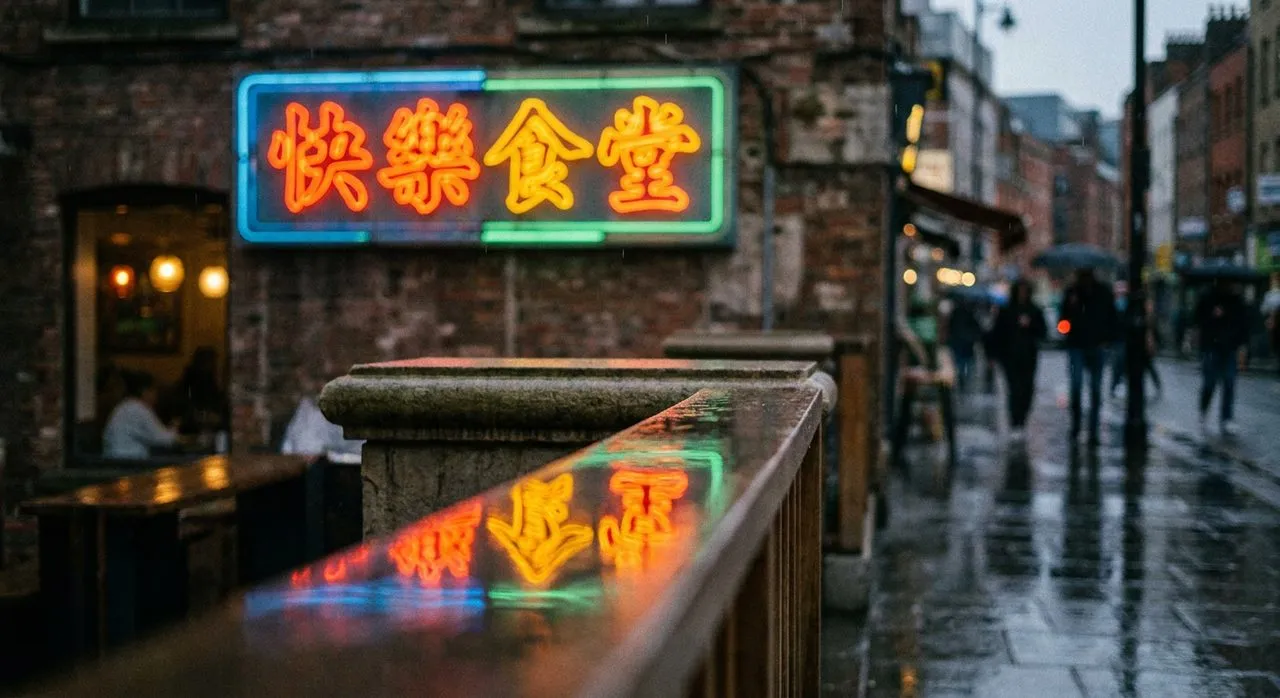
Notice the cast-iron columns, the faded painted ads on brick walls advertising long-gone tailors and haberdashers. The tenement facades are mostly intact, their cornices and lintels restored just enough to keep the buildings standing but not so much that they lose their worn-in character. By late afternoon in May, the light rakes across these surfaces at a low angle, picking out every texture. If the pavement is damp from an earlier shower, the reflections double everything.
The Zigzag Through Hester
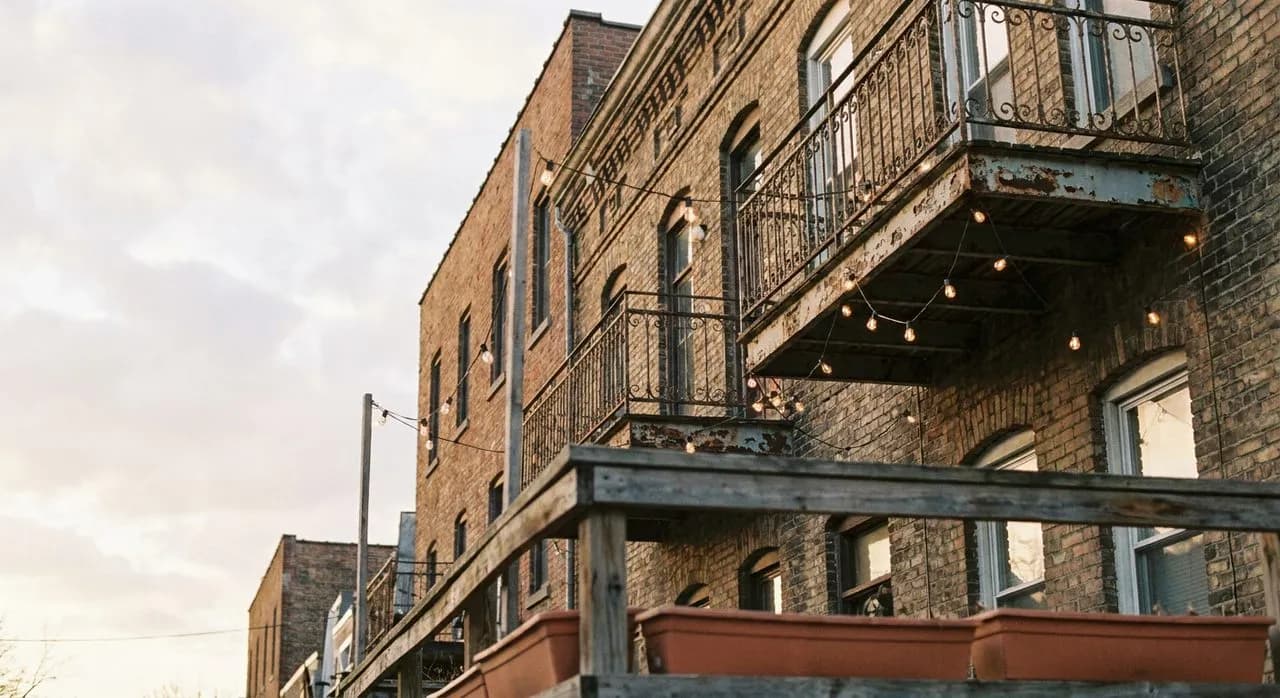
At Hester Street, jog east. The street narrows and the tempo changes. You're leaving the curated vintage district and entering a more residential pocket where laundry hangs from balconies and elderly women sit on folding chairs outside their buildings, watching the evening unfold. The sidewalks here are uneven—old Belgian block peeking through patches of asphalt—and the curbs are low, almost flush with the street, a remnant of an era when horses and carts needed gentle transitions.
Hester has always been a seam between neighborhoods, a street that belongs to no single identity. You'll pass small Puerto Rican bodegas, then a kosher bakery, then a storefront with a hand-lettered sign in Mandarin. The mix is not picturesque; it's functional, the product of a century of waves arriving and overlapping and making do. Keep your eyes up—the second-floor windows often tell the real story. Curtains, potted herbs, a string of prayer flags, a window-unit air conditioner duct-taped into place.
Eldridge Street and the Synagogue
Turn south on Eldridge and you'll see it immediately: the Eldridge Street Synagogue, a brick and terra-cotta confection with a rose window that could belong to a small European cathedral. Built in 1887, it's one of the first great synagogues erected by Eastern European Jews in America, and it stands as a quiet rebuke to anyone who thinks this neighborhood's history is simple. The building was abandoned for decades, then meticulously restored. You can pay to tour the interior during the day, but from the street at dusk the facade alone is worth the detour.
The block around the synagogue is mostly residential now, low-rise brick buildings with shops at street level. There's a particular quality to the light here as the sun sets—something about the narrow street and the height of the buildings creates a canyon effect, and for a few minutes the whole block glows amber. Stand still for a moment and listen: the hum of distant traffic on Canal, the clatter of a rolling gate being lowered, someone's radio playing Cantonese opera from an open window.
Crossing Into Chinatown Proper
Continue south and then angle west toward Canal. You'll know you've crossed an invisible border when the signs switch alphabets and the sidewalk vendors appear. Canal at dusk is a sensory carnival—stalls selling knock-off handbags and phone cases, steamer trays of buns in storefront windows, the smell of frying scallion pancakes mixing with diesel exhaust from the trucks double-parked in the bus lane. It's chaotic and glorious and utterly unapologetic.
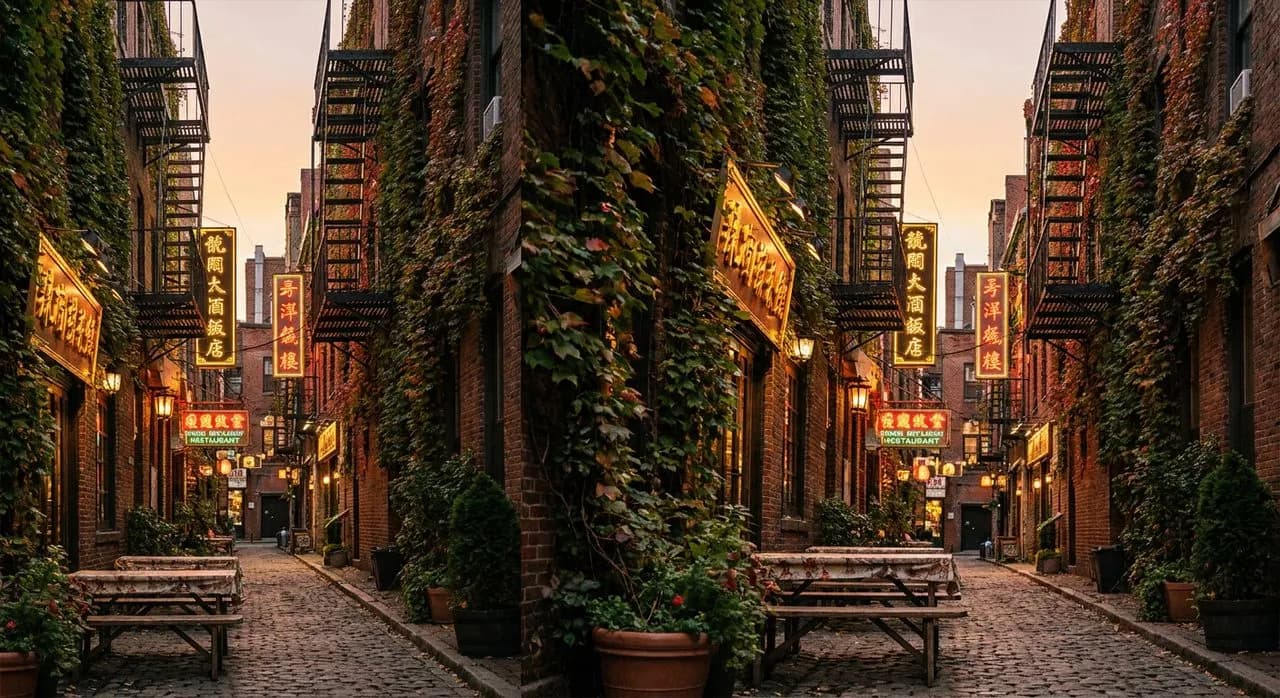
This is not the Chinatown that tour groups see during the day. The dinner hour brings a different crowd: families heading to their favorite noodle shops, older men carrying plastic bags of groceries, teenagers on scooters weaving through the foot traffic. The neon signs are starting to flicker on—red and green and gold characters advertising roast duck, dim sum, herbal medicine. If you've timed it right, the sky is deepening to indigo and the streetlights are just warming up, and for a few suspended minutes the neighborhood exists in two kinds of light at once.
Doyers Street and the Bend
From Canal, head south into the tangle of streets that make up Chinatown's historic core. Pell Street is one block south, and just off it you'll find Doyers, the narrow, sharply angled alley that once earned the nickname "the Bloody Angle" for the gang violence that erupted here a century ago. Today it's lined with restaurants and barber shops, and the bend in the street creates a stage-set effect—you can't see what's coming until you're right on top of it.
Stand at the corner of Doyers and Pell as the lights come fully on. This is your finish line. The restaurant signs glow in saturated colors, their reflections pooling on the pavement if it's rained. Steam rises from a basement vent, smelling of ginger and star anise. A waiter props open a door and a gust of warm, fragrant air spills onto the sidewalk. You've walked one mile and moved through a dozen versions of New York, and now the city is offering you dinner.
Practical Notes
Start at the intersection of Orchard Street and East Houston Street. The nearest subway is the F/M at Delancey Street–Essex Street (or the F at East Broadway) or the B/D at Grand Street (south on Chrystie). Street parking is scarce and metered; consider public transit. The walk covers roughly one mile and takes thirty to forty minutes at a leisurely pace. The route is mostly flat and the sidewalks are paved, though some blocks have uneven surfaces; standard city footwear is fine. The Museum at Eldridge Street (12 Eldridge Street) offers docent-led tours, but verify hours directly if you plan to go inside. Bring a light jacket in May—the temperature drops quickly after sunset—and a phone or camera if the pavement is wet and the reflections are good. The walk is best Thursday through Sunday evenings when the neighborhood is most alive, though weeknights have their own quieter charm.
Tags: #TheLongWayHome #LowerEastSide #Chinatown #NYCWalks #DuskWalks #OrchardStreet #DoyersStreet #EldridgeStreetSynagogue #CityWalking #NeighborhoodWalks #NYCSpring2026 #UrbanExploration #ManhattanWalks #KarposFinds #NYCAtDusk
Sources consulted: Lower East Side · Chinatown, Manhattan · NYC Landmarks Preservation Commission · Time Out New York · New York Times NY Region
All trademarks are the property of their respective owners.