Why the long way matters in 2026
New York has always moved fast, but by 2026, the city's tempo has reached a peculiar pitch. We optimize every commute, track every step, route ourselves through algorithms that promise efficiency. Yet something gets lost in all that optimization—the texture of a neighborhood after dark, the conversation that happens when you're not rushing, the way a familiar skyline looks unfamiliar from a different angle. This walk from Battery Park to the Brooklyn Bridge isn't about fitness tracking or sightseeing. It's about reclaiming the space between departure and arrival, the moments we've been trained to minimize.
Starting point: Battery Park's winter quiet
Battery Park after dark in winter is a different proposition than its summer self. The seasonal crowds have thinned, the ferry tourists have caught their last boats, and what remains is locals cutting through and the occasional contemplative soul drawn to where the island ends. The Sphere sculpture—Koenig Sphere, restored after its World Trade Center displacement—sits in its dignity, often with only the wind for company. The promenade along the water offers unobstructed views of the Statue of Liberty's floodlit silhouette and the twinkling sprawl of New Jersey's Gold Coast. On clear nights, the cold sharpens everything into high contrast. Start here not because it's convenient, but because beginning at the island's southern tip reminds you how much city lies ahead. The SeaGlass Carousel, located within the park, typically operates seasonally—check NYC Parks for current winter hours before planning your route around it. This isn't a park that demands your attention; it simply offers space, which in Manhattan is its own kind of generosity.
Through the Financial District's empty canyons
Moving north and east from Battery Park, you enter the Financial District's nighttime transformation. The towers that pulse with anxiety during market hours stand quiet, their lobbies glowing but empty. Stone Street—one of New York's oldest streets—shifts from its daytime tourist energy to something more subdued, though a few stalwart bars and restaurants maintain evening service; verify specific venues and hours closer to your visit. The neighborhood's architectural layers become more apparent without the distraction of crowds: Federal-style rowhouses pressed against glass modernist slabs, the old Custom House's Beaux-Arts grandeur holding its ground against surrounding verticality. Walk east on Pearl Street or south on Water Street, and you're tracing routes that predate the street grid, following the island's original waterfront before landfill extended Manhattan's reach. The occasional bar spills warm light and conversation onto the sidewalk—establishments like The Dead Rabbit or Stone Street Tavern have maintained consistent presences in this area, though operating hours vary seasonally. The point isn't to stop, necessarily, but to note these pools of warmth as you pass.
South Street Seaport's liminal hours
The South Street Seaport exists in perpetual transition, always being reimagined, never quite settled. By 2026, the area continues balancing its historic maritime identity with contemporary commercial ambitions. At night, this tension becomes atmospheric rather than frustrating. Pier 17's rooftop may be closed depending on season and weather, but the structure itself—jutting into the East River—creates interesting sightlines back toward the Brooklyn and Manhattan Bridges. The cobblestoned streets around Fulton and Front Streets retain their 19th-century proportions even as the buildings cycle through renovations. The historic tall ships docked at the museum piers rest quiet in their slips. If you time it right on certain evenings, you might catch Fulton Stall Market's extended hours or a late-service restaurant, but verify schedules as the Seaport's offerings remain somewhat fluid. What's reliable is the river itself, the way the East River's tidal currents catch city light, the particular smell of cold water and old pilings, the sense of standing at an edge.
The approach to Brooklyn Bridge
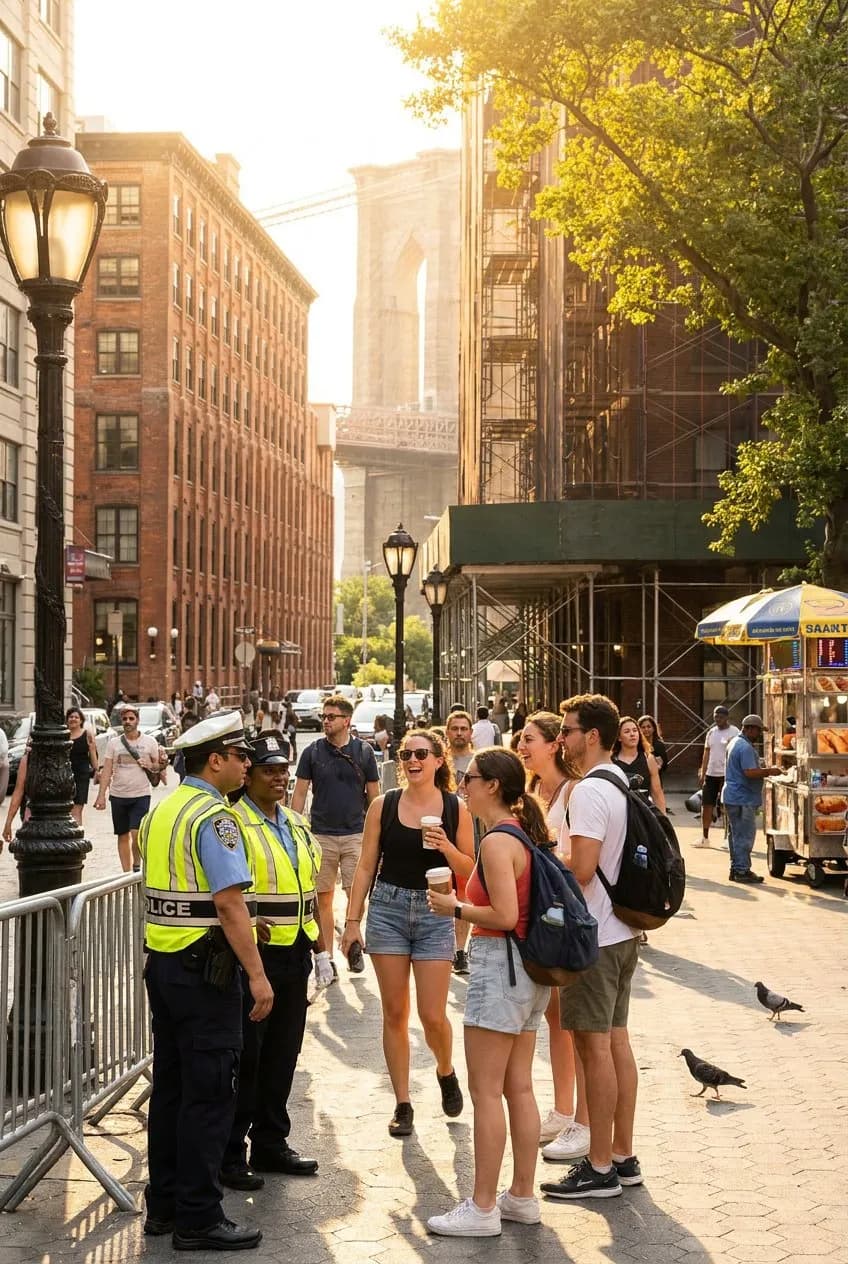
The pedestrian entrance to the Brooklyn Bridge walkway sits at the intersection of Frankfort Street, Park Row, and Centre Street—a convergence that feels appropriately ceremonial for what you're about to cross. By night, especially midweek in winter, the bridge sheds much of its daytime tourist density. You'll share the wooden planks with dedicated commuters, evening joggers undeterred by cold, and fellow wanderers who've also chosen the long way. The bridge itself, completed in 1883, presents differently in darkness. Its Gothic tower arches frame the lit skyline rather than blue sky, the suspension cables create geometric patterns against city glow, and the experience becomes less about the bridge as landmark and more about the bridge as threshold—suspended between boroughs, between the day you've finished and the evening that remains. The Manhattan skyline to your right, Brooklyn's lower-rise sprawl ahead, the dark water below: all the elements that make New York itself, arranged in their essential relationships.
Why walking matters more than arriving
There's a particular clarity that comes from walking alone through a city at night, especially in winter when the cold keeps you alert and moving. This route from Battery Park to Brooklyn Bridge—roughly two miles if you walk directly, longer if you allow yourself to wander—offers something increasingly rare in urban life: unstructured time in public space. You're not consuming anything, not performing for social media, not even explicitly exercising. You're simply moving through the city at human speed, which allows you to notice what faster transit obscures. The way neighborhoods shift block by block. The smell of subway exhaust mixing with river air. The particular echo of your footsteps on different street surfaces. These aren't monumental observations, but they accumulate into a felt sense of place that no amount of efficient commuting can provide. By the time you reach the Brooklyn side—whether you continue into DUMBO, Vinegar Hill, or catch transit from there—you've earned the satisfaction that comes not from arrival but from the journey itself. The long way home turns out to be the point.
Practical notes
Distance and duration: Battery Park to Brooklyn Bridge pedestrian entrance is approximately 1.5 miles, taking 30-40 minutes at a moderate pace without stops; add time for wandering. Seasonal considerations: Winter walks require layered clothing, good gloves, and awareness that waterfront wind significantly drops perceived temperature; dress warmer than you think necessary. Safety and lighting: This route follows well-lit, generally populated streets; the Financial District quiets considerably after business hours, but major through-streets maintain activity; standard urban awareness applies. Brooklyn Bridge access: The pedestrian walkway is accessible 24/7 and well-lit, though it can be windy; note that cyclists share the path, so stay in marked pedestrian lanes. Rest stops and facilities: Public restrooms are limited along this route—Battery Park has facilities near the ferry terminals (hours vary), and the Seaport area has commercial options during business hours; plan accordingly. Transit connections: Multiple subway lines serve the Brooklyn Bridge-City Hall area on the Manhattan side and DUMBO/Brooklyn Bridge on the Brooklyn side; check MTA for current schedules as service adjustments continue through 2026. Verify all specific venue hours, seasonal schedules, and facility availability closer to your planned walk.
Tags: #TheLongWayHome #NYCNightWalk #BatteryPark #BrooklynBridge #LowerManhattan #FinancialDistrict #SouthStreetSeaport #WinterWalking #UrbanExploration #NYCAfterDark #ManhattanWalks #SlowTravel #CityWalking #NYC2026 #EastRiver
Sources consulted: Battery Park — NYC Parks · Brooklyn Bridge — Wikipedia · Brooklyn Bridge — NYC DOT · MTA Transit Information · Lower Manhattan — Wikipedia
All trademarks are the property of their respective owners.