 SoHo Tailor Alteration Shop Finder for Sample Sale Finds
Neighborhood Guides
Lower Manhattan Historic Walking Route: Eight Outdoor Stops
Walk through colonial New York on a self-guided historic trail connecting Bowling Green, Fraunces Tavern, and Alexander Hamilton's grave at Trinity Church.
Lower Manhattan rewards a walk that distinguishes surviving objects from remembered events. This historic walking route starts at Bowling Green and follows eight outdoor stops: the park and its fence, the Custom House exterior, Fraunces Tavern exterior, Stone Street, Federal Hall exterior, Trinity Church, Saint Paul's Chapel, and City Hall Park. The route is free to follow from public streets. Museum interiors, churchyards, and building visits are optional and have their own access arrangements. Arrive by subway at Bowling Green or South Ferry and start with the park rather than trying to cross every landmark off a list. The streets bend around small blocks, and the changing relationship between older facades and much taller buildings is part of the experience. Keep the eight stops in order, but give yourself permission to shorten the walk after Wall Street if concentration or energy runs low.
Bowling Green and Dutch Colonial Foundations
Bowling Green makes a useful first lesson in separating an object from the story told around it. The Landmarks Preservation Commission dates the surviving fence to 1771. A crowd pulled down the equestrian statue of George III in July 1776, while the fence lost its decorative crowns. Those are related events involving different materials. The lead statue supplied metal for ammunition; the missing iron ornaments should not be credited with a particular musket-ball total. Look at the fence from the path without touching or climbing it, then compare the small enclosure with the much larger Custom House beyond. The LPC fence report is a useful background reading for this distinction. Treat the Custom House as the second exterior stop. Its monumental scale changes the question from revolutionary protest to the later civic architecture of trade and government.
Fraunces Tavern and Washington's Farewell
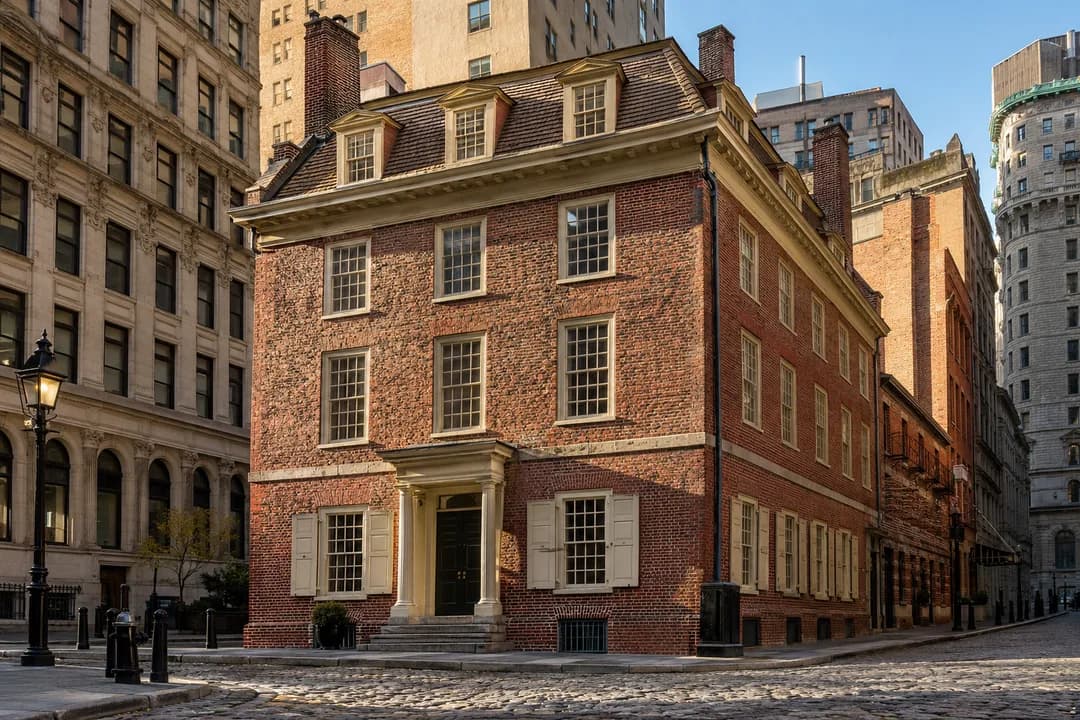
Leave Bowling Green via Broadway and use Beaver Street and Broad Street to reach Pearl Street and the Fraunces Tavern exterior. Its institutional history dates the original building to 1719 and Samuel Fraunces's purchase to 1762. Washington's farewell to his officers took place here in December 1783. The museum's own history offers a firmer starting point than an unsupported tale about every secret meeting that supposedly happened inside. From the pavement, examine the relationship between the low building and its neighbors. The building has a restoration history as well as a revolutionary one, so the present exterior should not be treated as an untouched scene from Washington's lifetime. This itinerary includes an outdoor pause here. An upstairs museum visit is a separate choice and can change the length and cost of the day. Leave space in your notes for what the street shows and what a historical source supplies.
Stone Street Cobblestones and Federal Hall
From Pearl Street, use Broad Street to reach the Stone Street pedestrian section. This is the fourth stop, a place to notice the lane's scale and paving rather than assume every stone and facade is colonial fabric. Continue along William Street to Wall Street, then turn west toward Federal Hall at Nassau Street. The current building and the earlier City Hall on the same site belong to different periods. Washington's 1789 inauguration took place at the earlier building, not inside the Greek Revival structure now facing Wall Street. For this walk, view the statue and facade from the street. The National Park Service visitor page identifies the visitor entrance on Pine Street; the monumental front steps should not be presented as an interior-entry instruction. An optional indoor visit needs its own place in the plan. An early start to the street walk does not imply that this or any other building admits visitors at that time.
Trinity Churchyard and Hamilton Gravesite
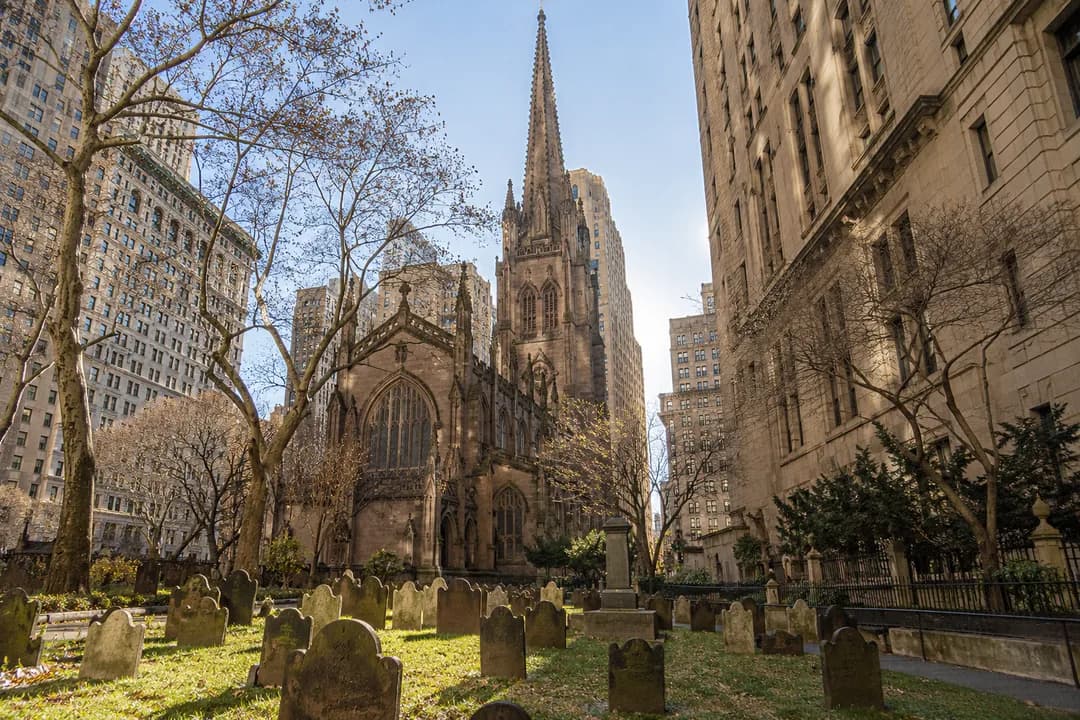
Walk west along Wall Street toward Trinity Church at Broadway. Its spire gives the street a strong visual endpoint, and the churchyard introduces a quieter scale beside the surrounding towers. The present church is the nineteenth-century successor to earlier buildings on this site. Keep that distinction in mind when reading about the parish's much older history. Hamilton's grave is a reason many people add a churchyard visit, but this route does not depend on access to the grounds or sanctuary. If a gate is closed, observe the exterior from the public sidewalk and continue. Avoid describing a worship space as continuously available sightseeing space. At this stop, compare the vertical lines of the spire with the rooflines around it, then look at the setback between church and pavement. A brief observation can be useful without turning every architectural feature into a claim about its precise date or original purpose.
Saint Paul Chapel and City Hall Historic Park
Continue north along Broadway to Saint Paul's Chapel, then carry on toward City Hall Park. These are the final two stops. The chapel offers another opportunity to distinguish the age of a congregation, the age of a building, and later events associated with it. Its survival and its role after September 11 are different chapters of the site's history. Treat interior displays as an optional extension rather than promise particular objects will be visible. At City Hall Park, end with a comparison of civic space: Bowling Green was a small enclosed starting point, while this park opens a different relationship between paths, public buildings, and surrounding streets. Look back at the sequence you have just walked. It links places connected with government and public memory across several periods, rather than reconstructing a single revolutionary day. That makes it easier to separate an eighteenth-century event from a nineteenth-century monument commemorating it.
Practical Walking Tips and Route Planning
Allow a flexible half day if you want to linger, with less time for an exterior-only version and more for any separately arranged museum visit. This is a walking plan rather than a measured accessibility survey. Stone paving, narrow passages, busy crossings, and street works can all affect the pace. Carry water and choose a rest point before fatigue makes the decision for you. After Federal Hall, continuing to Trinity is a simple shorter finish. The full version continues north to the chapel and park. Bring a street map for the small Lower Manhattan blocks, and cross at marked crossings rather than follow a diagonal line on a screen. In the Karpo APP, describe your neighborhood, companions, budget, and interest in early civic history to ask for suitable places and plans. The two images accompanying this guide are AI-generated illustrations, not documentary photographs or evidence of current building access.
Ask Karpo for more information.
Keep reading
- SoHo Tailor Alteration Shop Finder for Sample Sale Finds
 Williamsburg Tailor Alteration Shop Finder for Bike Riders
 Upper West Side Tailor Alteration Shop Finder for Kids