 SoHo Tailor Alteration Shop Finder for Sample Sale Finds
Neighborhood Guides
Washington Square Historic Plaza Walk: Village Route
Explore Greenwich Village on this historic plaza walk around Washington Square Park. Use the Karpo APP to find marble arches, folk heritage, and shady paths.
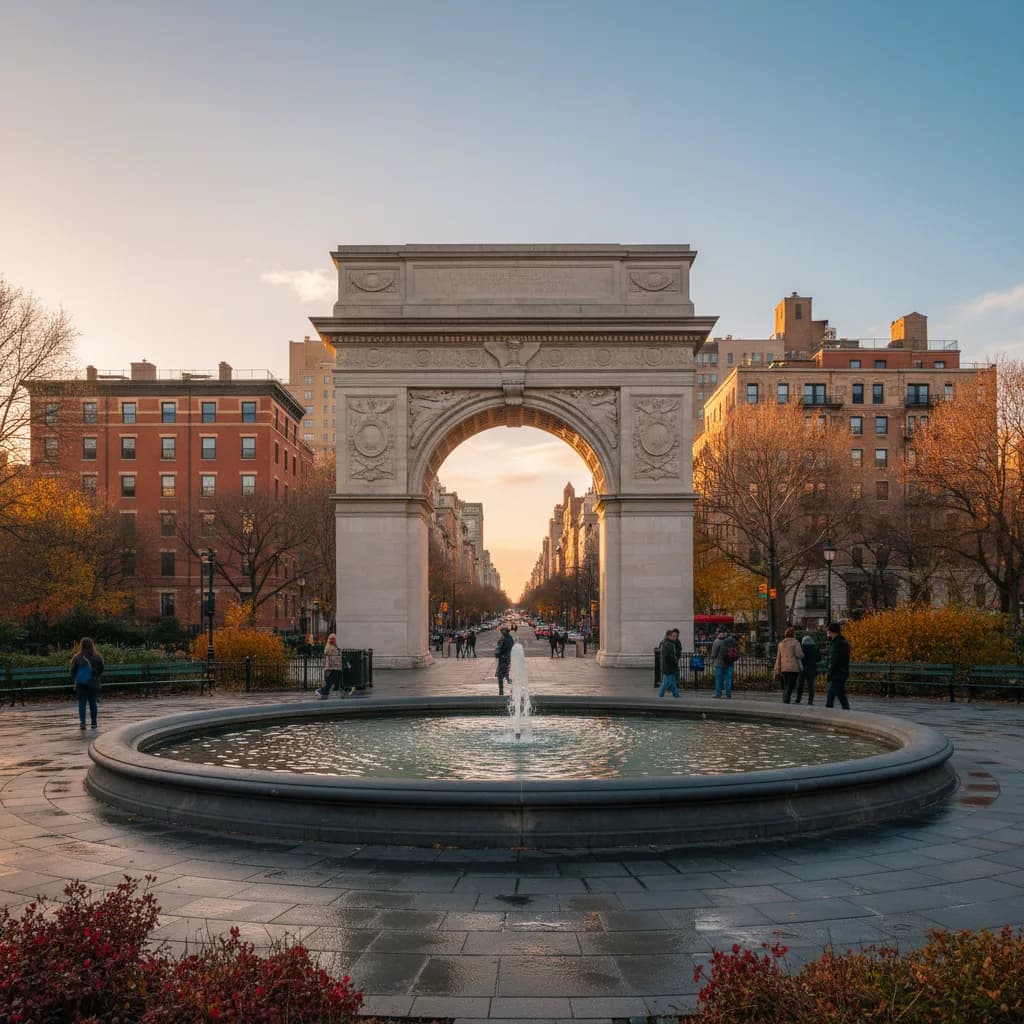
Washington Square Park forms the cultural nucleus of Greenwich Village, occupying the historic verdant grounds where Fifth Avenue terminates against marble monumental masonry. Established formally as a public park in 1827 after decades serving as farm fields and a municipal burial ground, the grounds evolved into a focal theater for Bohemian literature, folk music revivals, and neighborhood civic activism. This historic plaza walk guides pedestrians beneath monumental triumphal stonework, around an active granite fountain plaza, and along tree-shaded promenades rich in architectural pedigree.
Stanford White's Triumphal Arch and Marble Iconography
Arriving at the northern threshold introduces walkers to the iconic Washington Square Arch, designed by renowned Gilded Age architect Stanford White of McKim, Mead & White. Originally erected in 1889 as a temporary wood-and-plaster arch celebrating the centenary of George Washington's presidential inauguration, public admiration spurred the commission of a permanent monument. Completed in 1892 in brilliant Tuckahoe white marble and formally dedicated in 1895, the triumphal arch rises majestically above the roadway, framing the avenue with classical balance.
Examining the northern piers reveals two contrasting marble representations of Washington installed during the First World War. On the eastern pier, Hermon MacNeil sculpted Washington as Commander-in-Chief in 1916, depicting the general flanked by figures of Fame and Valor. The western pier, carved in 1918 by Alexander Stirling Calder, presents Washington as President accompanied by Wisdom and Justice. Standing directly under the arch's central coffered barrel vault frames a straight vista up the Fifth Avenue corridor.
The Historic Row of Washington Square North
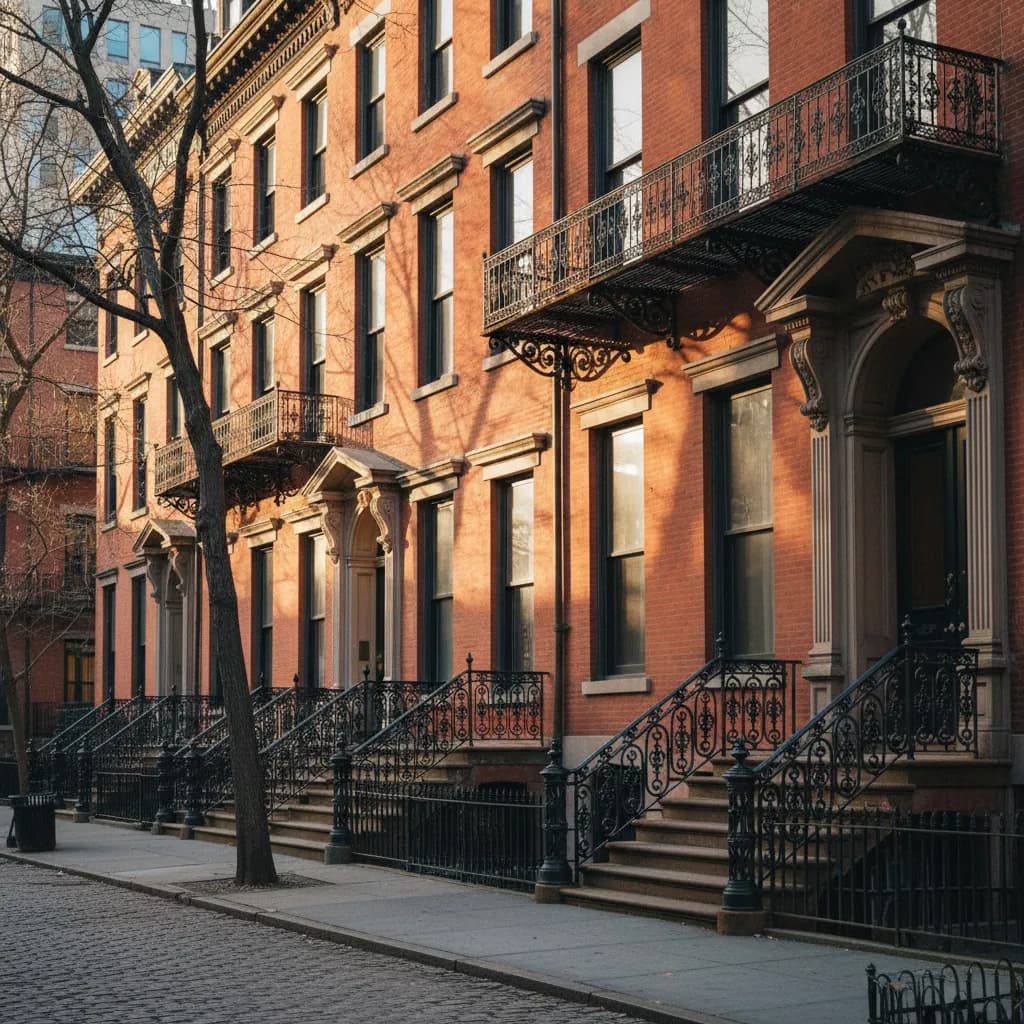
Bordering the park's northern perimeter along Washington Square North sits 'The Row,' an extraordinary preserved streetscape of Greek Revival brick townhouses built between 1831 and 1833. Developed by affluent Manhattan merchants escaping yellow fever outbreaks downtown, these stately four-story red-brick residences feature white marble entry porticos supported by fluted Ionic columns, deep cast-iron stoop railings, and decorative anthemion cresting along the balustrades.
Literary figures found deep creative inspiration along this tranquil curb during the late nineteenth and early twentieth centuries. Author Henry James drew upon his family's residence along Washington Square North to pen his celebrated 1880 novel Washington Square, while Edith Wharton frequented the salons held in neighboring drawing rooms. Pausing along the northern flagstone sidewalk permits quiet appreciation of early nineteenth-century domestic elegance preserved against the vibrant pulse of modern student life.
Circling the Granite Central Basin and Sunken Plaza
Strolling southward past the arch leads down into the circular central fountain plaza, an expansive stone amphitheater paved with concentric bands of blue stone. The central fountain basin was originally constructed in 1852 in connection with the Croton aqueduct system and later redesigned in 1872 during nineteenth-century park landscape improvements. The broad stone rim and surrounding steps serve as Manhattan's premier stage for street acoustic guitarists, jazz trios, and community audiences.
The open circular geometry encourages unhurried pedestrian wandering. During warm autumn afternoons, neighborhood residents gather along the curved stone ledges to read, sketch, and converse while children navigate perimeter paths. Because vehicular traffic was permanently closed across the park in 1959 following a landmark 1950s grassroots community campaign led by urbanist Shirley Hayes and activist Jane Jacobs, this central plaza remains an uncompromised pedestrian haven protected from automotive noise.
Ancient Canopies and the Legendary Hangman's Elm
Veering toward the northwest quadrant brings you beneath the towering canopy of the Hangman's Elm, universally recognized as the oldest living tree in Manhattan. This majestic English elm predates the American Revolution, celebrated by botanists and neighborhood historians as one of the oldest living trees in Manhattan. While historical records debunk folklore claiming public executions occurred from its heavy boughs, the ancient tree remains a reverent natural monument surviving centuries of municipal development.
The surrounding western paths meander through mature Kentucky coffeetrees, pin oaks, and American sycamores that provide dense overhead shade during sunny afternoons. Wooden benches set into alcoves along the manicured perennial borders offer quiet viewing angles overlooking the park's tranquil children's play areas and fenced dog runs, where neighborhood pets exercise on soft sand turf.
Chess Corners and Folk Music Heritage in the Southwest
Continuing the loop into the southwest corner deposits walkers in the legendary chess pavilion, where concrete game tables inlaid with slate chessboards have witnessed international chess drama since the 1940s. Grandmasters and neighborhood hustlers have tested rapid opening strategies here for generations, with prodigies including Bobby Fischer studying tactical positions across these very stone surfaces. Observing the rapid click of wooden pieces against clocks remains an essential sensory element of Greenwich Village culture.
A few yards eastward marks the historic gathering grounds where the American folk revival blossomed during the 1950s and early 1960s. Young musicians including Bob Dylan, Joan Baez, and Dave Van Ronk gathered beside the fountain on Sunday afternoons with acoustic guitars and banjos to share ballads and topical anthems. While organized political demonstrations required permits, the park's informal bohemian atmosphere fostered an enduring culture of spontaneous artistic expression.
Optimal Visiting Times and What to Skip
According to NYC Parks regulations, Washington Square Park remains open daily from 6:00 am until 1:00 am. Planning your plaza walk for a Sunday morning at 8:30 am allows you to experience the park at its most serene, when morning mist clears through the archway and sunlight strikes the north townhouses at a picturesque slant. Arriving at this early hour lets you stroll uninterrupted across the fountain plaza, secure a prime bench under the elms, and study the intricate arch carvings before mid-day crowds gather.
Skip visiting during crowded Friday and Saturday midnight hours when loud amplified speakers and packed student gatherings dominate the center fountain basin. If the central circle becomes noisy during your afternoon visit, make an easy tactical pivot to the small secluded seating alcoves near Holley Plaza in the western park grounds, where lush shrubbery buffers street activity.
Greenwich Village Exits and Culinary Landmarks
Exit through the park's southern gateway along Washington Square South, where Stanford White's Romanesque Judson Memorial Church, constructed in 1892, showcases towering stained glass windows designed by John La Farge. Turn down MacDougal Street to reach Caffe Reggio, serving fresh espresso since 1927 from an ornate chrome-and-bronze boiler imported from Italy. Stepping inside this historic coffeehouse lets you continue your historical journey amid Renaissance artwork and dark mahogany booths.
Transit connections are remarkably straightforward, with the West 4th Street-Washington Square subway station just one block west serving the A, B, C, D, E, F, and M trains per official MTA route maps. The R and W subway lines stop nearby at Eighth Street-NYU along Broadway. Grade-level paved walkways, modern tactile paving, and wide open plaza thresholds maintained by NYC Parks ensure this Greenwich Village historic plaza walk remains completely welcoming and accessible for all visitors.
Ask Karpo for more information.
Keep reading
- SoHo Tailor Alteration Shop Finder for Sample Sale Finds
 Williamsburg Tailor Alteration Shop Finder for Bike Riders
 Upper West Side Tailor Alteration Shop Finder for Kids