 SoHo Tailor Alteration Shop Finder for Sample Sale Finds
Neighborhood Guides
NYC Historic Plaza Walk: Union Square West Promenade
Experience pivotal American labor history, bustling Greenmarket stalls, and Gilded Age department store facades on a historic plaza walk along Union Square.
Situated at the dynamic convergence of Broadway and Fourth Avenue between Fourteenth and Seventeenth Streets, Union Square has served as New York City's premier civic forum, political rallying ground, and commercial retail showcase for nearly two centuries. Along its western perimeter, the historic Union Square West pedestrian promenade offers a tranquil walking corridor set back from major cross-town traffic. Instead of navigating congested transit corridors, walking this expansive tree-lined plaza allows urban explorers to appreciate soaring nineteenth-century commercial palazzi, bronze patriotic statuary, and agricultural market traditions at a contemplative pedestrian pace. Karpo's neighborhood walking route planner guides you through this historic plaza walk with curated historical milestones and seamless local context.
The Origins of Union Square as a Civic Forum
Laid out in the Commissioners' Plan of 1811 and formally opened as a public commons in 1839, the square received its name not from the federal Union of states, but because it marked the dramatic union of two major thoroughfares: the ancient Bloomingdale Road (now Broadway) and the Bowery's northward continuation into Fourth Avenue. During the mid-nineteenth century, wealthy merchants constructed lavish residential mansions around the perimeter park, making Union Square the fashionable epicenter of Manhattan society.
By the outbreak of the American Civil War, Union Square had evolved into the nation's foremost outdoor assembly space for political speech and social reform. On April 20, 1861, following the bombardment of Fort Sumter, over one hundred thousand citizens gathered across the square in what was then the largest public demonstration in American history to proclaim allegiance to the national flag. In September 1882, the Knights of Labor organized the country's inaugural Labor Day parade here, cementing Union Square's legacy as a designated National Historic Landmark for American labor history. In October 1898, the historic building also became home to early commercial motion picture exhibition galleries and innovative photographic supply showrooms, demonstrating the plaza's vital role as a proving ground for emerging American creative technologies and visual arts.
Throughout the late nineteenth and early twentieth centuries, suffragists, garment trade strikers, and civil rights advocates filled the broad plazas to demand social justice. The open western boundary of the park functioned as an organic public amphitheater where soapbox orators addressed crowds from stone pedestals under the shade of newly planted elms and pin oaks.
Gilded Age Department Stores Along Ladies' Mile
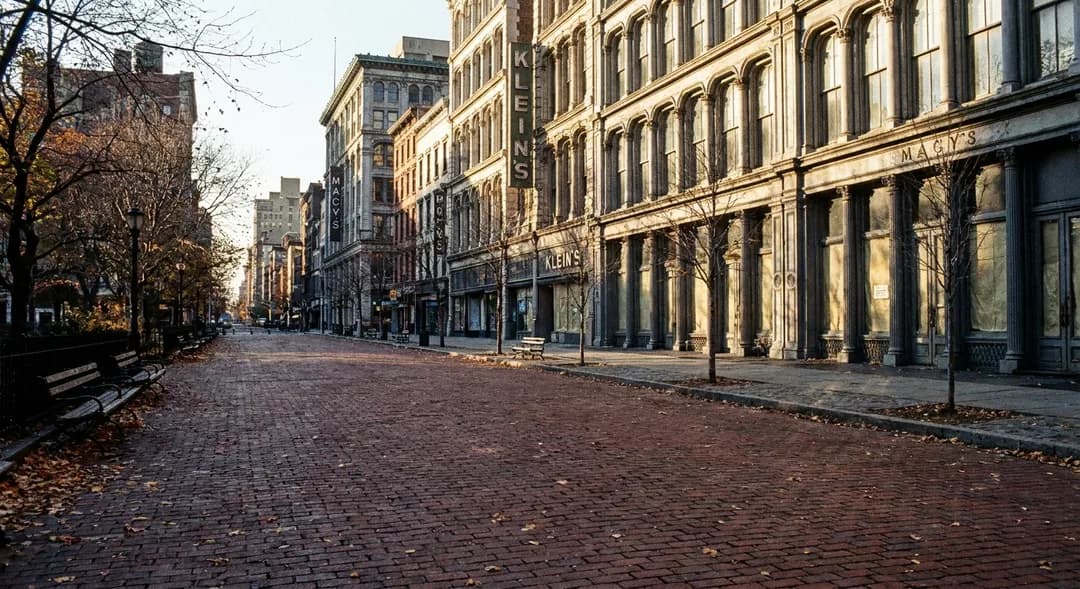
The western street wall facing the plaza forms part of the historic Ladies' Mile Historic District, the prestigious late-nineteenth-century retail strip where upscale dry-goods emporiums transformed American shopping culture. Prominent commercial structures along Union Square West showcase magnificent Beaux-Arts, Renaissance Revival, and Queen Anne architectural details. Massive plate-glass display windows, ornate cast-iron columns, and carved stone escutcheons speak to an era when fashionable shoppers traveled by private carriages to inspect imported European silks and Parisian fashions.
Notable among these landmarks is 33 Union Square West, formerly the Decker Building, designed in 1892 by architect John H. Edelmann. Its striking Venetian Gothic facade features polychrome brickwork, Moorish keyhole arches, and an elaborate copper-clad minaret tower that dramatically punctuates the skyline. During the late 1960s and early 1970s, the building entered modern pop-cultural lore when artist Andy Warhol established his famed Factory studio on the sixth floor, drawing international luminaries, avant-garde filmmakers, and musicians into the square.
Monumental Bronze Statuary Across the Plaza Walking along the wide brick-paved perimeter on clear autumn mornings reveals the magnificent play of warm sunlight reflecting across ornate terra-cotta pilasters, carved limestone pediments, and deep copper roof cornices that frame the sky above Union Square.
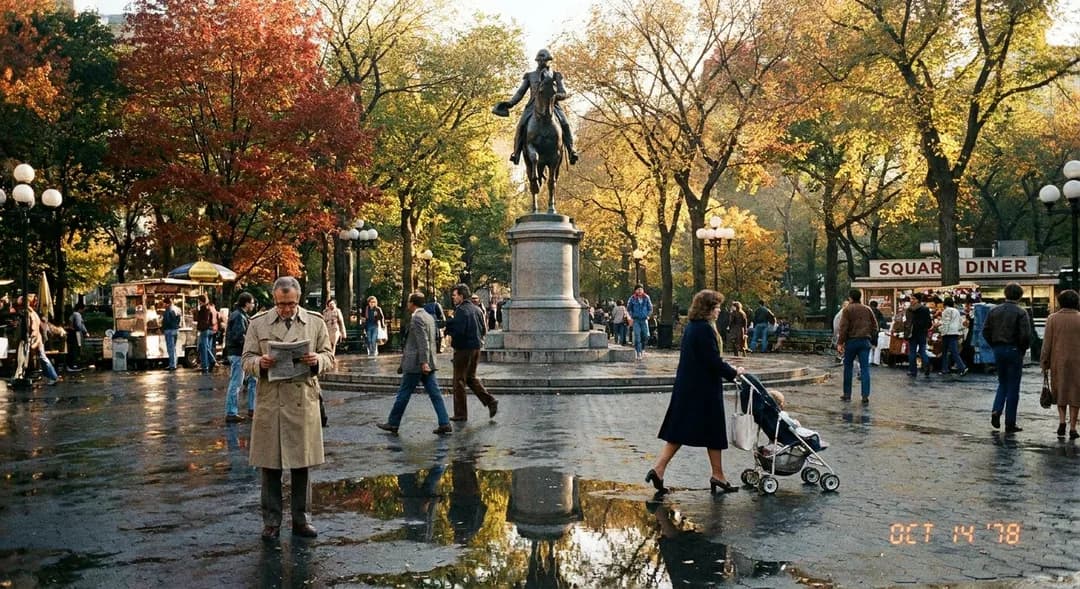
Walking the perimeter pathways reveals an exceptional collection of historic bronze statuary honoring foundational historical leaders. At the southern entrance to the park stands Henry Kirke Brown's monumental equestrian statue of George Washington, dedicated on July 4, 1856. Recognized as the first monumental public sculpture erected in New York City since the Revolutionary War, the bronze portrays General Washington raising his hand in peaceful benediction following the British evacuation of Manhattan in 1783.
Nearby along the eastern pathways stands Frédéric-Auguste Bartholdi's 1876 bronze monument to the Marquis de Lafayette, presented by the French government in gratitude for American support during the Franco-Prussian War, sculpted by the very artist who later created the Statue of Liberty. Towards the northern plaza stands Henry Kirke Brown's dignified standing portrait of Abraham Lincoln, erected in 1870, alongside a moving statue of Mahatma Gandhi unveiled in 1986, creating a continuous philosophical dialogue on civil rights and nonviolent civic leadership.
The Union Square Greenmarket and Surrounding Cafes
No walking tour of Union Square West is complete without experiencing the renowned Union Square Greenmarket, founded in 1976 by the Council on the Environment of New York City to support regional family farms and preserve agricultural farmland in the Hudson Valley and New Jersey. Operating year-round on Mondays, Wednesdays, Fridays, and Saturdays, the market fills the northern and western plazas with colorful canopies offering crisp heirloom apples, artisanal sourdough breads, regional honeys, and fresh cider pressed on local orchards.
Surrounding the plaza, a rich assortment of independent coffeehouses, European bakeries, and classic neighborhood bistros invite walkers to unwind. Pulling up an outdoor iron cafe chair along Seventeenth Street allows you to enjoy freshly baked almond croissants, pour-over Colombian coffee, or seasonal hot cider while watching artists sketch the historic architecture and park visitors stroll along the tree canopy.
Practical Walking Tips for Union Square West
To enjoy the optimal balance of market vitality and peaceful plaza photography, plan your visit for Wednesday or Friday mornings between nine and eleven in the morning. Early mornings provide clear walking paths through the Greenmarket stalls and soft angled sunlight illuminating the detailed terra-cotta facades along Union Square West. Sturdy walking shoes are recommended for strolling along the wide granite pavements and exploring the park's interior gravel paths.
Transit connections to Union Square are among the most comprehensive in Manhattan: the 14th Street-Union Square station directly underneath the plaza serves the 4, 5, and 6 express lines, the N, Q, R, and W Broadway lines, and the L cross-town train. Karpo APP provides interactive neighborhood route planning, historical landmark details, and live crowd activity updates, ensuring an enriching and effortless historic walking experience.
Ask Karpo for more information.
Keep reading
- SoHo Tailor Alteration Shop Finder for Sample Sale Finds
 Williamsburg Tailor Alteration Shop Finder for Bike Riders
 Upper West Side Tailor Alteration Shop Finder for Kids