 SoHo Tailor Alteration Shop Finder for Sample Sale Finds
Neighborhood Guides
Rockefeller Center Historic Plaza Walk: Midtown Promenade
Explore Art Deco landmarks on this historic plaza walk through Rockefeller Center in New York. Use the Karpo APP to find gardens, sculptures, and plazas.
Rockefeller Center stands as a pinnacle of twentieth-century urban planning, uniting fourteen original Art Deco limestone towers across the prominent midtown complex between 48th and 51st Streets. Financed during the Great Depression by philanthropist John D. Rockefeller Jr. and designed by an associated team of architects led by Raymond Hood and Wallace Harrison, the complex introduced the revolutionary concept of dedicated pedestrian plazas woven into commercial skyscraper footprints. Taking this historic plaza walk immerses pedestrians in an open-air museum of gilded mythology, seasonal horticulture, and monumental limestone carving.
Entering the Promenade of the Channel Gardens
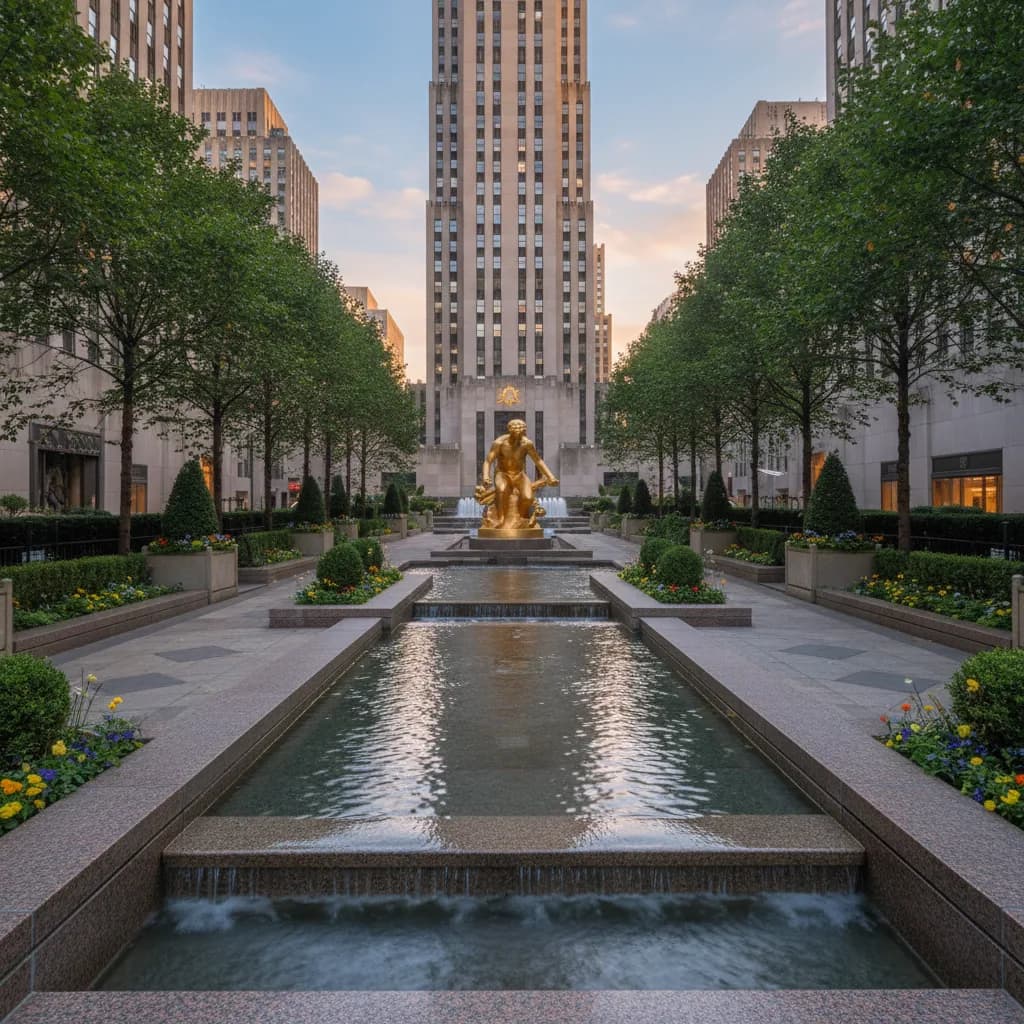
Your walking route commences along the western side of Fifth Avenue between 49th and 50th Streets, entering the world-famous Channel Gardens promenade. Gently sloping toward the lower plaza, this pedestrian concourse separates the British Empire Building on the north from La Maison Française on the south, its name playfully evoking the English Channel separating Britain and France. Six rectangular granite reflecting pools step down the promenade, each adorned with playful bronze fountain figures of tritons and nereids sculpted in 1935 by René Chambellan.
Flanking the water basins are meticulously maintained botanical beds that rotate distinct seasonal floral displays throughout the year, from spring tulips and summer tropical plantings to autumn chrysanthemums. Stepping between the polished granite planter ledges provides an iconic architectural perspective, framing the stepped limestone silhouette of 30 Rockefeller Plaza rising dramatically into the midtown sky.
Manship's Gilded Prometheus in the Sunken Plaza
Descending the granite stairs at the western end of the gardens brings walkers to the railing overlooking the Sunken Plaza, an architectural masterstroke originally devised to draw retail shoppers below street level. At the base of the western retaining wall stands Paul Manship's radiant 1934 gilded bronze sculpture of Prometheus, depicting the mythical titan soaring through an ornate zodiac ring as he delivers stolen fire to humanity. A gentle sheet of water cascades behind the golden figure across polished red Balmoral granite inscribed with a translation from ancient Greek playwright Aeschylus.
The sunken arena transforms with the city's seasons, serving as New York's premier outdoor ice skating rink from autumn through early spring, and hosting vibrant alfresco terrace dining during summer months. The sunken boundary keeps pedestrians insulated from surrounding cross-town automotive traffic while preserving soaring sightlines upward along the limestone skyscraper cliffs.
Art Deco Allegories and Lee Lawrie's Masterpieces
Ascending back to street level along Rockefeller Plaza—the central north-south pedestrian corridor between 48th and 51st Streets—reveals exceptional architectural bas-reliefs. Directly above the grand limestone entrance of 30 Rockefeller Plaza along Rockefeller Plaza, sculptor Lee Lawrie's colossal 1933 carved limestone and glass relief, titled Wisdom, commands the facade, depicting a bearded creator measuring the universe with calipers alongside an inscription celebrating wisdom as the stability of the times.
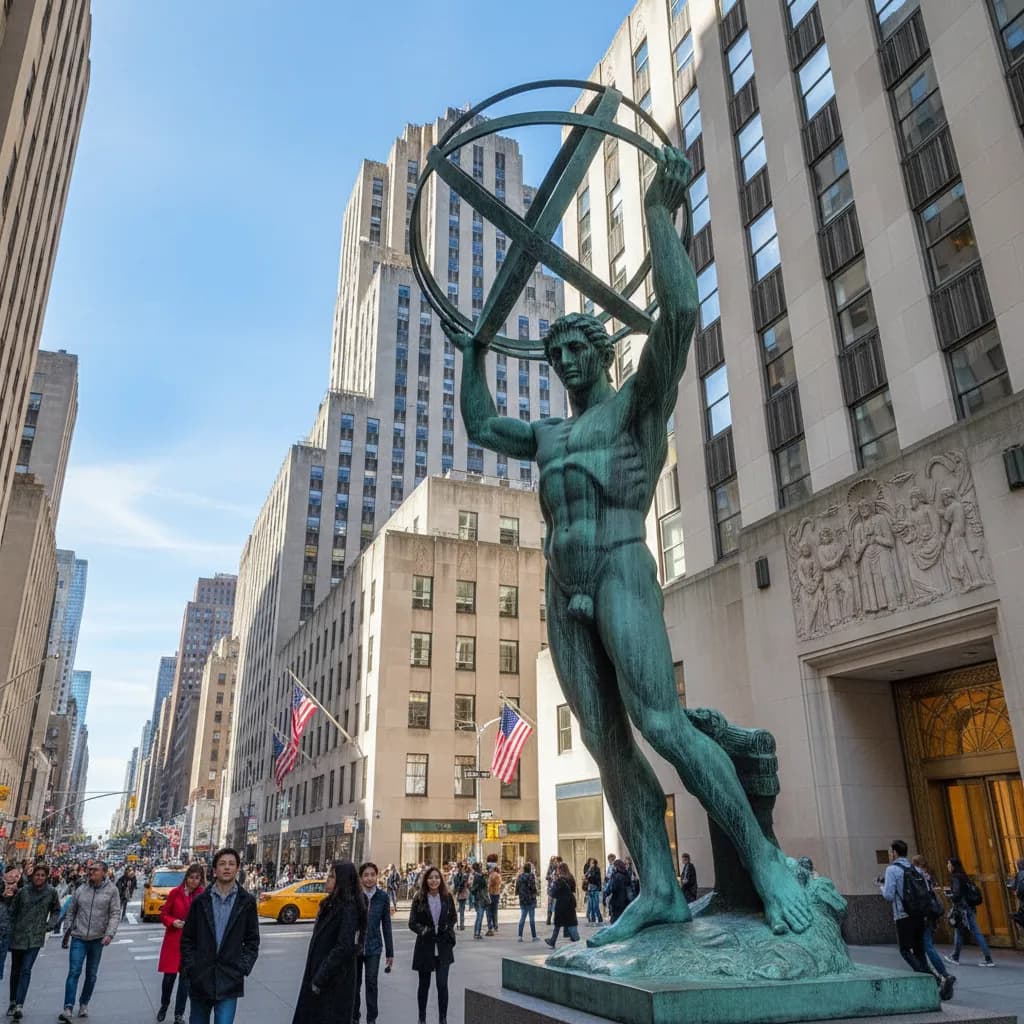
Turning northward within the International Building courtyard brings pedestrians face-to-face with Lawrie's monumental bronze statue of Atlas, executed in collaboration with René Chambellan and unveiled in 1937. Standing atop its massive granite plinth with muscular bronze limbs supporting an openwork armillary sphere aligned toward the North Star, the heroic titan gazes directly eastward across Fifth Avenue toward the twin Gothic spires of St. Patrick's Cathedral, creating one of Manhattan's most striking visual dialogues between classical pagan mythology and ecclesiastical architecture.
International Buildings and Limestone Bas-Reliefs
Continuing your perimeter circuit along 50th Street leads past the International Building and Radio City Music Hall, which opened in December 1932 as the world's largest indoor theater. The limestone walls throughout this sector feature decorative carvings and panels executed by prominent artists including Gaston Lachaise, Carl Milles, and Hildreth Meière. These intricate panels depict historic international themes of trade, agrarian labor, aviation, and human communication, carved directly into the durable Indiana limestone blocks.
The meticulous pedestrian integration across Rockefeller Center remains an inspiring case study in humane city design. Wide sidewalk aprons, sheltered colonnades, and bronze entrance doors welcome thousands of strollers daily without congestion, balancing the dense commercial demands of international television broadcasting and corporate offices with tranquil open-air public gathering spaces.
Optimal Strolling Windows and What to Skip
To experience this historic plaza walk in its most serene state, plan your visit for an early weekday morning at 8:00 am. At dawn, morning light illuminates the golden surface of Prometheus and reflects off the quiet Channel Gardens pools before midtown office workers arrive, offering peaceful viewing of the delicate floral arrangements and architectural inscriptions.
Skip attempting a leisurely stroll through the central plaza during the intense midday lunch crush from 12:00 pm to 2:00 pm, or during peak December holiday tree-lighting crowds when pedestrian movement slows to a standstill. If midtown crowds overwhelm the Channel Gardens during an afternoon visit, step one block north to the quiet landscaped plaza flanking the 51st Street entrance of the International Building, where granite stone benches offer restful seclusion.
The Underground Concourse and Subterranean Detours
If inclement rain or chilly winter gusts sweep down Fifth Avenue, descend the escalator stairs into the climate-controlled Concourse at Rockefeller Center. Extending underground across multiple city blocks, this historic subterranean network connects commercial towers across the complex, lined with historic black-and-white construction photographs, public murals, artisan bakeries, and casual coffee counters.
The underground passages allow completely protected walking exploration, leading directly to lower-level views of the skating rink and offering indoor transit connections without stepping onto wet midtown pavements. Following the concourse signage westward brings you directly beneath the iconic neon marquee of Radio City Music Hall along Sixth Avenue.
Transit Connections and Practical Walking Advice
Rockefeller Center provides direct subway access via the 47th-50th Streets-Rockefeller Center station, served by the B, D, F, and M train lines directly beneath Sixth Avenue per official MTA subway schedules. Alternatively, the E and M trains stop nearby at Fifth Avenue-53rd Street, while the 1 train serves 50th Street along Broadway. Accessible street elevator access is situated along the west side of Sixth Avenue near 49th Street, connecting pedestrians directly between street level, concourse retail passages, and subway platforms.
Paved stone sidewalks, wide pedestrian promenades, and smooth access ramps throughout Rockefeller Plaza ensure accessible outdoor navigation for strollers, wheelchairs, and walking enthusiasts alike per official Rockefeller Center visitor information. Keep this Rockefeller Center historic plaza walk as your essential midtown walking route whenever you wish to experience the harmonious marriage of Depression-era civic optimism, Art Deco craftsmanship, and timeless New York grandeur.
Ask Karpo for more information.
Keep reading
- SoHo Tailor Alteration Shop Finder for Sample Sale Finds
 Williamsburg Tailor Alteration Shop Finder for Bike Riders
 Upper West Side Tailor Alteration Shop Finder for Kids