 SoHo Tailor Alteration Shop Finder for Sample Sale Finds
Neighborhood Guides
NYC Historic Plaza Walk: Grand Army Plaza Manhattan
Discover Gilded Age elegance and monumental civic sculpture on an unhurried historic plaza walk through Grand Army Plaza and the Pulitzer Fountain in Manhattan.
At the prestigious junction where Fifth Avenue meets Fifty-Ninth Street at the southeastern threshold of Central Park lies Manhattan's Grand Army Plaza, one of the most magnificent Beaux-Arts civic spaces in North America. Bisected gracefully by Central Park South, this twin-oval plaza forms a ceremonial gateway connecting the high-energy luxury shopping corridor of Upper Fifth Avenue with the peaceful pastoral landscapes of Frederick Law Olmsted and Calvert Vaux's urban park. Rather than hurrying past the surrounding Gilded Age hotel towers and horse-drawn carriages, undertaking a dedicated historic plaza walk across its granite terraces reveals over a century of civic patronage, world-class figurative sculpture, and architectural harmony. Karpo's neighborhood walking route planner guides you through this historic plaza walk with refined spatial appreciation and deep historical context.
The Beaux-Arts Vision for Grand Army Plaza
Conceived during the City Beautiful movement at the turn of the twentieth century, Grand Army Plaza was designed to establish a monumental classical vestibule worthy of New York City's emergence as a premier world metropolis. The plaza's spatial layout was masterminded by visionary architect Thomas Hastings of the renowned firm Carrère and Hastings, celebrated for designing the New York Public Library Main Branch at Forty-Second Street. Officially named Grand Army Plaza in 1923 by the Board of Aldermen, the space commemorates the Grand Army of the Republic, the fraternal organization of Union veterans who served in the American Civil War. Walking along the fountain terrace on crisp mornings, the gentle splashing of cascading water creates an acoustic sanctuary that softens the distant traffic rumble of Fifth Avenue, providing a contemplative space where visitors and local office workers can pause to appreciate the timeless classical harmony of the surroundings.
Hastings designed the plaza with two symmetrical half-oval terraces divided by the cross-traffic of Central Park South. The southern half, facing the Gilded Age facade of the Plaza Hotel, centers upon the monumental Pulitzer Fountain, while the northern half, projecting into the wooded perimeter of Central Park, serves as an open-air pedestal for Augustus Saint-Gaudens' celebrated equestrian monument. Fine gray Maine granite balustrades, classic bronze lampposts, and double rows of meticulously manicured London plane trees frame both halves, creating an enduring sense of Parisian elegance in Midtown Manhattan.
The Pulitzer Fountain and Pomona Monument
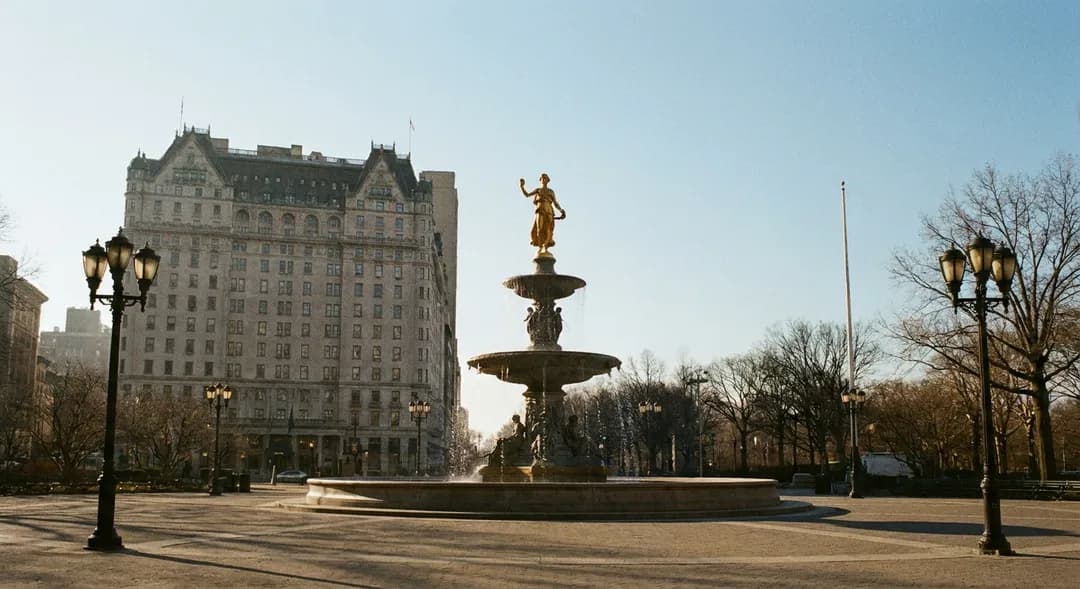
Anchoring the southern plaza stands the magnificent Pulitzer Fountain, executed in six concentric limestone and granite basins that cascade water with melodic grace. The fountain was made possible by a generous twenty-five-thousand-dollar bequest from legendary newspaper publisher Joseph Pulitzer in 1911, who envisioned a grand public fountain modeled after those adorning the Place de la Concorde in Paris to bring beauty and tranquility to everyday New Yorkers.
Perched atop the uppermost basin is the celebrated bronze sculpture of Pomona, the Roman goddess of abundance, fruit, and agriculture, sculpted by acclaimed American artist Karl Bitter. Bitter modeled the graceful nude figure after Audrey Munson, the prolific Beaux-Arts muse who posed for dozens of New York City's most iconic municipal sculptures. Holding a basket of orchard fruits, Pomona gazes serenely downward toward Fifth Avenue, framed by the soaring French Renaissance chateau rooflines and mansard dormers of the landmark Plaza Hotel.
Saint-Gaudens' Golden Sherman Monument
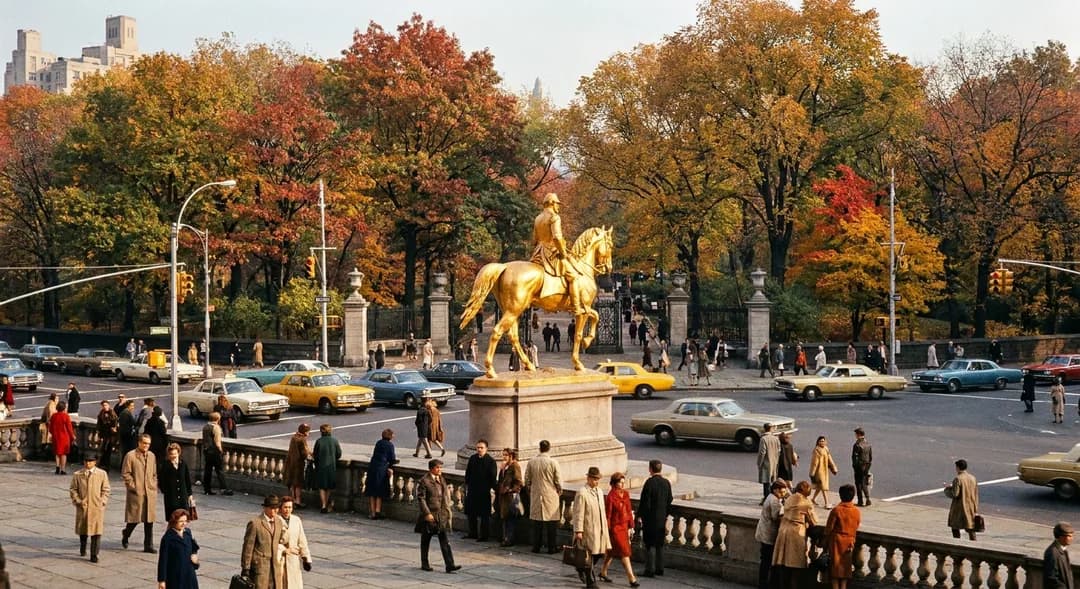
Crossing Central Park South to the northern oval brings visitors before one of the undisputed masterpieces of American equestrian sculpture: Augustus Saint-Gaudens' gilded bronze monument to Union General William Tecumseh Sherman. Unveiled on Memorial Day in 1903, the heroic monument portrays General Sherman mounted on his battle charger, led forward by an allegorical winged figure of Victory. Saint-Gaudens spent eleven years perfecting the sculpture in his Cornish, New Hampshire studio, drawing international acclaim at the 1900 Paris Exposition Universelle. Nearby sidewalk cafes and gourmet food halls located within the concourse level of the Plaza Hotel offer seasonal refreshments including rich hot chocolate, French viennoiserie, and warm artisanal teas, making Grand Army Plaza a delightful year-round starting point for wider explorations of Central Park and Museum Mile.
The dynamic winged figure of Victory, modeled after African-American model Hettie Anderson, strides barefoot across the granite pedestal, holding a palm branch aloft while guiding Sherman's horse. Meticulously restored and re-gilded with twenty-three-karat gold leaf by the Central Park Conservancy, the radiant sculpture gleams brilliantly against the deep green canopy of surrounding mature pin oaks and copper beeches. Walking around the pink Stony Creek granite pedestal designed by architect Charles Follen McKim allows admirers to appreciate the energetic drapery and lifelike anatomical tension captured in every contour.
The Surrounding Landmark Architectural Enclave
Surrounding Grand Army Plaza is an extraordinary cluster of landmark architecture spanning over a century of New York design history. Anchoring the western plaza flank stands the Plaza Hotel, designed by Henry Janeway Hardenbergh in French Renaissance style and opened in October 1907. Its white-glazed terra-cotta brick, verdigris copper gables, and opulent public salons—including the legendary Palm Court with its stained-glass ceiling dome—have welcomed world leaders, literary figures like F. Scott Fitzgerald, and international dignitaries for generations.
Looking across Fifth Avenue reveals the chic neoclassical marble facade of the historic Bergdorf Goodman department store, constructed in 1928 on the former site of the Cornelius Vanderbilt II mansion, alongside the soaring marble-clad General Motors Building and the iconic transparent Apple Fifth Avenue glass cube. This dramatic coexistence of early twentieth-century classical masonry and twenty-first-century modern minimalism creates a visual timeline of Manhattan's evolving civic ambition.
Practical Tips for Exploring Grand Army Plaza
To enjoy Grand Army Plaza at its most tranquil and atmospheric, embark on your walking route during weekday mid-mornings between eight-thirty and ten o'clock, or around sunset when warm golden light reflects off the Sherman monument and the Pulitzer Fountain's water jets glow against the evening sky. Wide stone steps and teak park benches provide comfortable seating to pause, observe horse-drawn carriages departing for park drives, and admire seasonal flower displays curated by the Central Park Conservancy.
Transit connections to Grand Army Plaza are remarkably convenient: the Fifth Avenue-59th Street subway station directly under the southern plaza serves the N, R, and W lines, while the 57th Street station on the F line sits just two short blocks south, and the 59th Street-Columbus Circle hub provides access to the 1, A, B, C, and D lines along Central Park South. Karpo APP offers interactive neighborhood walking maps, architectural guides, and real-time transit directions, helping you explore Manhattan's most iconic civic landmarks with effortless confidence.
Ask Karpo for more information.
Keep reading
- SoHo Tailor Alteration Shop Finder for Sample Sale Finds
 Williamsburg Tailor Alteration Shop Finder for Bike Riders
 Upper West Side Tailor Alteration Shop Finder for Kids