 SoHo Tailor Alteration Shop Finder for Sample Sale Finds
Neighborhood Guides
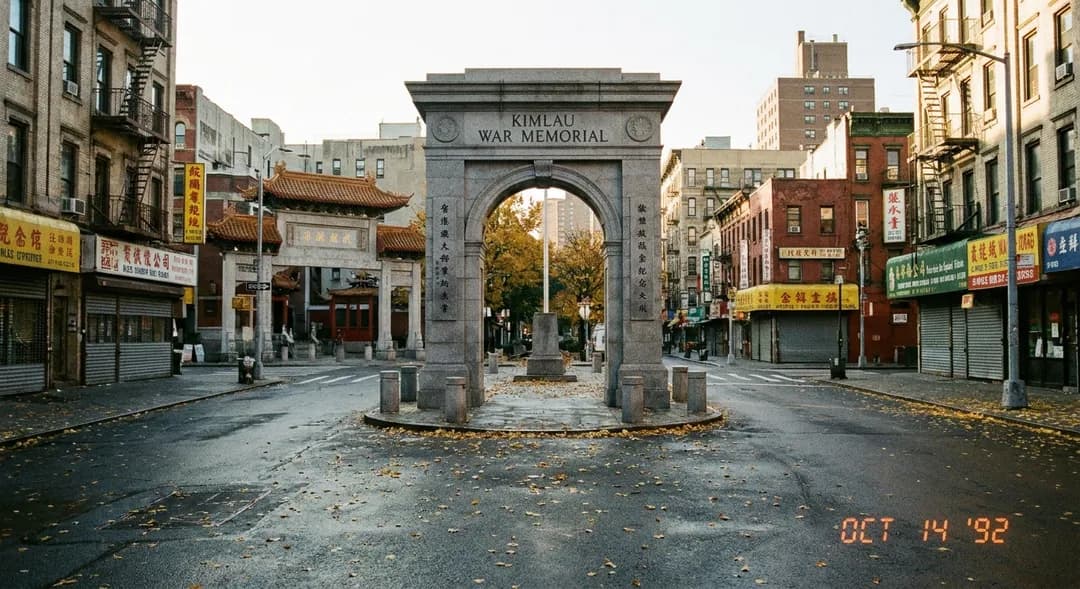
NYC Historic Plaza Walk: Chatham Square in Chinatown
Discover centuries of Lower Manhattan heritage on an immersive historic plaza walk through Chatham Square, Kimlau War Memorial, and surrounding alleys.
At the dynamic intersection where the Bowery, East Broadway, Park Row, Mott Street, and Worth Street converge lies Chatham Square, one of the oldest and most culturally layered crossroads in Manhattan. Long before it became a bustling ceremonial gateway to Chinatown, this expansive multi-street junction functioned as an indigenous trading trail, a Dutch colonial cattle pasture, and later a roaring nineteenth-century maritime entertainment district. Today, navigating Chatham Square on foot offers urban explorers an extraordinary opportunity to encounter monumental civic memorials, traditional Chinese pavilion architecture, and historic commercial lanes in a single continuous circuit. Karpo's neighborhood walking route planner guides you through this historic plaza walk with curated historical context and unhurried ease.
The Historic Crossroads of Chatham Square
Chatham Square began its documented history in the seventeenth century as an open clearing known as the Bowery cattle market, linking agricultural farms in northern Manhattan with the fortified settlement of New Amsterdam to the south. During the American Revolutionary era, British forces and colonial merchants frequented its busy stagecoach inns, tavern halls, and open-air horse auctions. Named in honor of William Pitt, the first Earl of Chatham and a British statesman who defended American colonial rights, the square evolved throughout the nineteenth century into a vibrant cultural melting pot where Irish, German, and Jewish immigrants lived and traded side by side. Local historians document that before William Pitt's defense of colonial representation in Parliament was celebrated, this crossroads also marked the starting point of the Boston Post Road, the essential overland postal highway connecting Manhattan with colonial New England. Weary travelers arriving by horse-drawn carriage would rest their teams at surrounding stables before entering the crowded lanes of the lower town.
By the late nineteenth century, elevated train tracks shadowed the plaza, while dime museums, music halls, and tattoo parlors catered to merchant sailors disembarking from nearby East River docks. As Chinese immigrants established homes along Mott, Pell, and Doyers Streets, Chatham Square transformed into the civic heart of Manhattan's growing Chinatown community. Standing on the wide pedestrian islands today, visitors can observe how decades of transit modernization have opened generous sightlines toward surrounding tenements, municipal civic buildings, and community monuments.
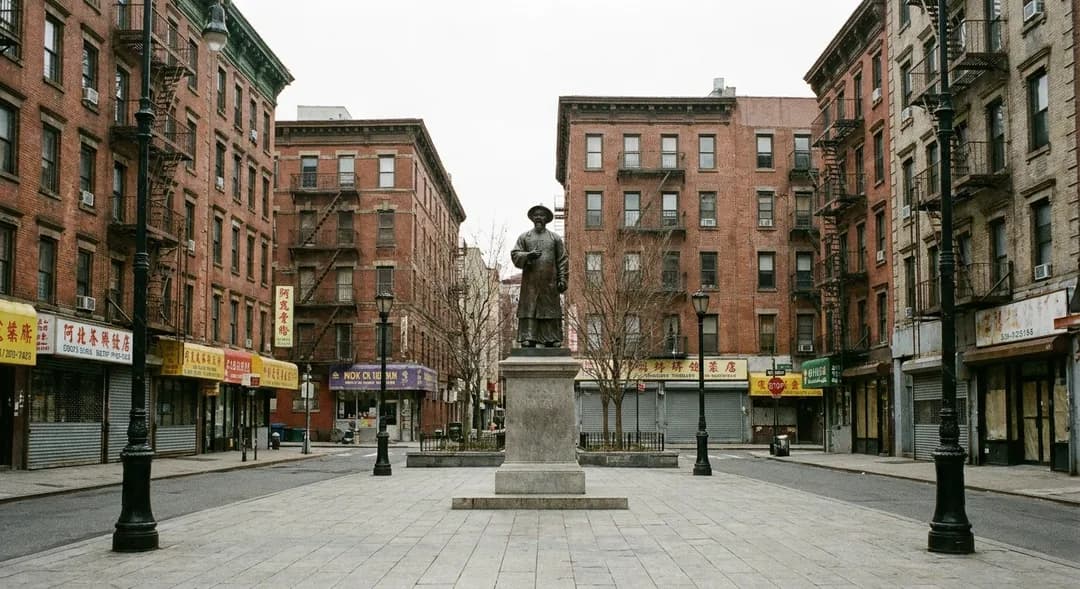
Kimlau War Memorial and Lin Zexu Plaza
Dominating the central traffic island of Chatham Square stands the Kimlau War Memorial, an elegant ceremonial arch of light gray New Hampshire granite dedicated in 1962. Erected by American Legion Chinatown Post 1291, the memorial honors Lieutenant Benjamin Ralph Kimlau, a courageous Chinese-American bomber pilot who died in combat during World War II, along with all Chinese-American service members who sacrificed their lives for the United States. Designed with traditional Chinese architectural cornices, the monument features bilingual bronze inscriptions celebrating patriotism, loyalty, and civic courage.
Just north of the Kimlau Arch, a commanding bronze statue of nineteenth-century scholar-official Lin Zexu gazes purposefully along Bowery. Unveiled in 1997 and sculpted by master artist Li Wei-Qing, the monument honors the Chinese statesman renowned for his uncompromising moral stance against the opium trade. Resting on a polished black granite pedestal, Lin Zexu's dignified portrait creates a reflective public gathering space where elders from the neighborhood meet daily to discuss local news, practice tai chi, and feed migratory sparrows beneath leafy ginkgo trees.
Strolling Historic Mott, Pell, and Doyers Streets
Directly branching off the western perimeter of Chatham Square are the three foundational residential corridors of original Chinatown: Mott Street, Pell Street, and Doyers Street. Strolling down Doyers Street, famous for its sharp ninety-degree elbow bend, reveals historic brick facades that once housed nineteenth-century Chinese opera houses, underground boarding corridors, and merchant associations. Today, the curve is home to historic legacy bakeries, traditional barbershops, and subterranean tearooms tucked beneath vintage hanging lanterns. Looking down the gentle incline of Pell Street reveals multi-tiered metal fire escapes painted in rich forest green and vermilion red, creating a layered visual canopy framed by ornate cast-iron building cornices. The street reflects a dynamic tapestry of community life where second-generation shopkeepers work alongside elder craftspeople preserving traditional paper lanterns, calligraphy scrolls, and hand-carved soapstone seals.
Turning onto Pell Street brings you past Edward Mooney House at the corner of Bowery and Pell Street, constructed between 1785 and 1789 for a wealthy butcher and merchant. Recognized as the oldest surviving row house structure in Manhattan, its mixed Georgian and early Federal brick masonry illustrates post-Revolutionary residential construction. Along Mott Street, family-run dim sum halls, herbal medicine dispensaries, and tea merchants spill out onto sidewalk displays filled with fresh pomelos, ginger roots, and fragrant dried chrysanthemum blossoms.
Nearby Landmarks and Traditional Tearooms
After exploring the central monuments and curving alleyways of Chatham Square, several nearby cultural spots provide wonderful settings for mid-walk reflection. Continuing two blocks north on Bowery brings you to the Museum of Chinese in America, while heading west leads to Columbus Park. Formerly the center of the notorious nineteenth-century Five Points neighborhood, Columbus Park now features open pavilions where lively Cantonese opera singers and traditional erhu musicians perform outdoors on clear afternoons.
For warm refreshments, historic neighborhood establishments along East Broadway and Mott Street serve steamed roast pork buns, warm tofu pudding drizzled with ginger syrup, and freshly brewed oolong tea poured into porcelain bowls. Sitting near an open window overlooking the bustling foot traffic of Chatham Square allows you to absorb the rhythm of street vendors, vegetable stalls, and neighborhood conversation echoing through the square.
Practical Tips for Navigating Chinatown Plazas
To experience Chatham Square and its adjacent historic lanes at their most relaxed and photogenic, schedule your walking route for weekday mid-mornings between nine and eleven in the morning, before lunchtime crowds gather outside popular noodle houses. Early mornings offer golden angled sunlight through the Kimlau Arch and clear pedestrian flow along narrow sidewalks. Comfortable flat walking shoes are ideal for exploring the brick paving stones and curb ramps around the plaza.
Public transportation to Chatham Square is exceptionally accessible: the East Broadway station on the F line lies three blocks to the east, while the Grand Street station on the B and D lines sits four blocks north. Alternatively, the Brooklyn Bridge-City Hall terminal on the 4, 5, and 6 lines provides a scenic walk eastward through Foley Square. Karpo APP delivers customized walking itineraries, live transit guidance, and historical architectural notes, helping you navigate Manhattan's vibrant cultural centers with confidence.
Ask Karpo for more information.
Keep reading
- SoHo Tailor Alteration Shop Finder for Sample Sale Finds
 Williamsburg Tailor Alteration Shop Finder for Bike Riders
 Upper West Side Tailor Alteration Shop Finder for Kids