 SoHo Tailor Alteration Shop Finder for Sample Sale Finds
Neighborhood Guides
NYC Historic Plaza Walk: Bowling Green to Stone Street
Explore Lower Manhattan cobblestones on an unhurried historic plaza walk linking colonial Bowling Green, Alexander Hamilton Custom House, and Stone Street.
Walking the southern tip of Manhattan on foot reveals the foundational layers of New York City where Dutch colonial trading paths, maritime slips, and nineteenth-century merchant houses first took physical shape. Between the teardrop green of colonial Bowling Green and the curving cobblestones of Stone Street lies one of the dense urban fabric's most atmospheric pedestrian walking corridors. Instead of rushing past towering modern glass facades, stepping into these preserved public spaces allows travelers and local explorers to experience original seventeenth-century street widths, hand-laid Belgian paving blocks, and grand classical granite porticos at a thoughtful human pace. Karpo's neighborhood walking route planner maps out this historic plaza walk so you can wander through four centuries of civic evolution with effortless direction.
Starting at Bowling Green Colonial Park
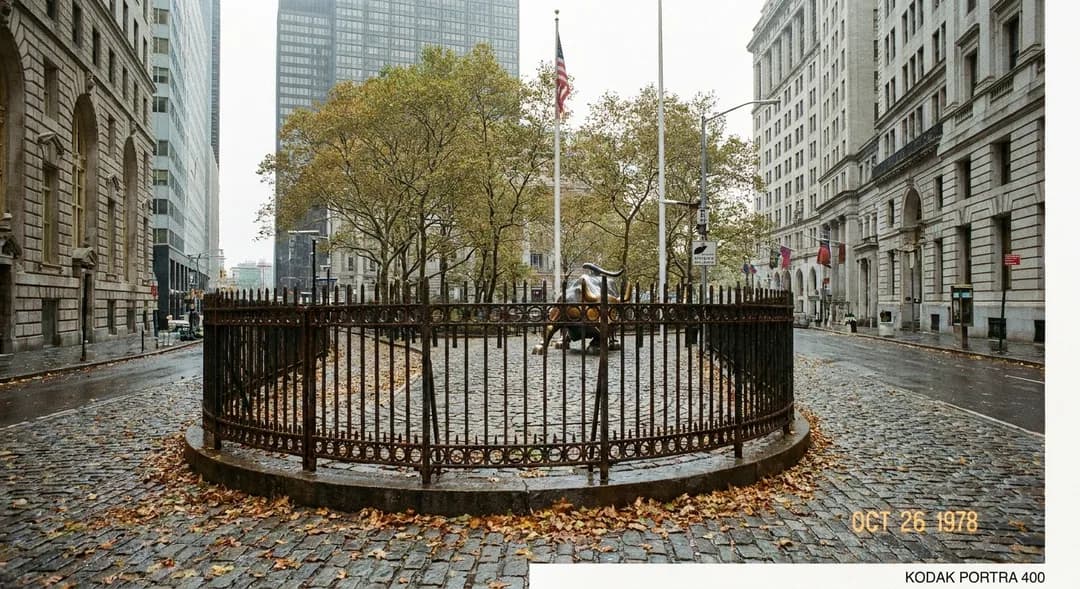
The journey begins at Bowling Green, designated in 1733 as New York City's earliest municipal park and civic gathering place. Long before European settlement, Lenape trading routes converged at this shoreline terrace overlooking Upper New York Bay. Under Dutch colonial administration, the open clearing served as a bustling cattle market and military parade ground situated directly opposite Fort Amsterdam. The centerpiece 1771 cast-iron perimeter fence still encircles the oval lawn, retaining unmistakable saw marks where revolutionary patriots hacked off royal decorative crowns on July 9, 1776, immediately following the first public reading of the Declaration of Independence in Manhattan.
Standing beside the ornate Victorian central fountain on a crisp autumn morning, the striking contrast of intimate colonial scale against the backdrop of soaring Financial District skyscrapers feels truly singular. Towering mature London plane trees shade weathered teak benches, providing a peaceful vantage point to watch downtown commuters emerge from the 1905 Guastavino-tiled Bowling Green subway entrance. Looking south across State Street, the Beaux-Arts facade of the Alexander Hamilton U.S. Custom House commands the horizon, marking the physical transition from early civic green to early twentieth-century global maritime gateway.
The Monumental Architecture of the Custom House
Crossing southward from the park plaza leads directly to the monumental granite grand staircase of the Alexander Hamilton U.S. Custom House, designed by architect Cass Gilbert and opened in 1907. Gilbert's Beaux-Arts civic masterpiece anchors the southern terminus of Broadway with massive Corinthian columns and four allegorical limestone sculptures created by Daniel Chester French, representing the continents of Asia, America, Europe, and Africa. Each heroic figure captures early twentieth-century trade routes and cultural archetypes through intricate classical drapery and symbolic carvings executed in solid Maine granite.
Ascending the exterior stairs into the second-floor ceremonial rotunda brings visitors beneath a massive elliptical Guastavino dome adorned with sweeping maritime frescoes. Painted in 1937 by Reginald Marsh under the Treasury Relief Art Project, these ceiling murals depict cargo ships and ocean liners navigating through the Narrows into New York Harbor alongside portraits of sixteenth-century maritime navigators. Because the landmark now houses the Smithsonian National Museum of the American Indian, admission to the historic rotunda, grand ceremonial halls, and rotating artifact galleries is free to the public, offering a rich architectural intermission along your route.
Navigating the Cobblestones of Stone Street
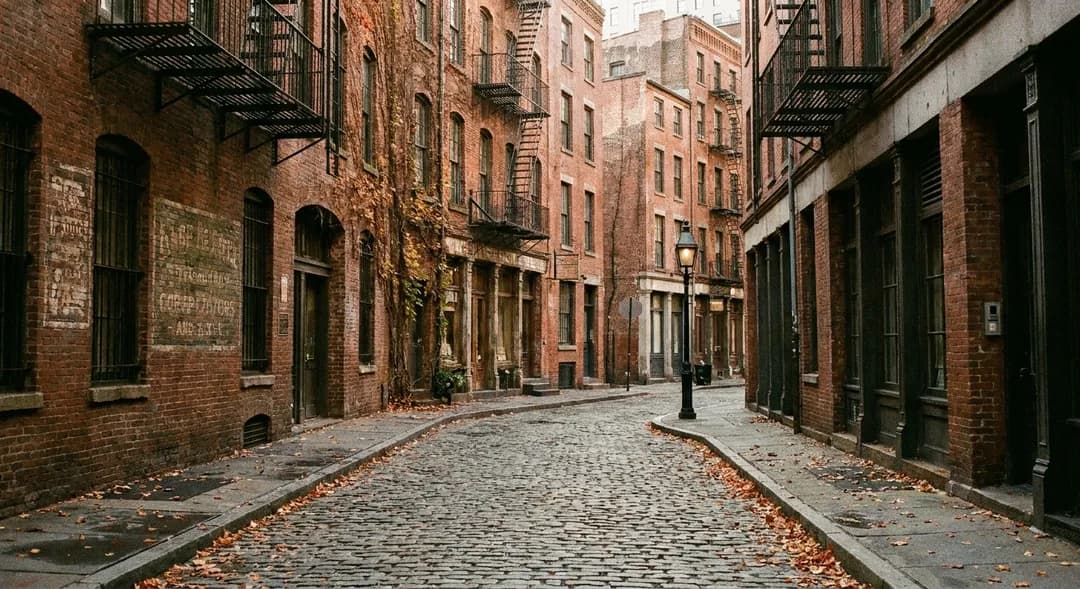
Exiting the museum and strolling northeast along Beaver Street brings you across Broad Street into the protected enclave of the Stone Street Historic District. In 1658, Dutch colonial authorities paved this curved lane with native cobblestones to prevent commercial wagons and livestock from sinking into coastal mud, establishing the very first paved street in New Amsterdam. The gentle arc of the street right-of-way preserves seventeenth-century property lines intact, contrasting sharply with the relentless rectangular street grid later mapped across Midtown and Upper Manhattan.
Following a devastating warehouse district fire in 1835, commercial dry-goods merchants rebuilt the lane in unified Greek Revival and neo-Renaissance brick styles, incorporating split granite curbs, raised stone loading thresholds, and multi-paned loft windows. Closed completely to vehicular traffic, Stone Street functions as a vibrant European-style pedestrian promenade where communal wooden benches and festoon string lighting hang between four-story brick buildings. Walking over the rounded Belgian blocks while the midday chimes of Trinity Church echo through the street canyon creates an extraordinary sensory connection to maritime Manhattan.
Connecting Passages Through Coenties Alley and Hanover Square
Continuing eastward through the pedestrian corridor of Stone Street reveals two of Manhattan's narrowest surviving historical lanes, Coenties Alley and Mill Lane. These tiny stone-paved passages once bustled with barrel coopers, ship chandlers, and maritime print shops supporting the tall ships moored along the East River piers. Emerging onto William Street brings you face-to-face with the rounded corner facade of the landmark Delmonico's building, which pioneered American restaurant dining in 1837 with private dining salons and printed menus. Ornate marble doorways and classic brass lantern fixtures still accent the historic corner.
Turning southward onto Pearl Street brings you to Fraunces Tavern at 54 Pearl Street, a restored eighteenth-century landmark where George Washington bade an emotional farewell to his Continental Army officers in December 1783. Today, the upper floors operate as a museum showcasing Revolutionary War documents and military flags, while the historic ground-floor taproom offers a welcoming hearth to enjoy colonial-style ales, hard ciders, or hearty pub fare amidst heavy oak beams and tavern paintings.
Practical Walking Route Recommendations
For the most serene atmosphere and dramatic lighting conditions along this plaza circuit, plan your walk during weekday mid-mornings between nine and eleven o'clock, or on weekend afternoons when Lower Manhattan's financial offices close and foot traffic drops significantly. Because the hand-hewn Belgian blocks and historic granite curbs on Stone Street can be uneven and slick in damp weather, wearing flat, supportive walking shoes ensures maximum walking comfort throughout your excursion.
Transit connections to this historic cluster are remarkably straightforward: the Bowling Green station brings the 4 and 5 express subway lines directly onto the park's perimeter, while the Whitehall Street station provides easy access via the R and W lines, and the South Ferry terminal connects travelers to the 1 line and the Staten Island Ferry. Karpo APP provides turn-by-turn neighborhood walking routes, architectural points of interest, and live plaza crowd updates, allowing you to discover the historic heart of New York City with ease.
Ask Karpo for more information.
Keep reading
- SoHo Tailor Alteration Shop Finder for Sample Sale Finds
 Williamsburg Tailor Alteration Shop Finder for Bike Riders
 Upper West Side Tailor Alteration Shop Finder for Kids