 SoHo Tailor Alteration Shop Finder for Sample Sale Finds
Neighborhood Guides
Williamsburg Historic Architecture Walking Route: 5 Domes
Walk a Williamsburg historic architecture walking route from the 1875 Williamsburgh Savings Bank dome to Fillmore Place and the 1882 Domino brick facade.
Long before steel towers and converted loft apartments reshaped Brooklyn's East River shoreline, the independent nineteenth-century municipality of Williamsburgh rivaled lower Manhattan with its classical banking temples, brick row-house enclaves, and waterfront sugar refineries. Walking a Williamsburg historic architecture walking route from the foot of the Williamsburg Bridge at Broadway and Driggs Avenue out to Kent Avenue and Northside streets reveals how ferry wealth, industrial engineering, and immigrant congregations left an extraordinary sequence of domes, mansard roofs, and arched brick walls.
Rival Bank Temples under the Elevated Tracks on Broadway
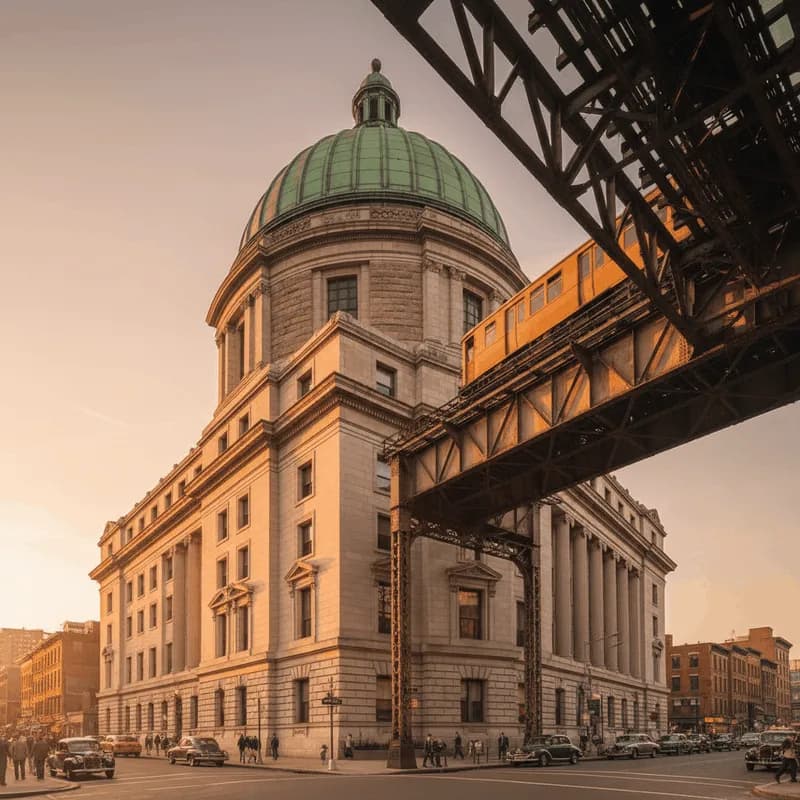
Anchor the start of your route at the intersection of Broadway and Driggs Avenue, where the Williamsburgh Savings Bank Building rises in serene Classical Revival contrast to the rattling steel trestles of the elevated J, M, and Z subway line. Completed in 1875 by pioneering skyscraper architect George B. Post and expanded eastward in 1906 by Helmle, Huberty and Hudswell, this limestone and Westerly granite temple is crowned by a soaring dome inspired by the Pantheon in Rome and the Baptistery in Florence. Step onto the south sidewalk of Broadway to admire the monumental Corinthian columns, the deeply coffered entrance arch, and the tall arched windows that once illuminated a rotunda rising more than one hundred feet above the banking floor.
Walk one block west along Broadway to the corner of Bedford Avenue to compare Post's Roman dome with the older Kings County Savings Bank Building, completed in 1868 by the architectural partnership of King and Wilcox. Built in the French Second Empire style at the height of post-Civil War prosperity, its rusticated Dorchester sandstone walls, paired columns, and convex slate mansard roof pierced by circular dormers established Broadway as Brooklyn's northern financial spine. Just across the bridge approach plaza on South Fifth Street stands a third financial landmark, the 1906 Williamsburgh Trust Company Building, designed as a compact Beaux-Arts pavilion with Ionic colonnades.
Standing at the western edge of Washington Plaza, look up at the monumental granite anchorage and the open-lattice steel approaches of the Williamsburg Bridge, engineered by Leffert L. Buck with architectural detailing by Henry Hornbostel and opened in December 1903. When it debuted as the first major suspension bridge built with all-steel towers rather than stone masonry piers, its dual transit decks and pedestrian footway connected the Lower East Side directly to Broadway in Brooklyn, fueling an immediate building boom of Classical Revival schools, bathhouses, and libraries—including architect Richard A. Walker's 1908 Williamsburgh Branch of the Brooklyn Public Library just south at Division Avenue and Marcy Avenue.
Intact 1850s Italianate Row Houses on Fillmore Place
Turn north off Grand Street between Driggs Avenue and Roebling Street to slip into Fillmore Place, a single-block time capsule designated as a New York City Historic District in 2009. Laid out in 1853 on land owned by merchant Samuel E. Fillmore, this tranquil street preserves twenty-eight continuous three-story Italianate red-brick row houses built during the 1850s for local ship captains, merchants, and master craftsmen. Because no mid-rise apartment buildings ever broke the cornice line, both sides of the roadway retain their original scale and rhythm.
Take a few minutes to study the subtle variations in cast-iron and wood craftsmanship along Fillmore Place. Many houses still display their original heavy bracketed wooden cornices, molded window lintels, paneled double entrance doors, and decorative cast-iron front yard fences with gatepost urn finials. At the eastern end of the lane, the vista closes against a former nineteenth-century cannon and iron foundry building, reminding walkers that domestic row houses and heavy metalworking shops stood side by side in early industrial Brooklyn.
Romanesque Industrial Brickwork along the East River and Onion Domes Northward
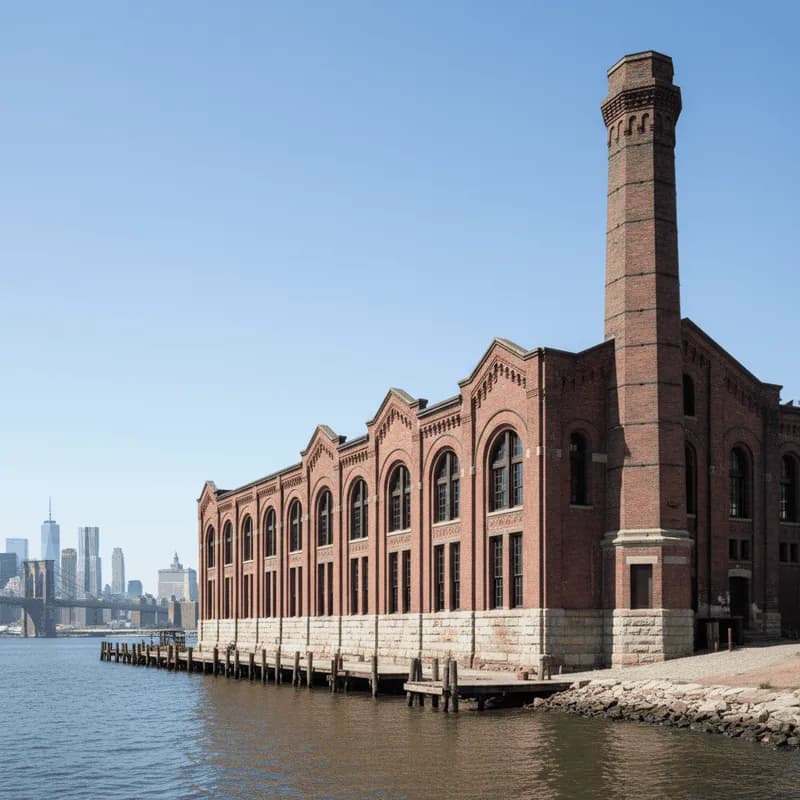
Head west down Grand Street or South Fourth Street to the East River esplanade at Domino Park along Kent Avenue and River Street. Towering above the waterfront lawn is the preserved red-brick shell of the Domino Sugar Refinery's Filter, Pan, and Finishing House, reconstructed between 1882 and 1884 for the Havemeyer family after a catastrophic fire destroyed an earlier plant. Built in the American Round-Arch and Romanesque Revival industrial idiom, its thick load-bearing brick walls, rhythmic tiers of segmental-arched windows, and soaring brick chimney stack once processed more than half of the refined sugar consumed in the United States.
Completed in 2023 inside that nineteenth-century masonry envelope, a vaulted glass-and-steel barrel structure rises slightly above the historic parapet, separated by a narrow perimeter gap that lets you see the original multi-wythe brick thickness from the elevated catwalk in Domino Park. If you extend your walk ten minutes north along Bedford Avenue and Driggs Avenue toward McCarren Park, stop at the corner of North Twelfth Street and Driggs Avenue to view the Russian Orthodox Cathedral of the Transfiguration of Our Lord. Designed by Brooklyn architect Louis Allmendinger and built between 1916 and 1921, its buff brick walls and five oxidized green copper onion domes bring sixteenth-century Muscovite church geometry to the edge of Greenpoint and Williamsburg.
Lighting Angles, Weekend Bottlenecks to Skip, and Your Waterfront Plan B
Late morning through mid-afternoon offers the most rewarding light across Williamsburg: midday sun penetrates beneath the Broadway elevated tracks to illuminate the sandstone reliefs of the 1868 and 1875 bank facades, while afternoon rays off the East River turn the 1882 red brickwork of the Domino refinery a warm terracotta glow. Along quiet residential enclaves like Fillmore Place, keep voices conversational and observe cast-iron fence details from the public bluestone sidewalk rather than leaning over private courtyard gates.
Skip walking Bedford Avenue between Metropolitan Avenue and North Seventh Street on Saturday and Sunday afternoons if you want an unhurried architectural stroll; heavy boutique and brunch foot traffic crowds the narrow curbs and obscures the surviving nineteenth-century wood-frame and brick cornices. Also skip standing directly under the Williamsburg Bridge roadway ramps at Roebling Street during weekday rush hours when bus and truck noise peaks. If wind off the East River or a passing shower interrupts your Kent Avenue segment, switch to your Plan B by looping inland along Berry Street—which operates as a shared slow-speed street during daytime hours—or pausing beneath the sheltered archways around Grand Street and Driggs Avenue. Use the Karpo APP to link these five Williamsburg landmarks into a smooth walking route paired with nearby waterfront benches or coffee roasters.
Ask Karpo for more information.
Keep reading
- SoHo Tailor Alteration Shop Finder for Sample Sale Finds
 Williamsburg Tailor Alteration Shop Finder for Bike Riders
 Upper West Side Tailor Alteration Shop Finder for Kids