 SoHo Tailor Alteration Shop Finder for Sample Sale Finds
Neighborhood Guides
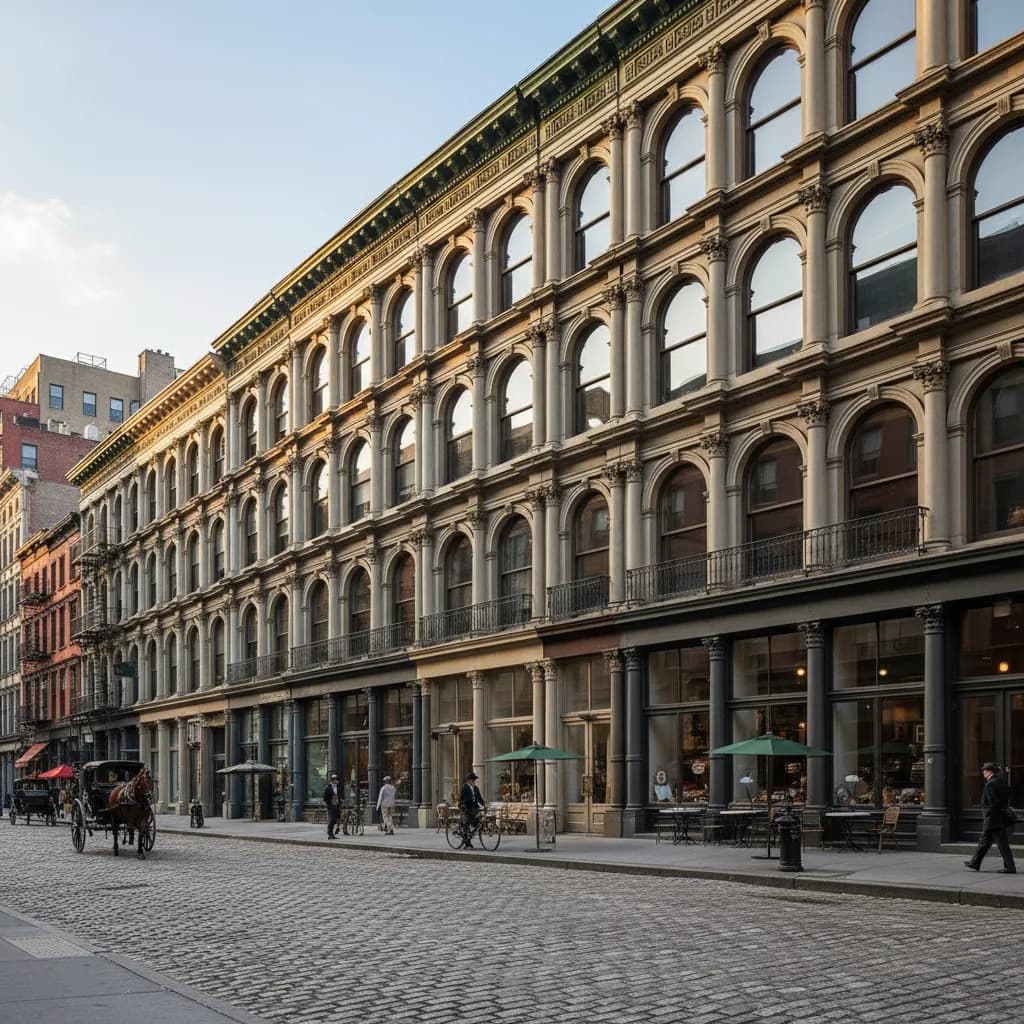
SoHo Historic Architecture Walking Route: Cast-Iron Walk
Trace a SoHo historic architecture walking route along Greene Street, Broadway, and Crosby Street to inspect 1857 cast-iron columns and Belgian block lanes.
At first glance from the sidewalk along Greene Street or Mercer Street, the towering cream, olive, and ochre facades of SoHo appear to be carved from blocks of Italian marble and French limestone. Tap your knuckles gently against a ground-floor pilaster, however, and a hollow metallic ring gives away the secret that transformed nineteenth-century American building technology. Following a SoHo historic architecture walking route between Canal Street and Houston Street immerses you in the world's largest surviving collection of prefabricated cast-iron commercial palaces, protected since 1973 within the SoHo-Cast Iron Historic District.
How Prefabricated Iron Palaces Replaced Stone along Broadway
During the 1850s, inventors James Bogardus and Daniel D. Badger demonstrated that molten pig iron poured into sand molds could replicate intricate Renaissance columns, Corinthian capitals, and arched window spandrels at a fraction of the cost of hand-chiseled stone. Better still, bolted iron frames were strong enough to support vast plate-glass windows that flooded dry-goods showrooms and textile lofts with natural daylight. Begin your route at the northeast corner of Broadway and Broome Street in front of the E. V. Haughwout Building, completed in 1857 by architect John P. Gaynor with iron modules cast at Badger's Architectural Iron Works.
Modeled after Jacopo Sansovino's sixteenth-century library in Venice, the Haughwout facade repeats ninety-two arched window bays framed by fluted Corinthian columns and keystones across five stories. Because both street elevations were bolted together from identical iron castings, the building achieved a crisp classical rhythm that also concealed a technological milestone inside: Elisha Graves Otis installed the world's first steam-powered passenger safety elevator here in 1857, proving that upper stories of commercial lofts could command prime retail prestige.
Walking the Cast-Iron Canyon of Greene Street from Canal to Prince
Walk two blocks west from Broadway and turn north onto Greene Street, where fifty uninterrupted cast-iron structures line the five blocks between Canal Street and Houston Street. Between Canal Street and Grand Street, pause to compare the neighboring facades affectionately known to architectural historians as the King and Queen of Greene Street. Completed in 1873 by architect Isaac F. Duckworth, the Second Empire King building projects boldly toward the roadway with three-dimensional Corinthian columns, deep shadow lines, and a central pedimented portico that mimics a grand stone temple.
Just up the block between Grand Street and Broome Street stands the Queen of Greene Street, designed by J. Morgan Slade and completed in 1882 as a warehouse before its ornate French Renaissance mansard roof and central cupola were added. As you continue north toward Spring Street and Prince Street, crouch near the base of the ground-floor piers to hunt for oval and rectangular iron foundry plaques bolted to the plinths. Stamps reading Cornell Iron Works, Architectural Iron Works, and Lindsay, Graff and Megquier still mark the Brooklyn and Lower East Side furnaces where these columns were cast more than a century ago.
Terra-Cotta Curtain Walls and Sidewalk Vault Lights on Broadway and Crosby
Cut back east at Prince Street to Broadway to study how turn-of-the-century engineers pushed metal-and-glass framing into the twentieth century. Rising twelve stories on the west side of Broadway just north of Prince Street, the Little Singer Building—completed in 1904 by architect Ernest Flagg for the Singer Manufacturing Company—abandons historicist stone imitation in favor of a bold red-brick, buff terra-cotta, and wrought-iron curtain wall. Notice the delicate lacy iron balconies at the recessed fifth floor, the expansive gridded glass window bays, and the curving cantilevered metal cornice at the summit.
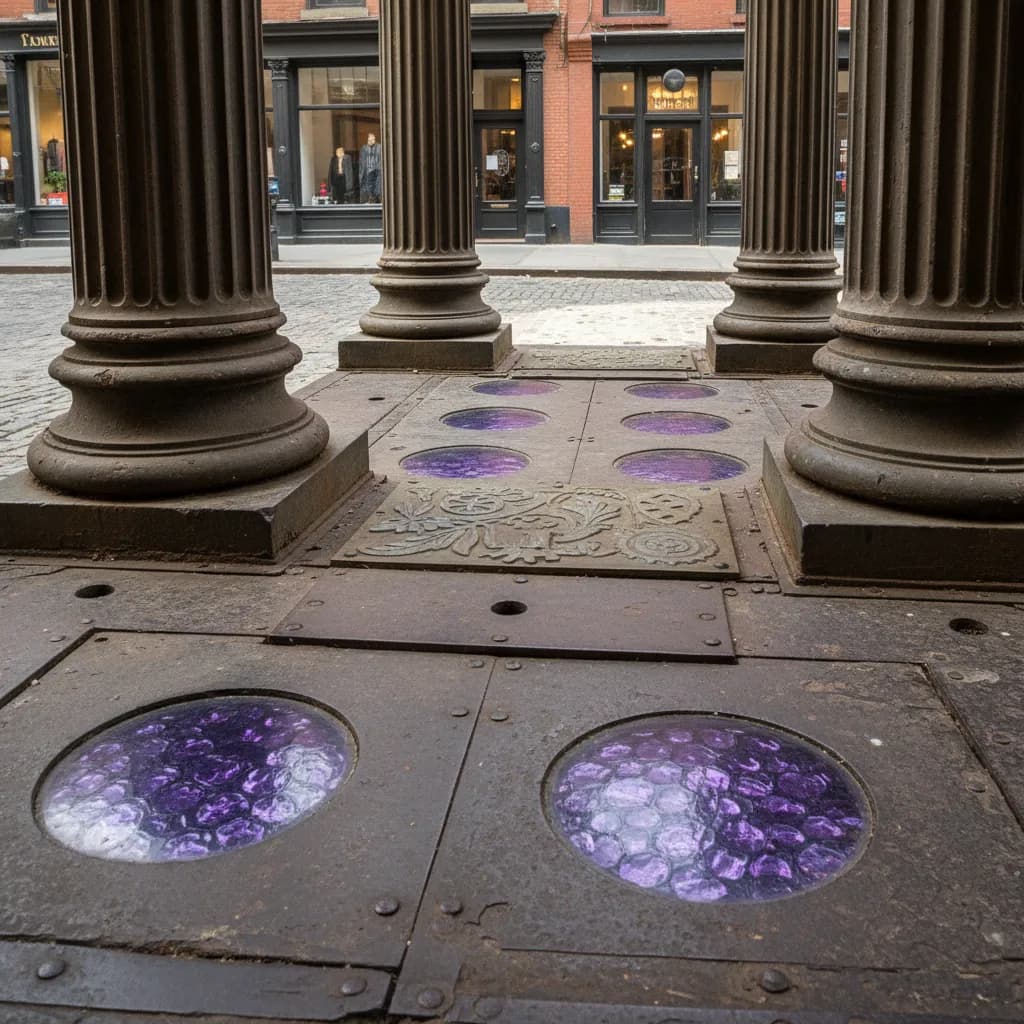
Slip one block east behind Broadway onto Crosby Street, once a service alley for horse-drawn freight wagons backing up to the rear of Broadway department stores. Underfoot, rectangular Belgian granite paving blocks still line the roadway, while raised cast-iron loading steps along the building fronts are studded with hundreds of round glass vault lights. Originally clear, the manganese dioxide mixed into the nineteenth-century glass has reacted with decades of ultraviolet sunlight, turning the thick glass lenses a deep amethyst purple while they continue to filter daylight into basement storage vaults below the sidewalk.
Before leaving the eastern edge of the district, walk north along Crosby Street to the corner of Houston Street and Lafayette Street, where the Romanesque Revival Puck Building anchors the block. Designed by architect Albert Wagner and erected in two phases between 1885 and 1893 for the J. Ottmann Lithographing Company and the satirical *Puck* magazine, its load-bearing red brickwork, rounded entry arches, and two gilded lead statues of Shakespeare's mischievous sprite sculpted by Henry Baerer demonstrate how heavy masonry competed with cast-iron lofts at the close of the nineteenth century. Comparing the Puck Building's massive brick piers with the slender iron columns and curved corner plate glass of Griffith Thomas's 1871 Gunther Building at Broome and Greene Streets crystallizes why SoHo remains essential viewing for anyone studying structural design.
Best Morning Light, Crowds to Skip, and Your Mercer Street Plan B
Because Greene Street, Wooster Street, and Mercer Street run south to north inside deep five- and six-story loft canyons, the best light for observing column fluting and cornice brackets arrives between nine in the morning and noon. Bring flat-soled walking shoes with firm grip: polished iron step plates studded with glass vault disks become slick after morning mist or rain, and uneven Belgian block crosswalks on Greene and Crosby Streets demand steady footing. You will frequently spot industrial design students rubbing pencil tracings of foundry stamps and photographers framing the repeating perspective of fire escapes.
Skip walking Broadway between Canal Street and Spring Street on Saturday and Sunday afternoons, when wall-to-wall flagship retail crowds make stopping to look up at the Haughwout or Little Singer facades nearly impossible. Also skip Prince Street between Broadway and West Broadway during midday weekend shopping peaks. When foot traffic thickens on Greene Street or a sudden rain squall hits, activate your Plan B by shifting one block west to Wooster Street or one block east to Mercer Street below Broome Street, where deeper loading bays offer overhead shelter and quieter sidewalks preserve clear diagonal views of the upper ironwork. Open the Karpo APP before your walk to organize your SoHo cast-iron stops and pair the loop with nearby gallery courtyards or espresso bars.
Ask Karpo for more information.
Keep reading
- SoHo Tailor Alteration Shop Finder for Sample Sale Finds
 Williamsburg Tailor Alteration Shop Finder for Bike Riders
 Upper West Side Tailor Alteration Shop Finder for Kids