 SoHo Tailor Alteration Shop Finder for Sample Sale Finds
Neighborhood Guides
NYC Historic Architecture Stroll: Free Village Route
Explore Greenwich Village on this historic architecture stroll past Federal brick facades, Victorian Gothic towers, and leafy preserved courtyard gates.
Few neighborhoods anywhere in the United States embody such a rich convergence of revolutionary history, avant-garde artistic culture, and remarkably preserved historic architecture as Greenwich Village. Escaping the rigid gridiron imposed on upper Manhattan by the Commissioners Plan of 1811, the Village retains its charming eighteenth-century street layout, where narrow thoroughfares follow old colonial property lines and meandering waterways like Minetta Brook. Within this intimate urban fabric survives a remarkable density of late Federal brick townhouses, Greek Revival mansions, Victorian Gothic public monuments, and secluded courtyard lanes. This self-guided historic architecture stroll takes you through the heart of the Greenwich Village Historic District, uncovering hidden architectural treasures, literary sanctuaries, and historic civic battles that preserved this beloved neighborhood across two dynamic centuries of urban growth.
Washington Square North and The Greek Revival Row
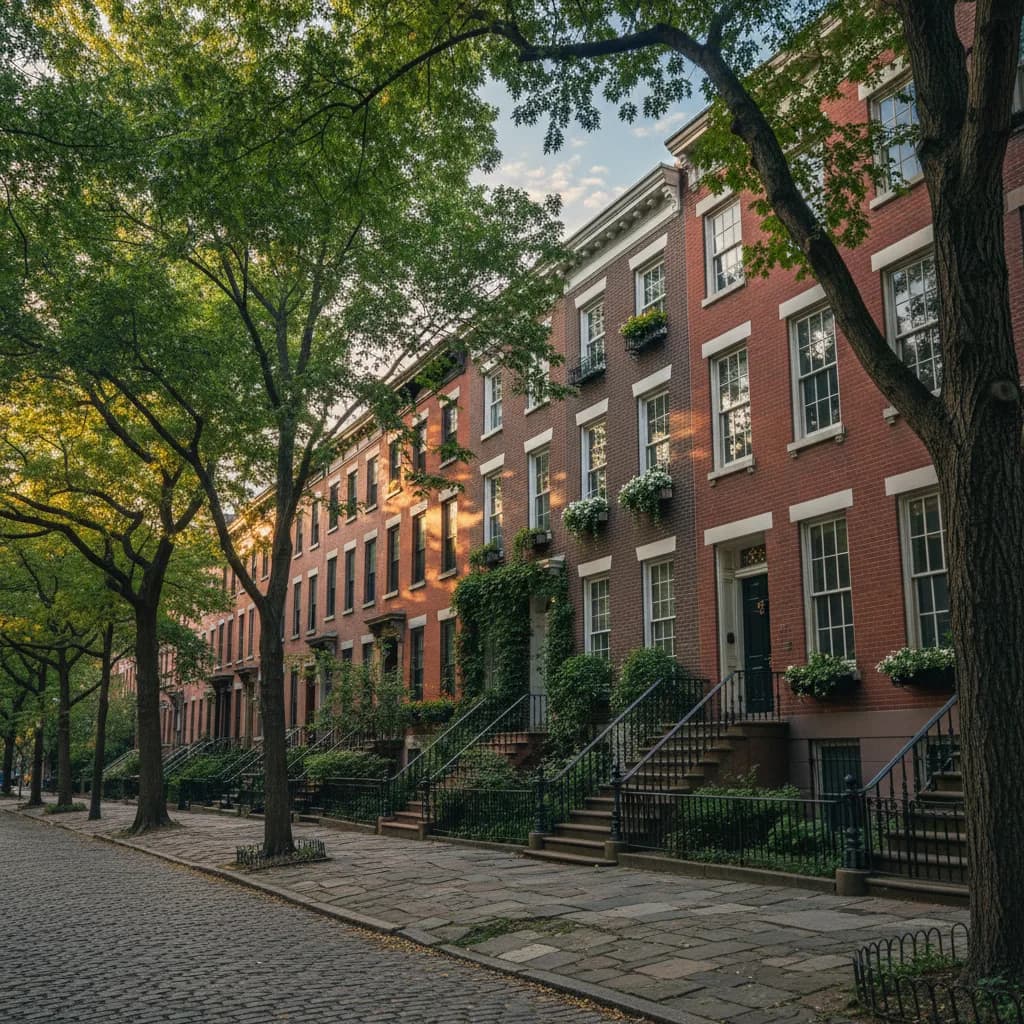
Begin your stroll on the north side of Washington Square Park along Washington Square North, home to one of the most celebrated domestic architectural ensembles in the city, known simply as The Row. Erected in the early 1830s for New York merchant elite, these stately red brick townhouses feature gleaming white marble stoops, classical Ionic entrance porches, and continuous iron roof balustrades. Walking past numbers 1 through 13 reveals where figures like Henry James and Edward Hopper found enduring creative inspiration, looking southward toward the marble Washington Square Arch.
The Washington Square Arch itself, designed by renowned architect Stanford White and dedicated in 1892, provides a monumental neoclassical anchor for Fifth Avenue. Constructed of Tuckahoe marble, this Roman triumphal arch commemorates the centennial of George Washington presidential inauguration, featuring heroic relief carvings of Washington as commander-in-chief and civilian leader surrounded by allegorical figures of Fame, Valor, and Justice. Notice the classical frieze carved with wreaths and crossed swords beneath the heavy crowning attic story.
Take a moment to look at the transition from Federal style to Greek Revival across Washington Square North. Number 21 and 22 feature delicate fanlight transoms above wooden entry doors, while Number 3 showcases heavier stone pilasters and bold Greek fretwork along the window architraves, illustrating the rapid shift toward classical antiquity in early nineteenth-century domestic taste.
The deep setbacks from the sidewalk allowed wealthy residents to maintain private front gardens enclosed by cast-iron fences, creating a suburban air of aristocratic detachment in the midst of Manhattan rapid downtown expansion.
Gothic Revival Towering Splendor at Jefferson Market
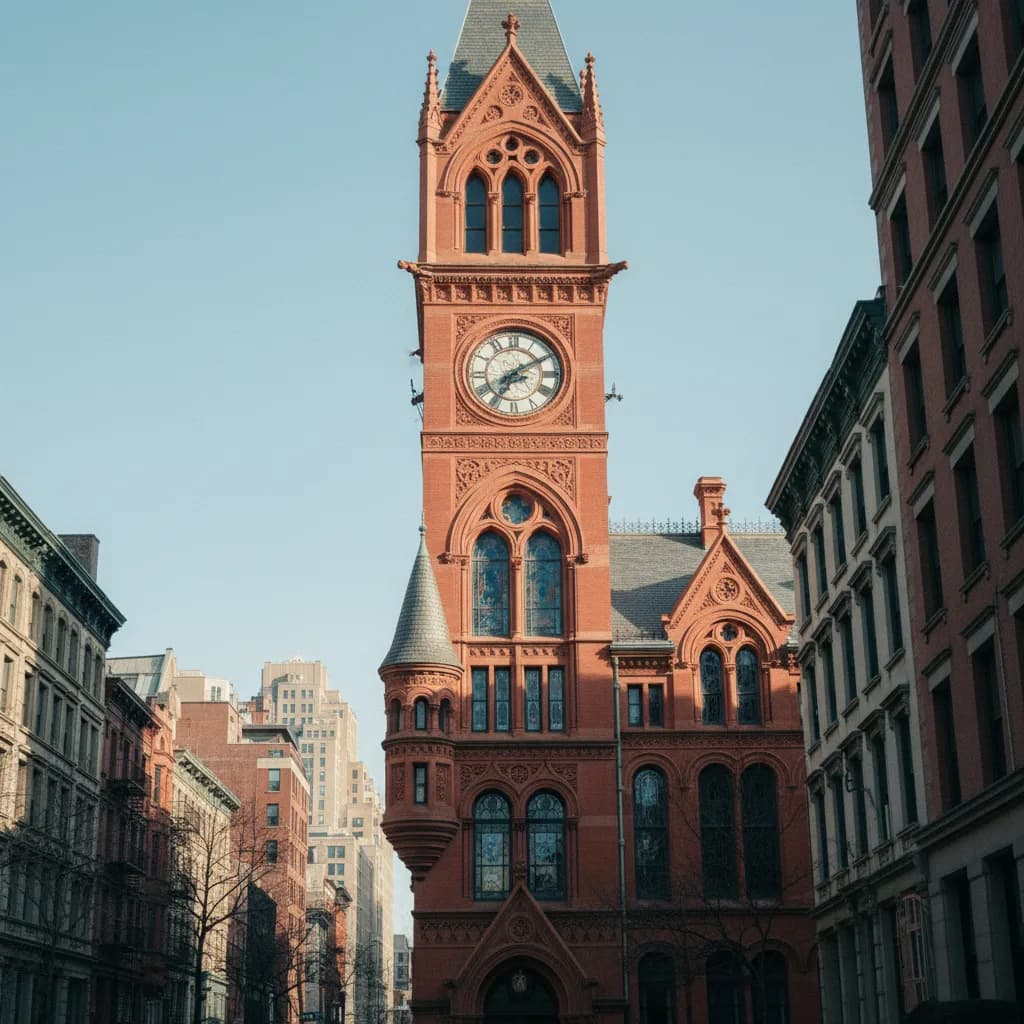
Wander westward along West 10th Street toward Sixth Avenue to behold the breathtaking High Victorian Gothic silhouette of the Jefferson Market Library at 425 Sixth Ave. Designed by architects Frederick Clarke Withers and Calvert Vaux and completed in 1877 as the Third Judicial District Courthouse, this picturesque civic complex features polychromatic brickwork, soaring granite arches, intricately carved animal gargoyles, and vibrant stained glass rose windows.
Crowning the landmark is a dramatic 172-foot clock tower that originally served as a volunteer fire lookout over Lower Manhattan. By the late 1950s, the abandoned courthouse faced demolition until local community leaders, including poet E.E. Cummings and critic Lewis Mumford, led a successful campaign to repurpose the structure into a public branch library in 1967, proving that historic civic architecture could find new life through thoughtful preservation.
Walk around the perimeter to visit the Jefferson Market Garden, formerly the site of the women house of detention. Today, this lush public garden offers a peaceful vantage point to admire the exterior stone traceries, whimsical relief carvings of water birds and storks, and patterned red-and-black roof slates that define High Victorian architectural romance.
The building clock tower still chimes on the hour, filling the surrounding intersection with deep, resonant tones that have marked the neighborhood daily rhythm for nearly a century and a half.
Secluded Enclaves of Patchin Place and Milligan Place
Just north of the library along West 10th Street, seek out the discreet wrought-iron gate guarding Patchin Place. Developed in 1848 as modest residential housing for Basque waiters employed at the nearby Brevoort Hotel, this tranquil ten-house cul-de-sac preserves one of the few remaining nineteenth-century gas lamps in Manhattan. The secluded brick courtyard provided a peaceful creative sanctuary for legendary writers, including poet E.E. Cummings, modernist author Djuna Barnes, and novelist Theodore Dreiser.
Around the corner on Sixth Avenue sits Milligan Place, another hidden triangular courtyard constructed in 1852 by Samuel Milligan. Tucked behind protective iron security gates and shaded by mature wisteria vines, these four-story brick residences showcase the layered domestic intimacy of the Village, where quiet interior courtyards shielded residents from the bustling commercial avenues just beyond their brick archways.
Federal Brickwork and Angle Irregularities on Bedford Street
Meander southward through the twisting intersection of West 4th and West 10th Streets toward Bedford Street. Outside 77 Bedford Street, examine the Isaacs-Hendricks House, the oldest surviving residential structure in Greenwich Village. Erected in 1799 as a standalone timber-framed farmhouse, the home was later faced in red brick and crowned with a historic gambrel roof, serving as physical testimony to the neighborhood rural origins during the yellow fever epidemics of the late eighteenth century.
Directly adjacent at 75 1/2 Bedford Street stands the narrowest house in New York City, measuring just nine and a half feet wide on the exterior and slightly over eight feet inside. Built in 1873 across what was once a carriage gateway between adjoining estates, this diminutive Dutch-gabled townhouse was inhabited by celebrated poet Edna St. Vincent Millay in the 1920s, who founded the Cherry Lane Theatre just down the block along Commerce Street.
At the intersection of Bedford and Grove Streets, pause outside Grove Court, a hidden enclave of six brick Federal townhouses built in 1854 behind a gaslit iron gate, illustrating how early nineteenth-century builders created peaceful residential clusters behind street-facing facades.
Stroll Logistics and Neighborhood Navigation Tips
This self-guided Greenwich Village architecture stroll covers roughly one point three miles and takes between sixty and seventy-five minutes to complete at an observant pace. Because the historic street grid features irregular angles where streets intersect themselves, walking with patience allows you to appreciate unexpected diagonal vistas and hidden carriage lanes at every turn.
Abundant public transit connects directly to the route: use the West 4th Street-Washington Square station serving the A, B, C, D, E, F, and M lines, or the Christopher Street-Sheridan Square station on the 1 train. The optimal time for photography is mid-morning on a weekday or Sunday afternoon, when natural light filters softly through the mature London plane trees lining the sidewalks. Karpo accompanies your journey in the Karpo APP, illuminating the winding Greenwich Village lanes and hidden Federal-era brick courtyards.
Ask Karpo for more information.
Keep reading
- SoHo Tailor Alteration Shop Finder for Sample Sale Finds
 Williamsburg Tailor Alteration Shop Finder for Bike Riders
 Upper West Side Tailor Alteration Shop Finder for Kids