 SoHo Tailor Alteration Shop Finder for Sample Sale Finds
Neighborhood Guides
NYC Historic Alleyway Walk Planner: Brooklyn Heights Mews
Brooklyn Heights became NYC's first historic district in 1965. Walk Hunts Lane, Grace Court Alley and Love Lane, then end on the Promenade facing Manhattan.
Grace Court Alley, Hunts Lane and Love Lane are the three carriage-house lanes of Brooklyn Heights, and together they make a quiet 70-minute historic alleyway walk that ends on the Brooklyn Heights Promenade as the sun drops behind lower Manhattan. Brooklyn Heights was designated the first historic district in New York City in 1965, and its mews are a big part of why. Start at Borough Hall station, walk west through the brownstone blocks, and save the river view for the finish.
Where the Horses Lived
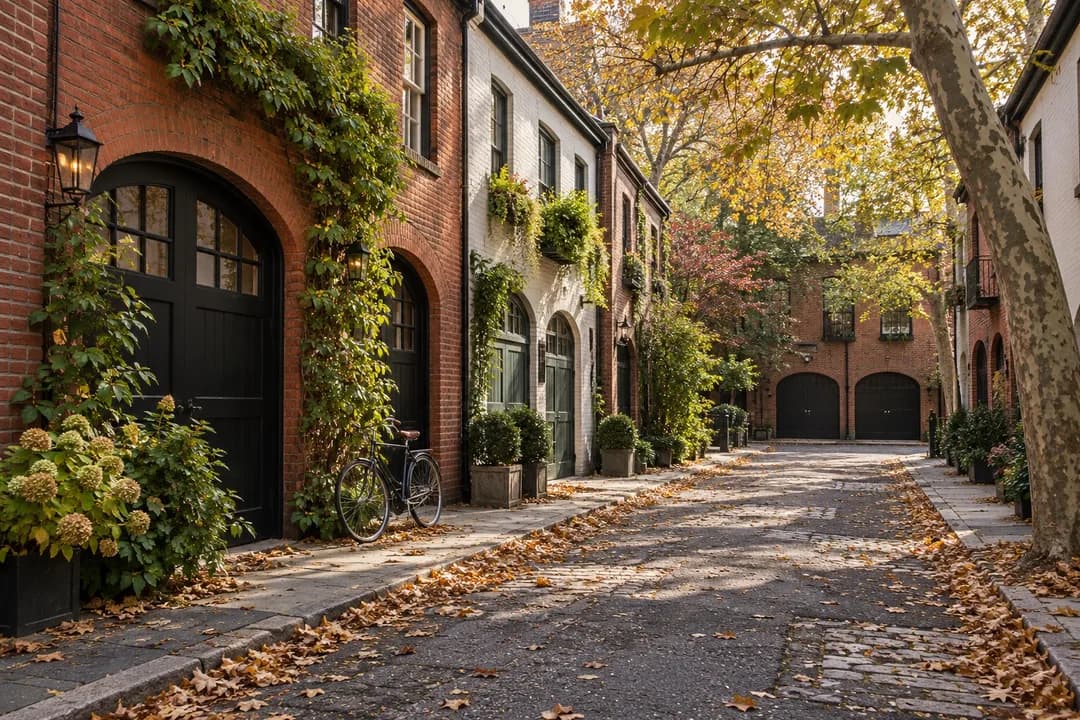
In the nineteenth century, the wealthy families who built brownstones and Greek Revival houses on streets like Remsen, Joralemon and Pierrepont did not keep horses at their front doors. They kept them in stables on small service lanes behind the main streets. Grace Court Alley and Hunts Lane are the clearest survivors of that system: short dead-end lanes lined with two-story brick carriage houses, many with arched doorways where the carriages once rolled in.
When the automobile arrived, the stables were converted into garages and later into homes, and the lanes became some of the most sought-after addresses in Brooklyn. That conversion is why the facades look like small houses with oversized doors. The 1965 historic district designation froze much of this streetscape in place, so the lanes you see today look much as they did when they were turned into homes a century ago.
Start at Borough Hall and Head West
Come up from Borough Hall station, served by the 2, 3, 4 and 5 trains, or Court Street on the R. Brooklyn Borough Hall, completed in the 1840s as Brooklyn's city hall when Brooklyn was still a separate city, is the landmark at the start. Walk west along Joralemon Street, one of the most handsome streets in the district, which slopes downhill toward the harbor and is lined with brownstones and a few wooden houses.
Joralemon Street is worth walking slowly. Its downhill slope gives you a view of the old rooflines stepping down toward the water, and the street mixes architectural styles from several decades of the nineteenth century. Turn right at Henry Street to reach the first mews. If you are short on time, you can skip the full length of Joralemon and cut over on Remsen Street instead.
Hunts Lane, Off Henry Street
Hunts Lane is a short dead end off Henry Street near Remsen Street, lined with converted carriage houses. It is narrow, quiet, and residential, so treat it as a look-in stop. Stand at the entrance for a couple of minutes and look at the line of doors: you can still spot the wide openings that fit carriages, now filled with garage doors or glass. Window boxes and climbing vines soften the brick in summer and turn red and gold in autumn.
There is not much more to do here than look, which is the honest truth about most mews. The value of this walk is the sequence: seeing three versions of the same nineteenth-century solution within a few blocks. Take one photo, note the shape of the doors, and continue west on Remsen Street toward Hicks Street.
Grace Court Alley, Off Hicks Street
Grace Court Alley opens off Hicks Street near Joralemon Street and is the most photogenic of the three lanes. It runs deeper than Hunts Lane, and the carriage houses along it are a mix of brick and painted fronts, many with arched doors and decorative brickwork. In autumn the light from the west filters in late in the afternoon. Like Hunts Lane, it is residential, so keep to the entrance and keep voices low.
If you want a slightly longer pause, walk a few steps south to Grace Court itself, a separate short street that ends at a view toward the harbor behind Grace Church. The two names are easy to confuse. Grace Court Alley is the mews, and Grace Court is the cul-de-sac with the church at its corner. Both reward a few minutes.
Love Lane and College Place
Walk north on Hicks Street past Pierrepont Street to Love Lane, a tiny street that runs between Hicks and Henry Streets. It is one of the shortest streets in the neighborhood, with low buildings and a sense of an old village lane. College Place, a short narrow lane, connects with it and adds one more slice of the old scale. Together they take about five minutes to see and are public streets, so you can walk through rather than peer in.
From Love Lane, you are only a few blocks from Plymouth Church on Orange Street, where the preacher Henry Ward Beecher drew huge crowds in the nineteenth century and the congregation was active in the antislavery movement. If you have extra time, walk up Hicks to Orange Street to see it from the outside. Otherwise, head west on Pierrepont Street toward the water.
Finish on the Promenade
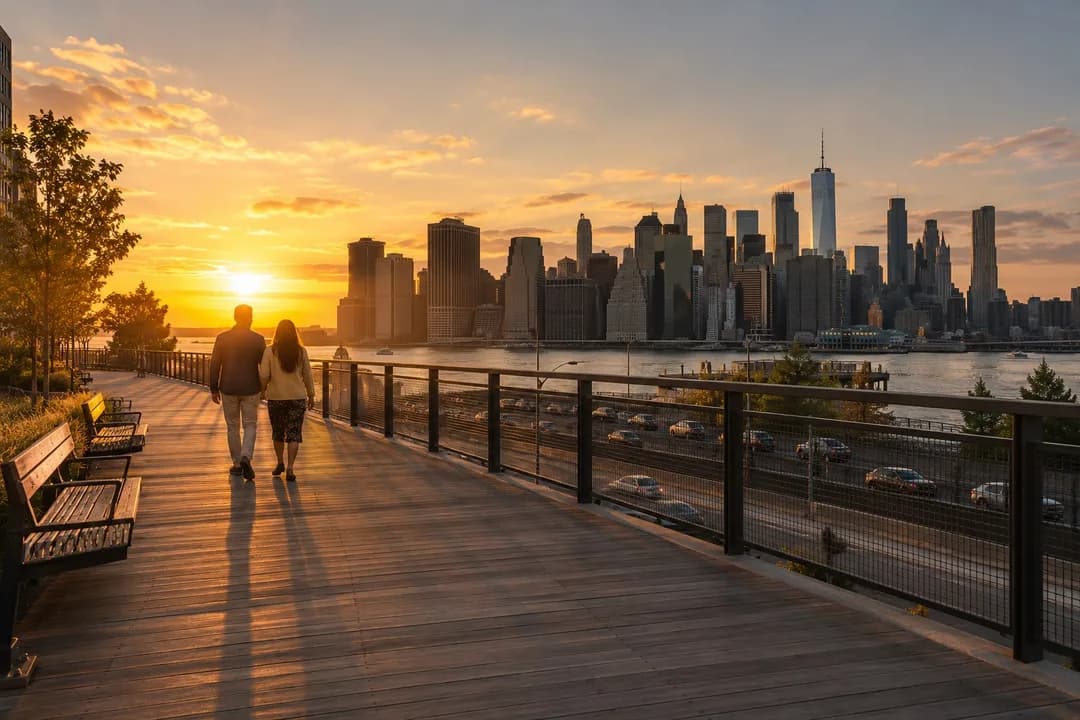
The Brooklyn Heights Promenade opened in the early 1950s on a cantilevered deck built over the Brooklyn–Queens Expressway. It runs for about a third of a mile along the edge of the Heights, with benches facing lower Manhattan, the Statue of Liberty in the distance and the Brooklyn Bridge to the north. Arrive here in the last 30 minutes before sunset, when the towers across the river catch the light.
If you are walking on a cloudy day, the Promenade is still worth it, but you could skip the final wait for sunset and head down to Brooklyn Bridge Park instead. Pierrepont Street leads to a set of stairs and paths connecting the Heights to the waterfront park. On a clear evening, though, the Promenade is the reason to time the walk around sundown.
Practical Notes
The full loop from Borough Hall through the three lanes to the Promenade is about a mile and a half and takes about 70 minutes with pauses. The streets are hilly in places and some sidewalks have tree roots and uneven slates, so wear comfortable shoes. Clark Street station on the 2 and 3 is a short walk from the north end of the Promenade for the trip home. To build your own version, tell Karpo in the Karpo APP when sunset is and how much time you have, and it will set the order.
Ask Karpo for more information.
Keep reading
- SoHo Tailor Alteration Shop Finder for Sample Sale Finds
 Williamsburg Tailor Alteration Shop Finder for Bike Riders
 Upper West Side Tailor Alteration Shop Finder for Kids