 SoHo Tailor Alteration Shop Finder for Sample Sale Finds
Neighborhood Guides
Heritage Historic District NYC: Hamilton Heights in 3 Views
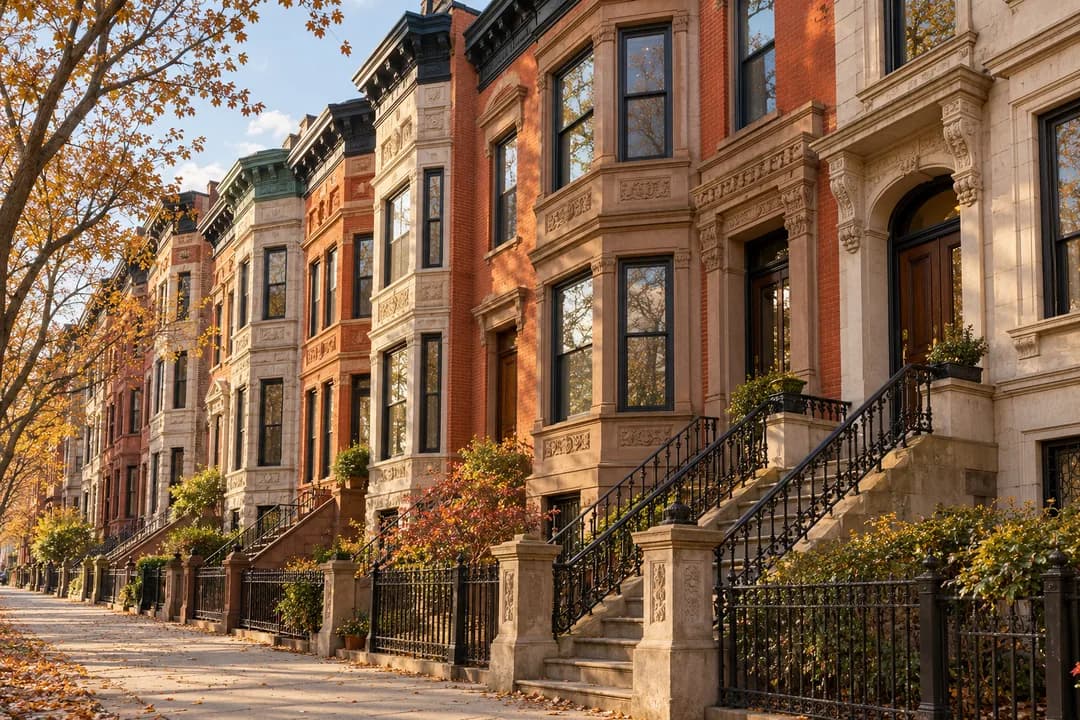
Hamilton Heights suits an exterior walk comparing rowhouses, larger residential facades and street rhythm, with official maps separating district boundaries.
Hamilton Heights is an NYC heritage historic district walk for readers who enjoy the changing rhythm of an urban facade. Convent Avenue and Hamilton Terrace give the outing a specific focus, while the city's district documentation supplies the boundary context. Look at how rowhouses, apartment buildings and religious architecture contribute different scales to a residential quarter. The proposed visit stays outside. It is not a tour of Alexander Hamilton's house or an invitation into a church: those would be separate visits with their own arrangements and a different purpose.
Follow the line above the front doors
Start by lifting your attention from the entrances to the roof edge. On a rowhouse street, the line across the tops can make several separate buildings read as a group. Then lower your eye to the windows and the bases of the facades. Ask whether the pattern continues or changes at each level. This is a useful first task because it makes you look at the composition of a street before deciding which individual house deserves a photograph.
A group does not have to be identical to feel connected. Height, spacing and repeated vertical divisions can supply continuity while the details vary. Think of the distinction between a repeated beat and a repeated note. For this walk, that is an analogy for looking, not a historical claim about an architect's intentions. Point to a visible feature when explaining your impression to a companion. A cornice line or projecting bay is a better starting point than a vague description such as charming.
Convent Avenue and Hamilton Terrace are a focus, not a rectangle
The LPC map identifies the original Hamilton Heights Historic District and labels the streets around it. The later extension has its own documentation. A route can use those references together without pretending that every nearby block belongs to one simple polygon. Keep the full district name attached to the map you save. Hamilton Heights as a neighborhood and Hamilton Heights as a particular designated area are related terms, but they are not interchangeable boundary descriptions.
Use Convent Avenue and Hamilton Terrace as the named focus when proposing the outing to a friend, then select a connected stretch from the official map. Avoid promising that a particular street corner is an official tour entrance. Your route is an editorial choice. The map establishes the designated geography, while you decide which exterior comparisons make sense for the group's time and interest. Keep those roles distinct, especially when sharing the route with somebody who has never visited the area.
The original district and its extension tell different parts of the story
The city's documentation dates the original designation to 1974 and the extension to 2000. The extension report explains that the added area brings apartment buildings and additional rowhouses into the preserved architectural picture. That is a useful reason to read both documents before making a list of things to notice. If you focus exclusively on a photogenic townhouse row, you can miss the variety that the expanded designation was meant to recognize.
This does not require an outing built around municipal chronology. Keep the dates as a small note, then look for a change in building scale. How does an apartment facade organize more windows or a larger entrance? How does a rowhouse announce an individual threshold? These questions connect the documentation to something a walker can actually observe. They also avoid the unsupported assumption that an older-looking building is more significant than a larger or less ornate neighbor.
Make one comparison about the street wall
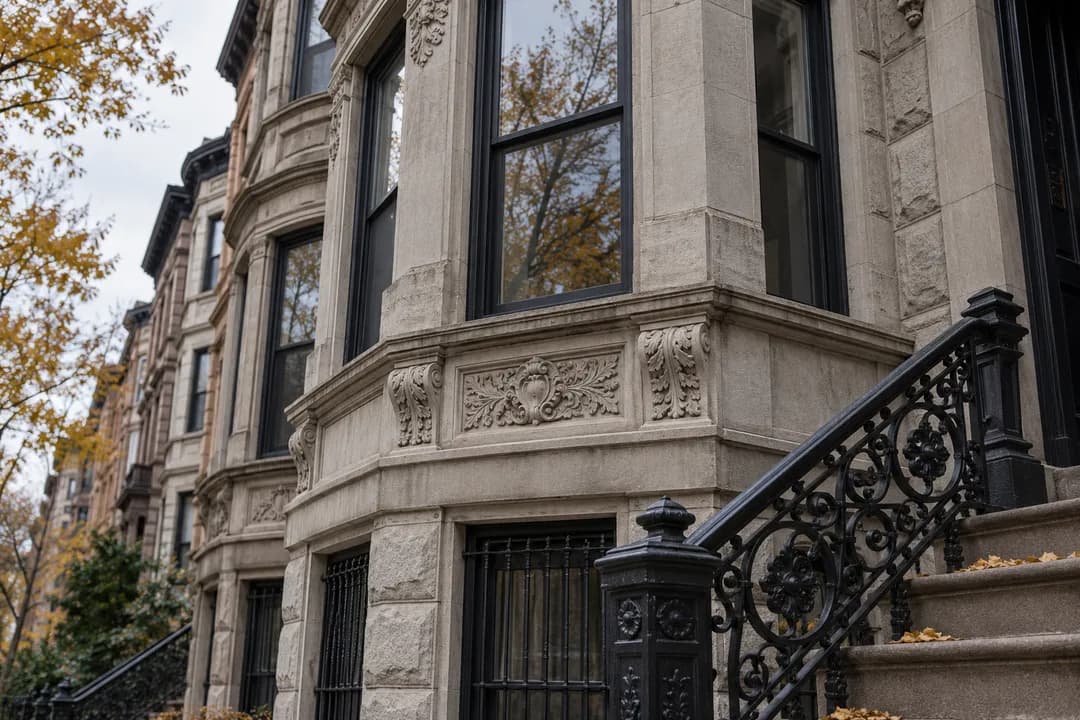
Pick two exterior compositions that you can view comfortably from public space. Give each a few plain descriptive words, such as a projecting window, a recessed entrance or a horizontal band. Then explain how those elements change the apparent depth of the facade. Do not label a building flat simply because the photograph is frontal. A slight change in viewpoint may reveal a bay, a step in the building line or the depth around an entrance that the first frame concealed.
For an architectural photography outing, make a deliberate pair: one image to explain the street wall, another to explain a detail. The pair should answer a question rather than merely add variety to an album. If the detail depends on cropping out most of the building, keep the wider frame beside it. Otherwise an attractive fragment can become detached from the street relationship that gives it meaning. Work from the viewpoint available without stepping onto a stoop or obstructing an entrance.
Religious buildings need a different viewing distance
The district's architectural record includes religious structures as well as housing. Their scale and role can change how a street is perceived, but this article does not promise interior access or describe a current service schedule. Treat a religious building as an exterior architectural observation unless you have made a separate, appropriate visit arrangement. A doorway that is being used by a congregation is not a convenient place to assemble a sightseeing group.
Stand where the broader mass can be understood, then compare it with the residential facades around it. The question is how a different building type meets the same urban street. Avoid inventing a community story from appearances alone. A photograph of an exterior cannot establish how a congregation uses the space or what residents think of it. If those human histories become your interest, use documented accounts rather than filling the gap with a plausible anecdote.
Hamilton's name does not have to dominate the walk
A familiar historical name can easily pull attention away from the buildings actually in front of you. For this outing, skip the impulse to turn every observation into a Hamilton biography. A museum visit and a district architecture walk can both be worthwhile, but combining them automatically can leave neither with enough attention. Keep this visit about the urban fabric: repeated houses, larger residential buildings and the way their entrances and rooflines shape the street.
That narrower choice also gives the day a natural ending. Finish after a comparison that the group can describe clearly. You do not need a distant celebrity address or an interior attraction to validate the walk. If a companion wants a museum-focused day instead, choose that as a separate plan. The benefit of an explicit purpose is that it lets you recognize when the planned outing fits the people joining it, before adding travel and expectations that point somewhere else.
Practical Notes for an exterior architecture outing
Use the LPC district and extension maps as the geographic references. Keep residential stoops, doors and private paths outside the stops, and leave room for ordinary pedestrian movement. No admission, guide, restroom, interior access or current event is included in this suggested walk. Choose the route according to the group's walking requirements rather than assume that a short line on a map describes an accessible experience. A preservation designation is historical context, not a visitor services guarantee.
When beginning a neighborhood conversation in the Karpo APP, describe the actual brief: Hamilton Heights, exterior architecture, Convent Avenue and Hamilton Terrace as the focus, and an interest in comparing rowhouses with larger building types. That is more useful than asking for every landmark in Harlem. Keep the municipal documentation for the facts and your own observations for the interpretation. The aim is to leave with a more exact way of seeing the street, rather than a collection of names detached from buildings.
Ask Karpo for more information.
Keep reading
- SoHo Tailor Alteration Shop Finder for Sample Sale Finds
 Williamsburg Tailor Alteration Shop Finder for Bike Riders
 Upper West Side Tailor Alteration Shop Finder for Kids