 Chelsea Consignment Shop Crawl Planner for Your First Studio
Hidden Gems & Odd Finds
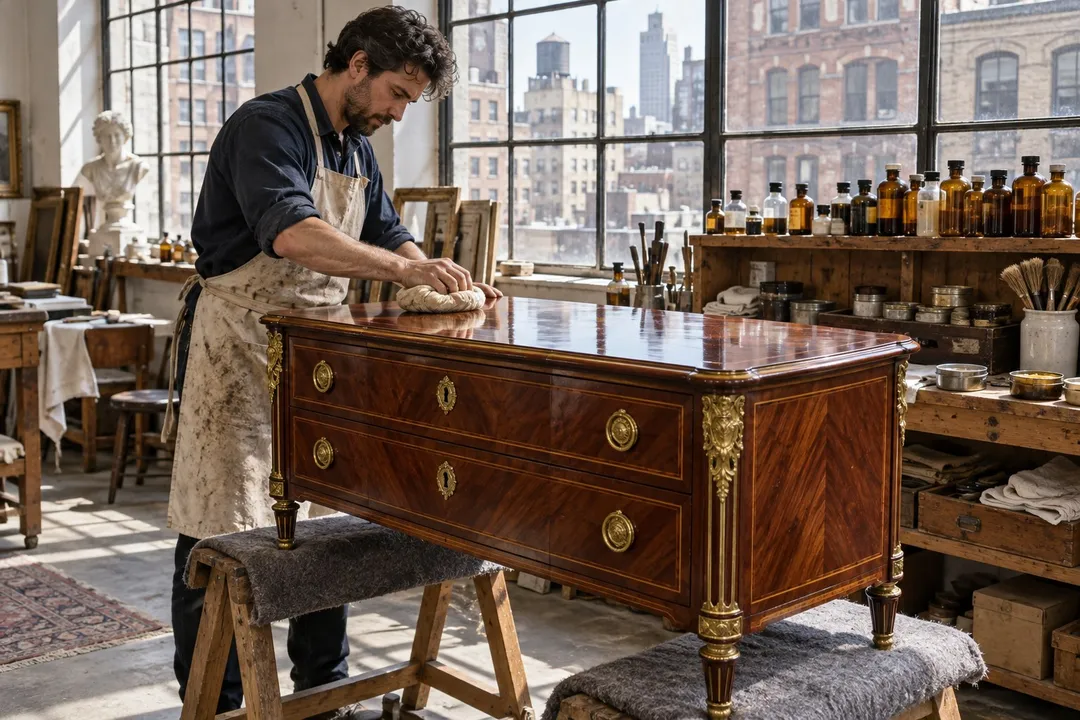
French Polish Furniture Restoration Shop in Midtown: Pourny
Christophe Pourny Studio, an appointment-only furniture restoration shop at 247 West 30th Street, brings Paris French polish and straw marquetry to Midtown.
Christophe Pourny Studio sits behind an eighth-floor door at 247 West 30th Street, Suite 8F, a few blocks south of Penn Station in Manhattan's old Garment District. It is a furniture restoration shop in the French tradition, run by a Provençal-born craftsman who wrote The Furniture Bible, and it works strictly by appointment. If an inherited commode has lost its shine or a straw marquetry box has started to shed its straws, this is one of the few Manhattan benches that still finishes wood with a hand-padded French polish.
A Childhood Spent in an Antique Shop in Fayence
Christophe Pourny was born in the Var, the hill country behind the Côte d'Azur, and grew up in his parents' antique store in the village of Fayence. His own biography on the studio's About page describes those years as his first training ground, among dealers, cabinets and the smell of wax. He later apprenticed with his uncle, Pierre Madel, in a workshop on Rue Jacob on the Left Bank of Paris, the street long known for antique dealers and restorers.
He moved to New York roughly twenty-five years ago. The first jobs were done inside clients' townhouses, polishing paneling and repairing pieces that could not easily leave the house. A restoration studio in Brooklyn followed, and the work grew to include civic commissions. The studio lists restoration work at City Hall, Gracie Mansion and the Holy See's Mission to the United Nations among its projects.
From The Furniture Bible to West 30th Street
In 2010 Jason Jobson joined as a partner, and the two developed a line of natural wood and leather care products made to the same recipes used on the bench. In 2016 Artisan Books published The Furniture Bible, Pourny's guide to identifying, repairing and caring for furniture, with a foreword by Martha Stewart. A retail store opened in Industry City in Sunset Park in 2019, and in 2024 the studio moved to its current Manhattan suite on West 30th Street. Press coverage has run in Elle Decor, Architectural Digest, The New York Times and The Wall Street Journal.
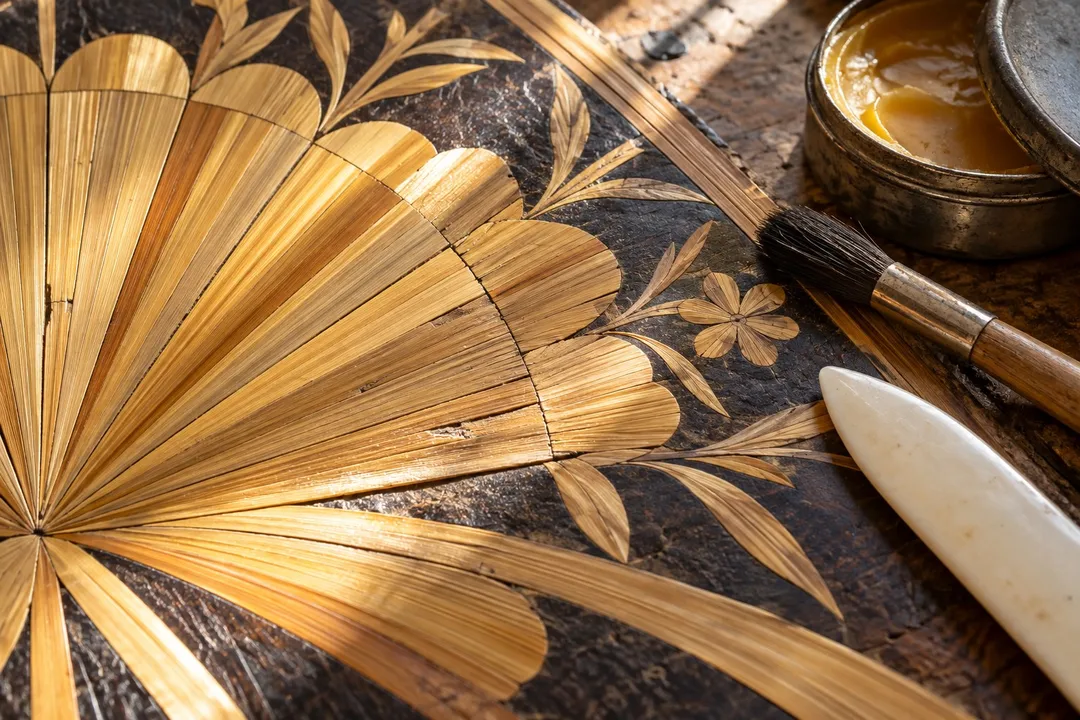
What the Bench Actually Restores
The studio describes its specialty as French polish, céruse, straw marquetry and other hand-padded finishes, used in the overall restoration of antiques of all types and periods. French polish means building up dozens of very thin layers of shellac with a cotton pad wrapped in linen, a slow process that gives mahogany and walnut a deep, glassy glow that sprayed lacquer cannot copy. Céruse is the limed finish that fills the open grain of oak with white pigment, popular on mid-century French pieces. Straw marquetry, in which split and flattened straws are glued in patterns, is a rare specialty, and repairing it requires matching both the straw color and the direction of the grain.
That focus matters when you are choosing a furniture restoration shop. Pourny's studio is not the place for a quick strip-and-spray job on a flat-pack dresser. It is the place for a Directoire table with a worn shellac top, a 1940s céruse oak sideboard, or a box whose straw panels have lifted. Bring the piece's history if you know it, because restorers decide how much original finish to keep based on age and provenance.
How Appointments Work
The studio footer says plainly that it operates by appointment only. The About page adds that the studio works with designers, architects and friends of the studio, which in practice means you should arrive with a booked time rather than ringing the buzzer on spec. No restoration labor prices are published, so every job is quoted individually after the team has seen the piece or the photographs.
Large case pieces need a plan for getting into a loft building. Measure the piece and ask about elevator access before you book a van. Small objects such as a tea caddy or a marquetry box can usually be carried in by hand.
The Care Products Worth Taking Home
You do not need a restoration job to come away with something useful. The studio sells its own wood care range online and the prices are listed on the Wood Care collection page. Paste Wax costs $22 in Natural, and the Furniture Care Kit, which bundles several of the products with application cloths, costs $120. A copy of The Furniture Bible is listed at $40 on the studio's book page. If you own antiques, the book's chapters on identifying finishes are the most practical part: they explain how to test whether a surface is shellac, lacquer or oil before you put any cleaner on it.
The house advice, repeated across the book and the product pages, is to feed wood rather than polish it with silicone sprays. A thin coat of paste wax once or twice a year, buffed with a soft brush, protects a French-polished surface far better than weekly aerosol sprays, which build up a cloudy film that eventually has to be stripped.
When to Visit and What to Bring
Because there is no walk-in counter, timing your visit is less about crowds and more about logistics. Weekday mornings are when furniture deliveries move most easily through the side streets around Seventh and Eighth Avenues, and when loading docks in the neighborhood are open. Bring photos from several angles and a tape-measure reading of height, width and depth. Put any loose veneer, carved fragments or straw pieces in a labeled envelope rather than throwing them away, because original material is always preferable to new. Note any past repairs you know about, since earlier glue or varnish changes how a piece is cleaned and treated.
A Short Walk Around West 30th Street
The building sits on a block of tall early twentieth-century loft buildings that once housed fur and garment workrooms. Directly across the street is the Church of St. John the Baptist, a Capuchin Franciscan church with a Gothic Revival brownstone facade and a tall spire that is easy to miss when you are looking down at your directions. Step inside if the doors are open; the carved woodwork and stained glass make a neat companion to an afternoon spent thinking about finishes.
A few blocks south, The Museum at FIT on Seventh Avenue at West 27th Street runs free exhibitions on fashion history and textiles, a good fit for a district whose loft buildings once cut and sewed the city's clothing. Head north and Madison Square Garden and Penn Station sit two blocks away, which makes the studio easy to reach from New Jersey Transit, the LIRR and Amtrak as well as the subway.
Practical Notes
Address: 247 West 30th Street, Suite 8F, New York, NY 10001, between Seventh and Eighth Avenues. Visits are by appointment only; there is no walk-in counter. Specialties: French polish, céruse, straw marquetry and hand-padded finishes on antiques of all periods, with restoration quoted per piece after the team reviews the item or your photographs.
Shop prices listed online: Paste Wax $22, Furniture Care Kit $120 and The Furniture Bible $40. Take the 1, 2 or 3 train to 34th Street–Penn Station on Seventh Avenue, or the A, C or E to the Eighth Avenue station. Ask the Karpo APP for a lunch spot near Penn Station or a coffee bar in NoMad to fill the hour after your appointment.
Ask Karpo for more information.
Keep reading
- Chelsea Consignment Shop Crawl Planner for Your First Studio
 East Village Consignment Shop Crawl Planner: Leather Jackets
 Harlem Consignment Shop Crawl Planner for a Jazz Night Look