 Fort Greene Holiday Market Browsing Guide for Young Shoppers
Weekend Plans

Choplet Ceramic Studio: Hands-On Wheel Throwing and Ceramic Studio Near Me
Choplet Ceramic Studio on Grand Street in Williamsburg offers beginner wheel crash courses, eight-week programs, open bench time, and garden studio pottery.
Choplet Ceramic Studio has anchored Grand Street in Williamsburg since 2005, providing a fully equipped clay facility and outdoor garden studio for ceramic artists across New York City. Founded by ceramicist Nadeige Choplet, this venue at 238 Grand St, Brooklyn, NY 11211 sits between Roebling Street and Driggs Avenue, four blocks south of the Bedford Avenue L train station. For newcomers seeking an authentic ceramic studio near me in northern Brooklyn, Choplet pairs rigorous wheel throwing technique with communal bench access, electric kiln firings, and specialized surface glazing.
Two Decades of Independent Craft on Grand Street
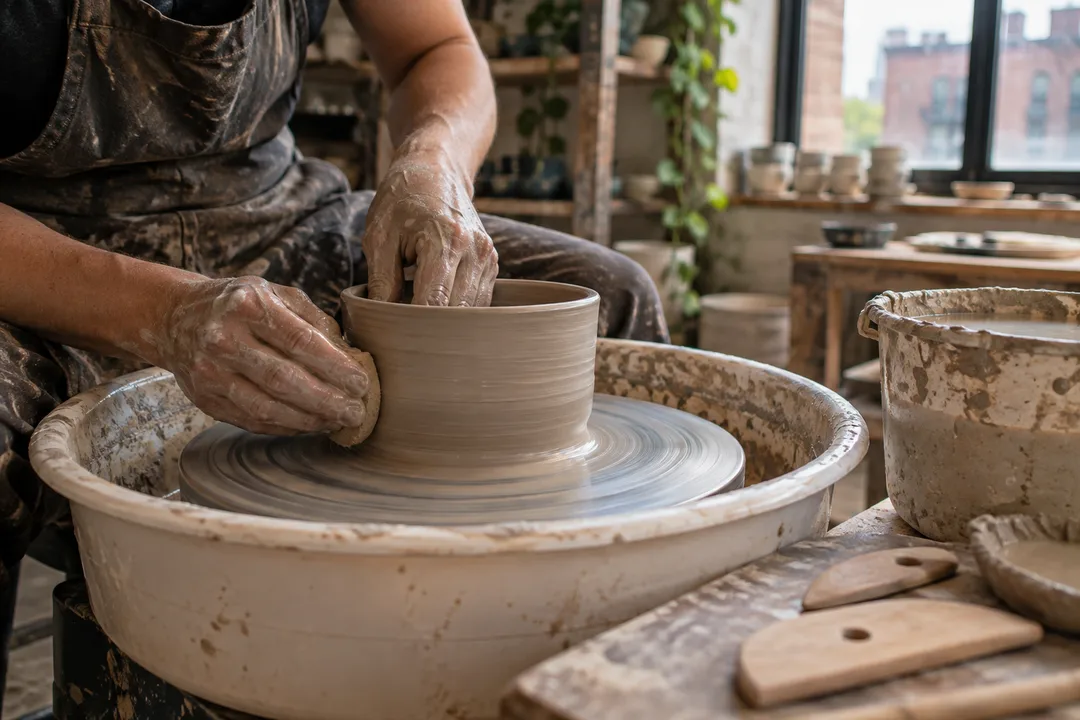
Nadeige Choplet established the studio inside a historic Williamsburg industrial brick building after completing classical fine arts training. Over the past twenty-one years, the facility has expanded into a sprawling dual-level complex featuring a skylit main throwing hall, designated plaster mold stations, glaze mixing labs, and a secluded bamboo garden courtyard where potters trim in open air during warm months. Unlike transient pop-up craft bars, Choplet operates as a dedicated professional school and production facility. The floor plan hosts twenty-four motorized Shimpo Whisper wheels, high-capacity slab rollers, dual pug mills for clay reclamation, and four top-loading Skutt electric kilns firing routinely to cone 6 oxidation. Long-term resident artists work alongside hobbyists, creating an industrious creative environment where novice wheel throwers witness master potters pulling ten-pound stoneware vessels.
Wheel Crash Courses and Eight-Week Foundation Programs
Structured instruction forms the core of Choplet's teaching calendar. The flagship entry point is the One-Day Wheel Throwing workshop, priced at $98, which gives absolute beginners two and a half hours of intensive wheel time covering clay wedging, wheel centering, bottom opening, and cylinder pulling. Students in the one-day class select up to two of their best pieces, which studio technicians trim, bisque fire, dip in house studio glazes, and glaze fire for later collection. For practitioners seeking technical mastery, Choplet runs comprehensive eight-week semester courses priced at $420. These weekly three-hour sessions systematically break down complex pottery mechanics: throwing balanced bowls, trimming foot rings with ribbon loop tools, pulling uniform mug handles, altering rim geometries, and mastering two-dip glaze combinations across white stoneware and red earthenware clay bodies.
Bench Time Access and Drop-In Studio Rules
Pottery requires relentless repetition beyond instructional hours, and Choplet accommodates this through structured open studio access. Enrolled multi-week students receive unlimited practice bench time outside their scheduled class slots, while experienced independent potters can purchase drop-in day passes for $50. Drop-in visitors must demonstrate proficient centering and wheel hygiene before working autonomously on the wheels. Independent bench time runs from 10:30 AM to 10:00 PM on Mondays, Wednesdays, and Thursdays, 12:30 PM to 9:30 PM on Tuesdays, 1:00 PM to 7:30 PM on Fridays, and 10:30 AM to 6:30 PM on Saturdays and Sundays. The studio provides shared banding wheels, stainless steel ribs, wire clay cutters, and wooden modeling tools, though serious ceramicists typically carry personal toolkit pouches containing favorite chamois strips and custom trimming blades.
Studio Floor Protocols, Clay Traps, and Wheel Hygiene
Silica dust control and equipment maintenance dictate daily life at 238 Grand Street. In accordance with professional ceramic safety standards, Choplet strictly enforces wet-sponge cleaning protocols across all workstations. Sweeping dry clay particles into the air is strictly prohibited. Potters must sponge down their wheel heads, splash pans, work counters, and tool trays with damp towels before vacating their stations. Splash pan slop and wet trimmings must be dumped into labeled scrap buckets rather than regular trash bins, feeding the studio's closed-loop pug mill recycling system. All studio sink basins are plumbed with three-stage Cink sedimentation traps that capture clay silt before graywater enters municipal city pipes, preventing subterranean plumbing clogs. Every student washes their own apron and leaves the shared throwing room as pristine as they found it.
Kiln Firings, Glaze Formulations, and the Two-Week Pickup Window
Turning a damp lump of mud into vitrified functional stoneware requires patience and precise thermal chemistry. After thrown greenware slowly air-dries to leather-hard and bone-dry consistency on drying racks, studio technicians load pieces into bisque kilns heated gradually to 1,940 degrees Fahrenheit. Bisqued pots are then glazed using Choplet's twenty-plus house formulated dipping tubs, featuring signature finishes like celadon green, matte cobalt, glossy satin white, and iron luster. Glazed ware undergoes a second cone 6 firing reaching 2,232 degrees Fahrenheit to achieve non-porous vitrification. Finished pottery is ready for pickup approximately two to three weeks following workshop completion. Choplet stores student work in labeled pickup cubbies for thirty days. Vessels left unclaimed after sixty days are donated to annual studio benefit fundraisers.
Practical Studio Advice: Techniques to Skip and Common Errors
Beginners frequently attempt ambitious ceramic stunts that end in structural failure on the wheel. Skip attempting tall vases or delicate multi-finger handles during your initial one-day workshop. Pulling walls thinner than a quarter-inch before mastering fundamental clay centering inevitably causes wet walls to collapse into an unsalvageable spiral. Similarly, skip carving intricate surface patterns into greenware before the clay reaches firm leather-hard consistency, as wet incisions drag burrs and warp delicate rims. Do not wear favorite designer clothing or long dangling rings to the studio. Dried clay slip stiffens linen, and metal jewelry gouges rotating vessel walls. Wear close-toed canvas shoes and trim fingernails short prior to arrival, as long nails slice through clay walls during internal finger pulls.
Williamsburg Neighborhood Stroll Along Grand Street
Choplet's location in central Williamsburg places students steps away from Brooklyn's premier dining and cultural corridors. After wrapping up an intensive throwing session, walk one block east along Grand Street to Martha's Country Bakery on Bedford Avenue for a warm cappuccino and a slice of sour cream apple walnut pie. If you crave savory nourishment, walk two blocks west toward Havemeyer Street to grab tacos at Birria-Landia or a wood-fired slice at Best Pizza on Havemeyer Street. A ten-minute stroll down Grand Street toward the East River brings you directly into Domino Park, where you can relax on waterfront tiered bleachers while watching dusk light illuminate the Manhattan skyline across the river.
Alternative Brooklyn Studios and Advance Booking Considerations
Due to high demand for weekend creative workshops in northern Brooklyn, Choplet's one-day wheel classes regularly book out two to three weeks in advance. If you encounter a fully booked weekend and cannot secure a seat at 238 Grand Street, consider booking a handbuilding or wheel session at Clay Space BK up in Greenpoint at 275 Calyer Street or checking weekend availability at Artshack Brooklyn in Bed-Stuy. Arrive fifteen minutes ahead of your class time to stash coats in student cubbies, tie back hair, and secure an optimal wheel near the outdoor garden windows.
Ask Karpo for more information.
Keep reading
- Fort Greene Holiday Market Browsing Guide for Young Shoppers
 DUMBO Holiday Market Browsing Guide for Gifts to Mail Home
 Midtown East Holiday Market Browsing Guide for Commuters