 Chelsea Consignment Shop Crawl Planner for Your First Studio
Hidden Gems & Odd Finds
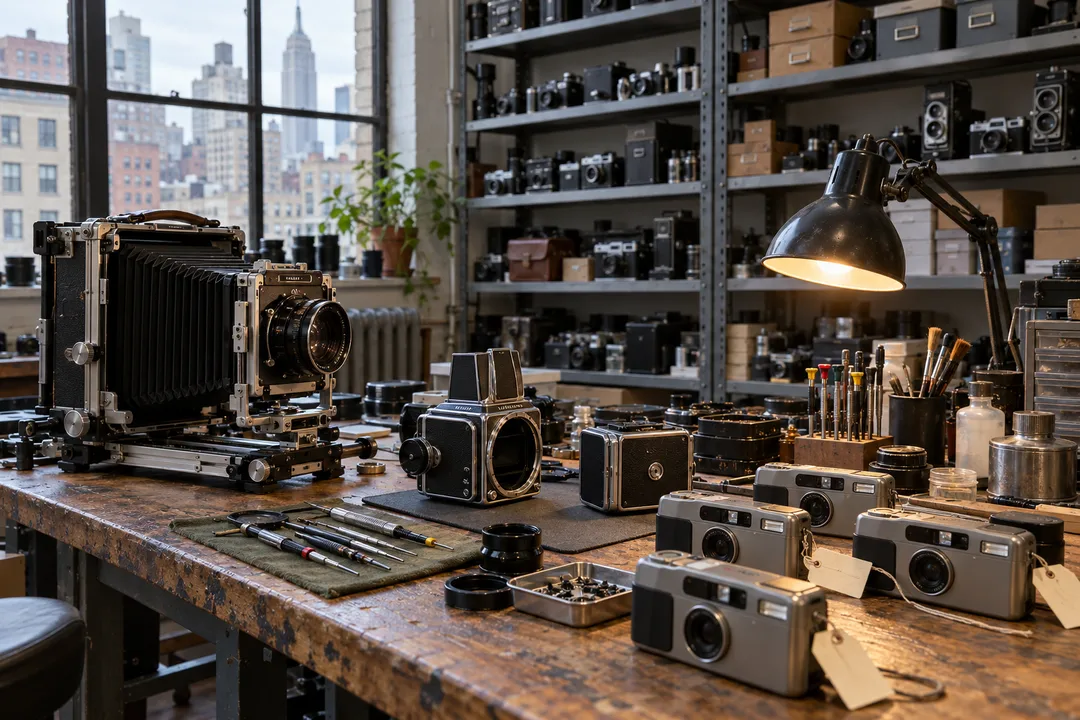
Film Camera Repair Shop by Bryant Park: Nippon Photoclinic
Nippon Photoclinic, at 37 W 39th St #401 in Midtown, inspects film cameras for $5 an item on weekdays. It is the US service center for Contax, Linhof and Wista.
Nippon Photoclinic charges $5 per item to inspect a camera or lens, so a body and a lens on the counter cost $10 before anyone opens a screw. This Midtown camera repair shop sits on the fourth floor of 37 W 39th St, Suite 401, a block south of Bryant Park, and it keeps short weekday hours: Monday to Friday, 9:30 am to 4:30 pm, closed weekends and every federal holiday. If your Contax T2 has stopped focusing or your Hasselblad 500 back keeps jamming, this is where New York photographers still bring it.
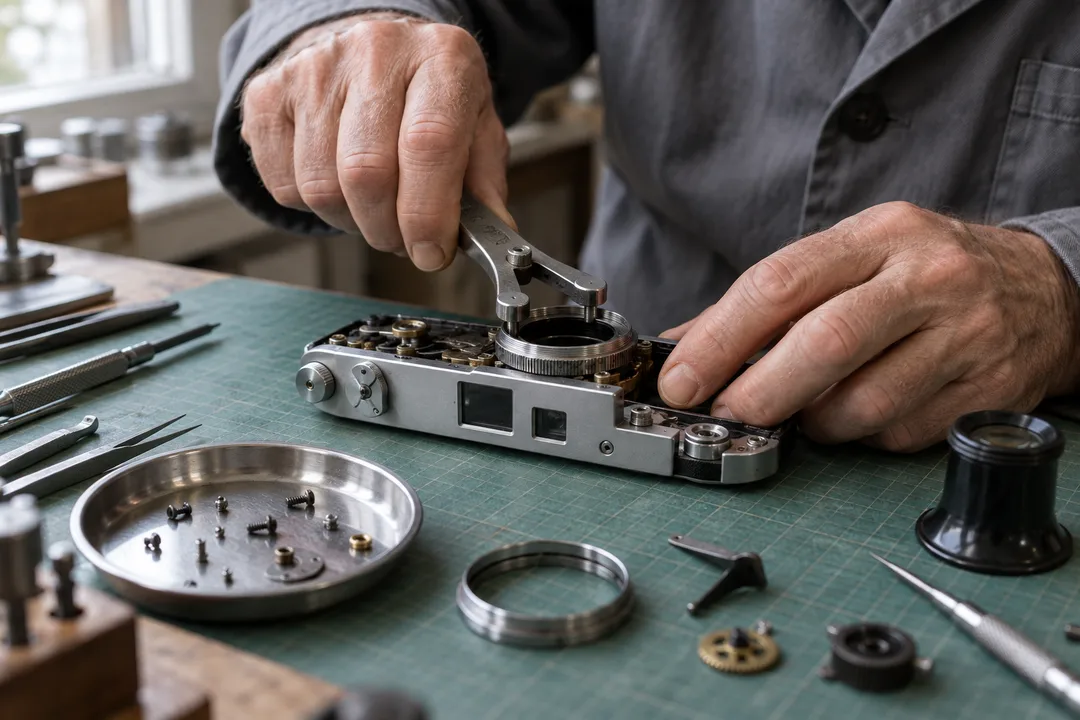
Forty Years of Contax, Linhof and Hasselblad
B&H's Explora feature on New York's last camera repair shops says Nippon Photoclinic has been around since 1984. The shop calls itself the exclusive North American authorized service center for Contax, Linhof and Wista cameras and lenses. According to the same Explora piece, when Contax left the market the clinic took in its spare parts, which is why so many T2 and T3 owners end up here rather than at a general electronics counter.
The Specialties page reads like a collector's shelf. On the Contax side it lists the T, T2 and T3, the G1 and G2, the 645 system (bodies and magazines, but no lens repair), the RTS II, the AX and RX, and the 137, 159 and 167 models. Technicians have worked on these Kyocera-era Zeiss cameras for over 40 years, and the page notes the shop is officially authorized as a Contax repair center.
What the Bench Will Take, and What It Won't
Beyond Contax, the Services page names Bronica SQ-A and ETRS bodies, Canon AE-1 and A-1, Canonet QL17, Copal 0, 1 and 3 shutters, Hasselblad 500-series bodies, lenses and magazines, Leica M bodies up to the M7, Nikon F, F2, F3, FM2 and FM3A, and Linhof Master Technika, Kardan and 612/617 panoramic cameras. Large-format view lenses and medium-format glass are fair game, and the technicians handle cleaning and recalibration as well as major overhauls.
The refusal list matters just as much. The shop no longer repairs any Fuji cameras, any twin-lens reflex including Rolleiflex, Polaroid, the Mamiya 6, the Pentax 645, the Olympus OM-2, the Yashica T4 and T5, or the Contax TVS series. Leica M5 and double-stroke M3 bodies are excluded too. Point-and-shoots are out except the Contax T2 and T3 and the Yashica T2 and T3. Autofocus lenses and Sony, Panasonic, Sigma and Ricoh gear are not serviced, and digital work stops at minor jobs such as sensor cleaning.
How Estimates and Approvals Work
Walk in during business hours and the inspection fee starts the clock. The shop says that because of volume, most estimates take one to two weeks, and it refuses rush orders outright, on the grounds that rushing is when mistakes happen. Nothing gets repaired until you send written approval or refusal by e-mail. Once approved, a repair can take anywhere from two to six weeks, since many fixes rely on modification or good used parts.
Bring the camera with its symptoms written down, not just described aloud. The Services page shows the format it wants for anyone dropping off more than six items: a numbered list with the model, the serial number and a one-line description of the fault, such as a Pentax 67 film back that must be forced shut. Pull out batteries, film and straps before you hand anything over, because the clinic says it is not responsible for accessories or film left inside.
The Six-Month Rule Regulars Know
The most repeated line on the website is printed in capitals on every page: cameras left at the shop six months after the last communication are treated as abandoned and may be scrapped or used for parts. Longtime customers treat that as the house rule. Answer the estimate e-mail promptly, keep the ticket number, and do not assume a call years later will find your Nikon F2 still on the shelf.
Who climbs the stairs here? The Explora writer recalls first bringing a Canon T50 in 1989, and a commenter on that article describes having Hasselblads, Nikons and a Leica M body serviced here over decades of fashion and advertising work. On a weekday afternoon you are just as likely to meet a student with a thrifted Canon AE-1 that has the familiar shutter squeal. The room is a working shop, not a showroom.
Shipping a Camera Instead of Carrying It
Out-of-town owners can mail equipment to Suite 401. The instructions are specific: one camera per plastic bag with its own sheet of paperwork, no batteries, no undeveloped film, at least two inches of packing on every side, and an insured, tracked carrier such as UPS, FedEx or USPS Priority Mail. Expect one to five business days for the item to be registered and estimated. Boxes that arrive without a name, phone number or e-mail may be disposed of, the shop warns.
Return shipping defaults to insured UPS Ground within the lower 48 states. International customers are asked to provide a prepaid return label or arrange pickup, and when a customer supplies a label the clinic currently charges a $10 handling and packaging fee. If you only need a quick look at a lens, skip the mail entirely: a walk-in estimate on a weekday morning saves the round trip and the packing.
Where It Falls Short
Be honest about fit before you go. If your camera is a Rolleiflex, a Fujifilm GW690, a Polaroid SX-70 or a modern mirrorless body, Nippon Photoclinic will turn it away, and you will have spent a subway ride for nothing. For instant cameras, Brooklyn Film Camera in Bushwick runs its own repair bench. For a digital body under warranty, the manufacturer's service channel is the faster route. Nippon is the right call for mechanical film cameras and large-format gear.
A Bryant Park Loop After Drop-Off
Because the clinic sits a block south of Bryant Park, a drop-off pairs easily with a walk. Head north across the park's lawn, then cut east to the Stephen A. Schwarzman Building of the New York Public Library on Fifth Avenue, where the Rose Main Reading Room is free to visit. Walking back south along Sixth Avenue takes you through the edge of the Garment District, with its trimming and fabric shops.
Practical Notes
Address: Nippon Photoclinic, 37 W 39th St, Suite 401, New York, NY 10018, between Fifth and Sixth Avenues. Hours: Monday to Friday 9:30 am to 4:30 pm, closed Saturday, Sunday and federal holidays. The nearest train is the B, D, F or M to the 42nd Street–Bryant Park station, or the 7 to Fifth Avenue. Inspection: $5 per item.
Ask Karpo for more information.
Keep reading
- Chelsea Consignment Shop Crawl Planner for Your First Studio
 East Village Consignment Shop Crawl Planner: Leather Jackets
 Harlem Consignment Shop Crawl Planner for a Jazz Night Look