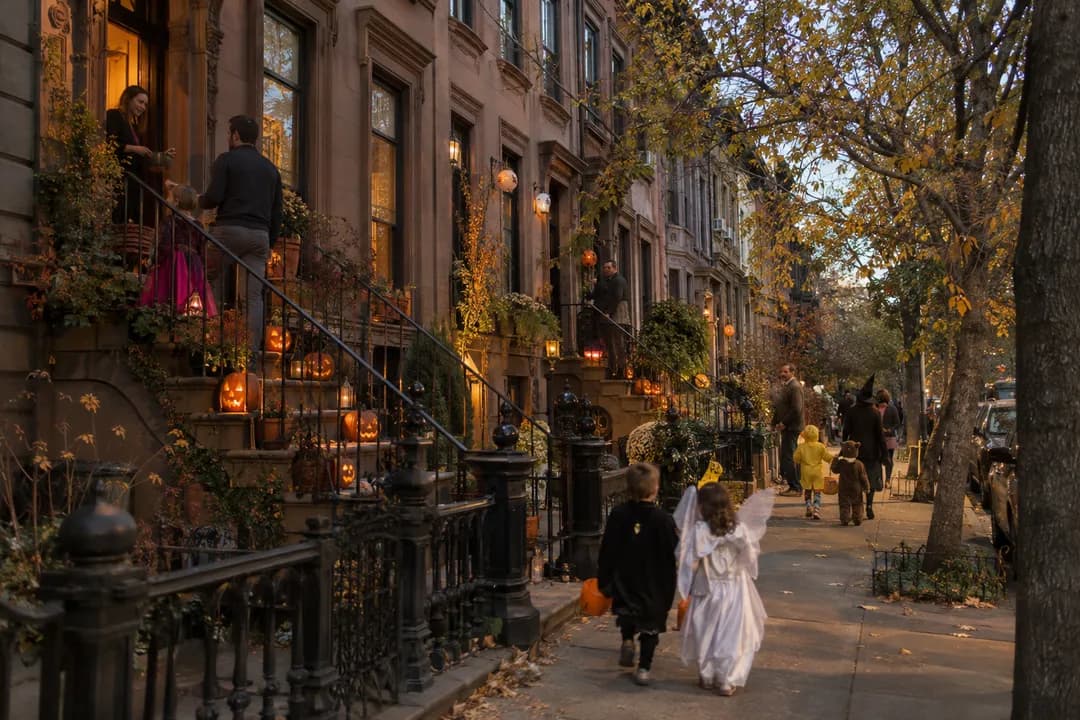
 Best Trick or Treating Neighborhoods Near Me: Park Slope
Neighborhood Guides
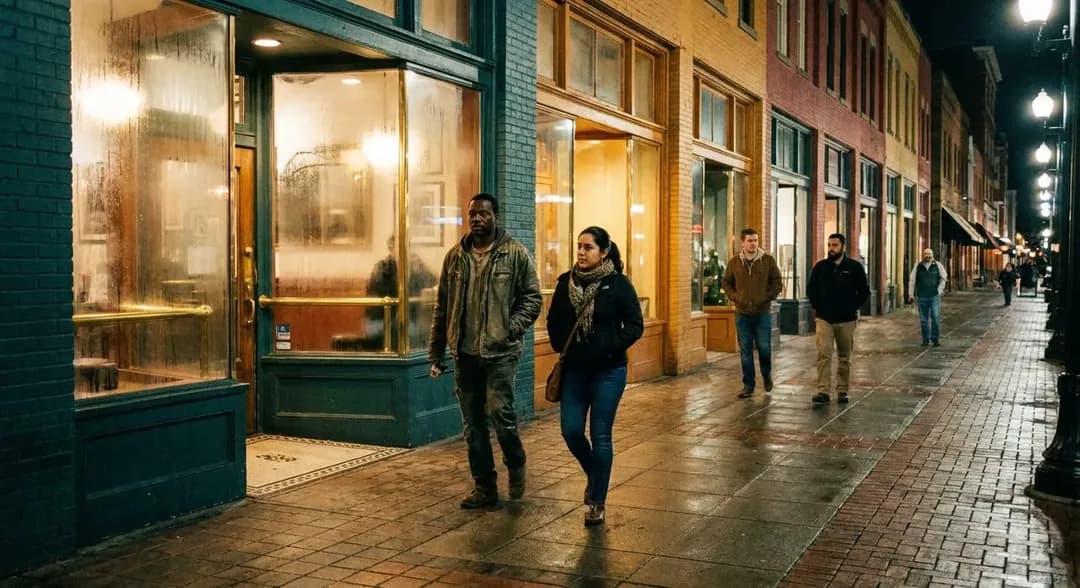
The Bowery After Midnight: Walking New York's Oldest Road End to End
The mile from Chatham Square to Cooper Square becomes something else when the last subway rumbles past. You're walking through centuries, not blocks.
The starting point
You begin at Chatham Square, where the Bowery peels away from the tangle of streets converging at the Manhattan Bridge's approach. At 1 a.m., the square is empty except for delivery trucks idling near the Kimlau War Memorial. The arch stands illuminated, casting long shadows across pavement that's been walked since this was a Native American trail. Face north. The Bowery stretches ahead, wider than you remember from daylight, the streetlights creating pools of sodium-orange that make the asphalt look wet even when it's dry.
The Edward Mooney House sits at 18 Bowery, its Georgian brick facade pressed against a modern storefront. Built in 1785, it's Manhattan's oldest surviving townhouse. At this hour, you notice details the daytime crowds obscure: the flemish bond brickwork, the stone lintels, the way the building leans slightly as if tired from witnessing two and a half centuries. A bodega occupies the ground floor now, its lights the only sign of life for three blocks.
The flophouse corridor

Between Chatham Square and Grand Street, the Bowery's skeleton shows through. The Sunshine Hotel closed in 2001, but its sign still hangs at 241 Bowery—white letters on red, advertising rooms that once cost three dollars a night. You can still see the narrow entrance, the steep stairs visible through the locked door. Next door, the former Andrews Hotel maintains its fire escape zigzagging down the facade. These weren't hotels in any conventional sense. They were cubicle hotels, cage hotels—chicken-wire partitions between beds, shared bathrooms, men who'd lost their way or never had one.
At this hour, you understand why this stretch earned its reputation. The buildings create a canyon effect, trapping sound and shadow. The loading docks of restaurant supply stores create deep recesses where darkness pools. A few figures move between doorways, but the interaction is minimal—everyone here after midnight has learned the etiquette of mutual invisibility. The old Palace Hotel at 221 Bowery is now luxury condos, but the bones remain: those tall, narrow windows, the pressed-tin cornice, the proportions of another era.
The lighting district
North of Grand Street, the Bowery transforms into an unlikely empire of illumination. Bowery Lighting at 132 Bowery keeps its window displays lit all night—a forest of chandeliers casting prismatic shadows onto the sidewalk. Next door, City Lights Antique & Modern at 134 does the same. The effect is surreal: you're walking through pools of refracted light, past crystal and brass and blown glass, while the rest of the street sleeps.
This concentration of lighting shops dates to the 1920s, when the Bowery's cheap rents attracted wholesalers. What's remarkable is their persistence. While SoHo gentrified and the Lower East Side transformed, these businesses held on, family operations passing through generations. At Lighting by Gregory, the third-generation owner still works the floor. The shops don't advertise their hours online, but insiders know: call ahead, ask for Marco at Bowery Lighting, and he'll open by appointment even on Sundays.
The punk archaeology

CBGB closed in 2006, but 315 Bowery remains a pilgrimage site. The awning is gone, replaced by a John Varvatos boutique that preserved some original elements: the graffitied walls in the basement, visible through a plexiglass floor panel near the denim display. At night, with the store dark, you can press your face to the window and see the ghost of what was—the narrow room, the low stage, the bathroom that became an art installation of band stickers and sharpie declarations.
Across the street, the New Museum's stacked-box architecture looks like it landed from another dimension. The contrast is the point. The Bowery has always been about collision—high and low, old and new, ambition and ruin. Walk past at 2 a.m. and the building's LED facade cycles through colors, bathing the block in shifting light. The security guard, if you catch him during his rounds, will tell you the building's cantilever extends seventeen feet over the lot line, a engineering feat that required special city approval.
Cooper Square terminus
The Bowery officially ends at Cooper Square, where it dissolves into the intersection with Third and Fourth Avenues. The Cooper Union Foundation Building anchors the corner, its brownstone bulk a Victorian assertion of educational democracy. Frederick Law Olmsted spoke at its opening in 1859. Abraham Lincoln spoke here in 1860. The Great Hall, on the building's lower level, still hosts events, but you need to know someone to get access outside regular hours.
This endpoint feels arbitrary—the Bowery could continue, but the city decided it needed a new name here. Stand in the middle of Cooper Square at 2:30 a.m. and you can see back down the entire route you've walked. The street rises slightly from south to north, so the view extends almost to Chatham Square, a corridor of light and shadow and history compressed into a single mile. A taxi passes, then silence returns.
The walk back
The return journey reveals what you missed heading north. The eastern side of the street carries different details: the loading dock at 190 Bowery where restaurant suppliers receive deliveries between 3 and 5 a.m., the small Buddhist temple at 64 Mott Street visible down the cross-street, its red lanterns glowing. You notice the fire escapes more on the return—how they create a secondary architecture, a network of iron that connects buildings vertically.
By 3 a.m., a few early risers appear: bakers heading to Chinatown bakeries, night cleaners finishing shifts, a jogger who nods as he passes. The Bowery is never truly empty, but these hours come closest. You're walking a road that predates the grid, that remembers when this was farmland, when it was the city's northern edge, when it was the bottom, when it was the next frontier. All of that remains, compressed into pavement and brick.
Practical notes
The walk from Chatham Square (Bowery and Division Street) to Cooper Square (Bowery and East 7th Street) covers approximately 1.1 miles and takes 25-30 minutes at a steady pace. The Bowery runs north-south, accessible via the J/Z trains at Bowery Station (between Delancey and Grand), the 6 train at Spring Street (two blocks east), or the B/D/F/M at Broadway-Lafayette (three blocks west). After midnight, stick to the well-lit sections and remain aware of your surroundings—the street is generally safe but isolated in stretches.
Most businesses are closed after midnight, though several 24-hour restaurants operate on cross streets: Wo Hop at 17 Mott Street (Cantonese, cash only), Veselka at 144 Second Avenue (Ukrainian, full bar). The lighting shops typically open 9 a.m.-6 p.m. weekdays, with limited weekend hours—call ahead. The New Museum (235 Bowery) opens Wednesday-Sunday, 11 a.m.-6 p.m., with Thursday hours until 9 p.m.; admission $18, free Thursdays 7-9 p.m. Dress in layers; the Bowery's width creates wind tunnel effects even in summer.
Tags: #TheLongWayHome #TheBowery #MidnightWalks #NYCHistory #LowerManhattan #BoweryLighting #CBGBHistory #CooperSquare #ChathamSquare #UrbanExploration #NewYorkAfterDark #LowerEastSide #NYCNights #ManhattanWalks #CityArchaeology
Sources consulted: MTA · NYC Parks · Time Out New York
All trademarks are the property of their respective owners.
Ask Karpo for more information.
Keep reading
- Best Trick or Treating Neighborhoods Near Me: Park Slope
 Best Trick or Treating Neighborhoods Near Me: Carroll Gardens
 Best Trick or Treating Neighborhoods Near Me: West Village