 Soccer Bar Near Me: Midtown's Basement Room For Early Kickoffs
Watch Parties
Beyond Dollar Slices: NYC Pizza Styles Every Visitor Should Try
New York's pizza landscape runs deeper than corner slices—here's how to navigate coal-oven, grandma, and Detroit pies worth the detour.
A weeknight crowd outside Prince Street Pizza isn't waiting for nostalgia. They're waiting for a specific thing: Sicilian-style square slices with edges that caramelize against the pan, a style most visitors walk past while hunting for the New York fold. The city's pizza reputation rests on that fold—thin crust, wide triangle, grease pooling in the center—but the dollar-slice era trained an entire generation of travelers to think that's the whole story. It isn't.
Text Karpo now for a live route between pizza stops that accounts for subway timing and current wait estimates, plus a backup slice shop if your first choice has a line out the door.
The taxonomy tourists miss
New York City has at least five distinct pizza styles operating simultaneously, and most of them don't announce themselves. Coal-oven pies predate the gas ovens that made dollar slices possible. Grandma pizza, a Long Island export that took root in Queens, sits somewhere between Sicilian and bar pie. Detroit-style, the Midwestern square with crispy cheese edges, has been quietly colonizing Brooklyn for a decade. And then there's the New Haven-adjacent bar pie, thin and blistered, showing up in Williamsburg and the East Village with cult followings that don't advertise.
If you're planning a watch party or a post-screening crawl, pizza is the load-bearing food: it travels in a box, feeds a group unevenly, and tastes better at room temperature than most takeout. But the logistics matter. A coal-oven margherita from Lombardi's in Little Italy won't survive a 40-minute subway ride to Astoria the way a grandma slice will. And a Detroit-style pan from Emmy Squared arrives as a sit-down experience, not a hand-held one. Knowing which style fits your night means knowing what each one actually is.
Five styles, five different nights
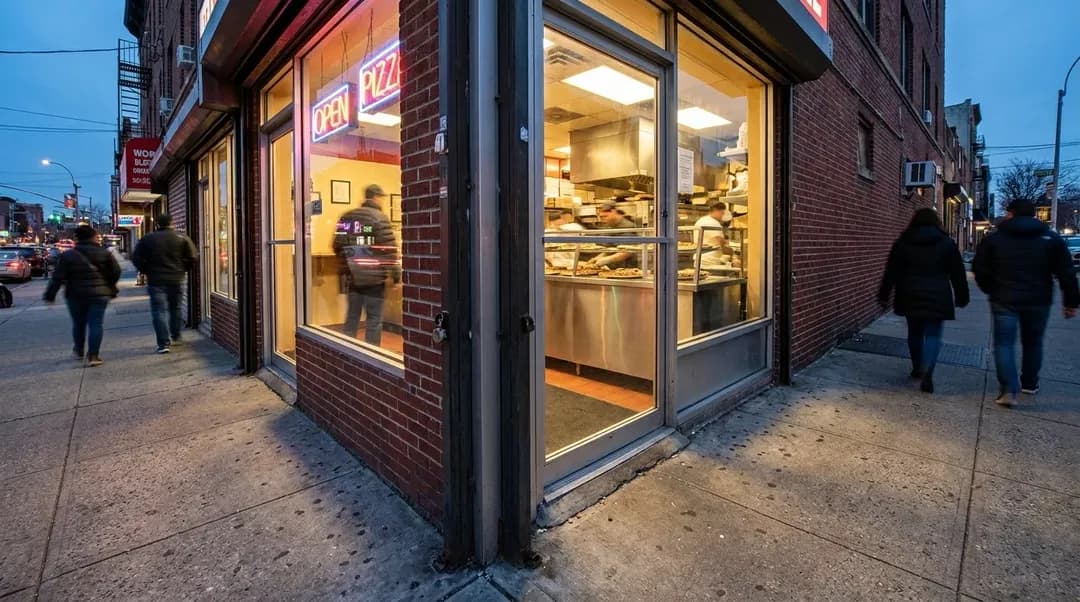
Coal-oven pizza—the kind Lombardi's and John's of Bleecker Street still make—burns hotter and faster than anything a modern gas oven can manage. The crust blisters and chars in under two minutes, leaving a rim that's both crisp and chewy, with a faint mineral taste from the coal smoke. It's the oldest continuously operating style in the city, and it doesn't travel. If you're eating coal-oven pizza, you're eating it within ten minutes of when it leaves the oven, which means your watch party starts at the restaurant or you're bringing a different style home.
Grandma pizza is the opposite: it improves in the box. The dough is oiled and pressed into a sheet pan, topped with mozzarella directly on the dough and then sauce on top, baked until the bottom is golden and the cheese has fused to the crust. It's softer than Sicilian, less bready, and it reheats better than any other style. You'll find good versions in Astoria—places that have been making it since before it had a name—and it's the style that makes the most sense if you're coordinating food for six people arriving on three different subway lines.
Detroit-style showed up in Brooklyn around 2012 and refused to leave. The dough goes into a rectangular pan, cheese all the way to the edges so it caramelizes against the metal, sauce ladled on in stripes after it bakes. Emmy Squared in Williamsburg and Williamsburg Pizza both do versions that people argue about. It's a sit-down style—too thick and too saucy to eat standing—but it's also the style that photographs well and feels like an event, which makes it the right call if your watch party is actually about the hang, not the game.
Bar pie, the thin-crust style that New Haven made famous, has been creeping into the city for years. It's cracker-thin, blistered in a deck oven, often topped minimally—clams, garlic, maybe some pecorino. Rubirosa in Nolita does a version with vodka sauce that people either love or find confusing. It's not a high-volume style; you're ordering two or three pies for a small group, and you're eating them at the bar or at a table, not on a couch.
And then there's the dollar slice, which still exists and still has a place. It's a gas-oven margherita reheated on a deck, sold by the slice for somewhere between $1.50 and $3 depending on the year and the corner. It's not trying to be memorable. It's trying to be fast, hot, and predictable, and it does that better than any other style. If your watch party is last-minute and your group is splitting up afterward, dollar slices are the correct answer, and there's no shame in that.
What the crawl actually costs
A coal-oven margherita at Lombardi's runs around $20 for a whole pie, which feeds two people generously or four people who are also eating other things. A grandma slice in Astoria will cost $4 to $5, and two slices is a meal. Detroit-style at Emmy Squared is $18 to $22 for a small pan, which is really a one-person portion if you're hungry or a two-person share if you're not. Bar pies range from $16 to $24 depending on toppings, and you'll want at least one pie per two people.
If you're doing a deliberate pizza crawl—hitting three or four styles in one night—you're looking at $30 to $50 per person depending on how much you eat at each stop and whether you're drinking. Most coal-oven and bar-pie places have beer and wine licenses, and a pint will add $8 to $10 to the tab. Grandma slices come from counter-service spots that don't serve alcohol, which keeps the cost down but also means you're standing or walking while you eat.
The real cost is time. A coal-oven pizza takes 15 to 20 minutes from order to table, and popular places don't take reservations for parties under six. Bar-pie spots often have waits after 7pm on weekends. Detroit-style restaurants are full-service, so you're committing to an hour. If you're trying to hit multiple styles before a late screening, you need to start by 5pm and accept that you'll be moving on before you're completely full at each stop. Karpo can route this in a way that minimizes backtracking, but the subway timing is what it is: the L train from Williamsburg to Union Square is 10 minutes; the N or W from Astoria to Manhattan is 20 to 30 depending on whether you catch a local or express.
One other cost: the risk of walking past Pizza Hut in Times Square and realizing it's not what you're looking for. Chain pizza exists in New York, but it's not part of the style conversation, and it won't teach you anything about the city's pizza culture. If you're here for three days and you spend one meal on a national chain, you've traded a coal-oven margherita for something you could eat in an airport.
Before you commit to the route
Check whether the place you're targeting is open. Coal-oven spots sometimes close on Mondays. Grandma-slice counters in Astoria keep irregular hours, and a few of them still close by 8pm. Bar-pie restaurants often don't start serving until 5 or 6pm, so a lunchtime crawl won't work. If you're planning this around a watch party or a late screening, confirm that your last stop will still be serving when you arrive—some kitchens close earlier than the bar does.
Know which subway transfers slow you down. The connection from the L to the N/Q/R/W at Union Square involves a long underground walk and often a wait. The transfer from the 6 to the N/W at 59th Street is faster than it looks on the map. If you're starting in Astoria and heading to Brooklyn, the route through Manhattan is almost always slower than it feels like it should be, and the timing gets worse after 10pm when some trains switch to local-only service.
Bring cash for the grandma-slice spots. Most coal-oven and bar-pie restaurants take cards, but the counter-service places in Queens are split, and some of them still have ATM-only signs taped to the register. If you're doing a crawl that includes multiple stops, assume you'll need $40 in cash to avoid the moment where you're holding up a line while someone runs to a bodega.
Plan your ride home before you start drinking. If your crawl includes bars or restaurants with wine lists, decide in advance whether you're taking the subway back or calling a car. Late-night subway service is reliable on most lines, but it's slower, and the walk from the station to your hotel or rental will feel longer at midnight than it did at 6pm. A rideshare from Williamsburg to Midtown runs $25 to $35 depending on surge; from Astoria it's $20 to $30. If you're in a group of three or four, splitting a car is often faster and not much more expensive than four MetroCards.
Finally, accept that you will not try every style in one trip. If you're here for a weekend, pick two or three styles and do them well. If you're here for a week, you have time for a proper crawl. The pizza will still be here next time, and the coal ovens have been burning since 1905. There's no urgency except the urgency you create.
Practical notes
- Coal-oven and bar-pie restaurants often have 20–30 minute waits after 7pm on weekends; arrive before 6pm or after 9pm to avoid the crush.
- Grandma slices in Astoria travel well for 30–40 minutes; coal-oven pies do not—plan your subway route accordingly.
- Bring $40 cash for counter-service slice shops in Queens; many are card-only or ATM-only.
- Late-night subway service slows down after 11pm, especially on the N/W and L lines; confirm your last train or budget for a rideshare home.
- If your crawl includes alcohol, plan a safe ride home in advance—rideshares from Brooklyn or Queens to Manhattan run $20–$35.
- Check current hours before you go; some coal-oven spots close Mondays, and slice counters in Astoria sometimes close by 8pm.
Tags: #karpo #nycpizza #pizzanyc #newyorkcity #pizzacrawl #coalovenpizza #detroitstylepizza #grandmapizza #astoriafood #williamsburgfood #watchparty #nycfoodie #pizzastyles #nyceats #pizzalovers
Sources consulted: NYC Parks · MTA Subway Service
Please drink responsibly. Must be of legal drinking age.
All trademarks are the property of their respective owners.
Ask Karpo first
Text Karpo for a live route between pizza styles that accounts for current subway timing and whether your target spot has a wait right now. Ask for a backup slice shop in case your first choice is slammed, and get a realistic train-home plan that factors in late-night service changes.
Ask Karpo for more information.
Keep reading
- Soccer Bar Near Me: Midtown's Basement Room For Early Kickoffs
 Soccer Bar Near Me in Flatiron: A Bartender's Rule for the Noise
 Soccer Bar Near Me: This West Village Cafe Fills Fast for Kickoff