 SoHo Tailor Alteration Shop Finder for Sample Sale Finds
Neighborhood Guides
Harlem Strivers' Row: A Free Architectural Landmark Walk
Strivers' Row in Harlem is a free, open-street walk along West 138th and 139th Streets, where three firms designed rival rowhouse blocks in the early 1890s.
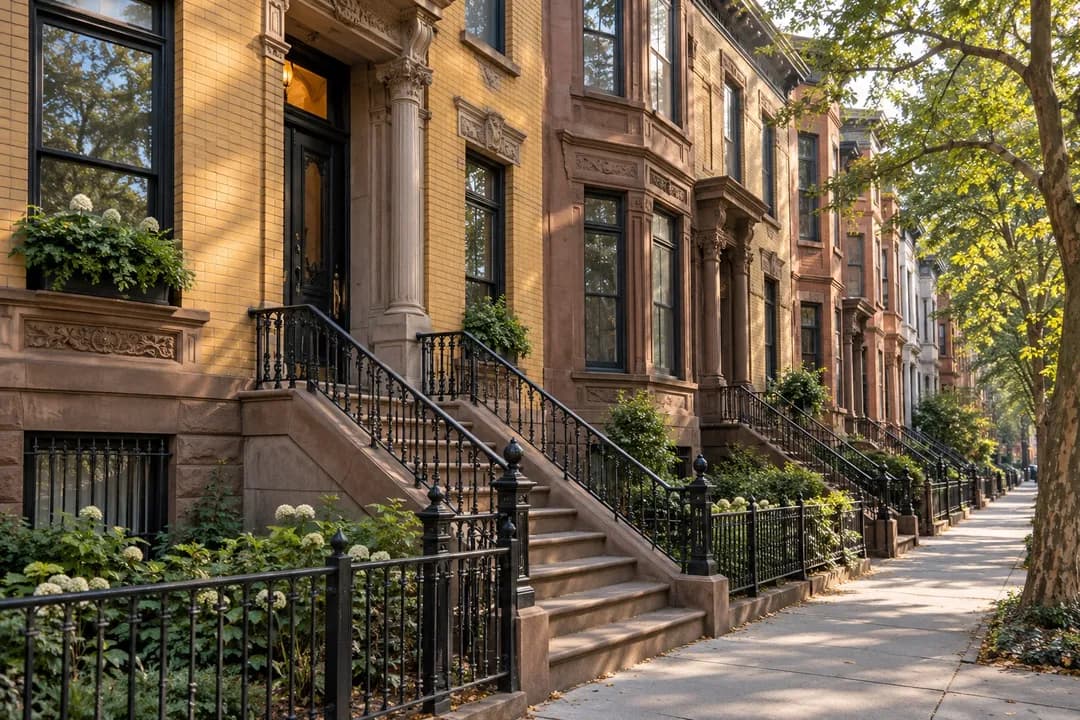
Strivers' Row is two Harlem blocks of rowhouses on West 138th and West 139th Streets, between Adam Clayton Powell Jr. Boulevard and Frederick Douglass Boulevard, and you can walk every facade for free from the public sidewalk. Developer David H. King Jr. put them up between 1891 and 1893, and he hired three different architects, so each side of each street reads like a separate entry in a design competition. That contrast is the whole reason this architectural landmark walk works in under an hour.
Why three architects share two streets
King marketed the project as the King Model Houses, and he split the commission instead of handing it to one office. James Brown Lord took the south side of West 138th Street, Bruce Price and Clarence S. Luce took the north side of 138th and the south side of 139th, and Stanford White of McKim, Mead & White took the north side of 139th. Standing in the middle of either street, you are looking at two different firms at once, one across from the other.
The developer who paid for all this was not a newcomer. King had already built the Equitable Building and the pedestal of the Statue of Liberty, and he planned these houses as a unified middle-class enclave with shared rear service lanes. Very few sold. During the depression of the mid-1890s the Equitable Life Assurance Society, which had financed the project, foreclosed on almost every unit, and the houses sat largely empty for years.
Start on West 138th Street with Lord's red brick
Begin at the Adam Clayton Powell Jr. Boulevard corner of West 138th Street and face the even-numbered south side. These are James Brown Lord's houses: red brick set on brownstone bases, in a Georgian Revival manner with high stoops and deep entrance doors. Look at how the brownstone lower floors anchor the street while the brick upper floors stay plain. The effect is sober and solid, the most conservative of the three designs, and it sets the baseline for everything else you will see.
Now turn around. The odd-numbered north side of the same block belongs to Bruce Price and Clarence Luce, and the switch is immediate: pale yellow brick, white limestone and terra cotta trim in a Colonial Revival style. On a sunny late morning these fronts almost glow next to Lord's darker brick across the way. Walk the block slowly on one side, cross, and walk it back on the other, so you see each facade straight on rather than at a sharp angle.
The rear alleys and the Walk Your Horses signs
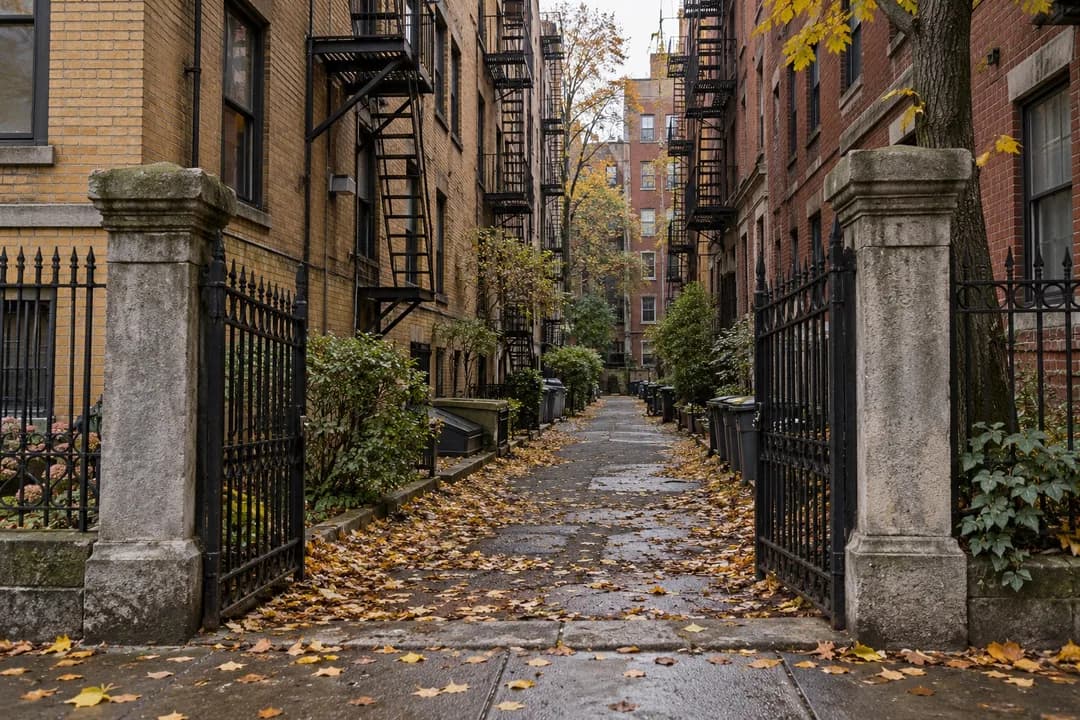
Between the two streets runs the feature that makes Strivers' Row unusual in Manhattan: rear service alleys, built so deliveries and horses could reach the back of each house without crossing the front stoops. Several of the alley gateposts still carry signs reading Walk Your Horses, a holdover from the stabling era. The alleys are private to the residents, so stay at the gate, take your photograph from the sidewalk, and do not wander in, even if a gate is open.
This is also the spot where many visitors get the history slightly wrong. The signs are not a museum installation or a modern revival. They mark a working lane that residents still use for parking and trash, which is why the alleys look ordinary once you peer past the gate. That ordinariness is the point: the planning idea from the 1890s still quietly does its job more than a century later.
West 139th Street and Stanford White's darker fronts
Cut through at either avenue to West 139th Street. The south side repeats the Price and Luce yellow brick, which lets you compare the same design from a different light angle. The north side is Stanford White's: dark brick, brownstone and terra cotta in an Italian Renaissance Revival style, with arched openings and richer ornament around the doors and windows. Of the three, it is the one that rewards a close look, so slow down on this stretch.
A useful exercise here is to pick one detail and follow it down the block. Track the cornice line, or the shape of the ground-floor windows, or the ironwork on the stoops. White's row was designed as a single composition, so the ornament repeats with small variations instead of changing house by house. Once you notice that rhythm, it becomes easy to see why preservationists treat the whole row as one building split into many homes.
How the name Strivers' Row was earned
The official name is the St. Nicholas Historic District, taken from nearby St. Nicholas Park, and the Landmarks Preservation Commission designated it in 1967. The nickname came later in a different way. The houses were not sold to Black buyers at first, and only around 1919 and 1920 were they finally offered to African American families. The professionals who moved in, ambitious doctors, musicians and entrepreneurs, were the strivers who gave the row its lasting name.
The resident list reads like a roll call of Harlem history. Composer W. C. Handy, bandleader Fletcher Henderson, tap dancer Bill Robinson, composer Eubie Blake, surgeon Louis T. Wright and architect Vertner Tandy all lived on these blocks, and so did Adam Clayton Powell Jr. You will not find plaques on every door, and residents value their privacy, so treat the names as context for what you are looking at rather than a house-hunting game.
Who this walk suits, and one honest caveat
On a typical weekend you will share the sidewalk with architecture students sketching cornices, small walking-tour groups pausing at the alley gates, and neighbors heading to church on Sunday morning in their best clothes. The unwritten rule is simple: these are lived-in homes, so keep off the stoops, keep your voice down near open windows, and do not block doorways while you frame a photo. A quick nod to anyone sitting outside goes a long way here.
The honest caveat is that two blocks is not a long walk. If you come expecting a full afternoon, you will be done in forty minutes and wondering what is next. Skip any idea of seeing interiors, since none of these houses are open to visitors. Treat Strivers' Row as the centerpiece of a larger Harlem loop instead, and pair it with the landmarks a few blocks west, which is where the walk becomes a proper half day.
Extend the loop toward Hamilton Heights
From the Frederick Douglass Boulevard end, head west and uphill through St. Nicholas Park. At the top of the park sits Hamilton Grange, the country house of Alexander Hamilton, which was moved to its current spot inside the park in 2008. Continue to Convent Avenue and the City College campus, where Shepard Hall, designed by George B. Post, shows off Collegiate Gothic towers built from dark Manhattan schist trimmed with white terra cotta.
If you prefer to stay east, walk one block toward Lenox Avenue on West 138th Street to see the Abyssinian Baptist Church, the neo-Gothic home of one of the oldest Black congregations in the country, where Adam Clayton Powell Sr. and his son both preached. Combining the church, Strivers' Row and the City College towers gives you three very different architectural answers to the same question of how Harlem wanted to present itself.
Practical notes for walking Strivers' Row
Getting there: the B and C trains stop at 135th Street on St. Nicholas Avenue, and the 2 and 3 trains stop at 135th Street on Lenox Avenue, both a short walk away. Everything on this route is visible from public sidewalks, so there is no ticket and no booking for the row itself. Morning light falls well on the north sides of both streets, while late afternoon flatters the south sides, so plan your direction around the facade you most want to photograph.
Bring comfortable shoes for the climb through St. Nicholas Park, which has long stairways. In rain, the row still works, since wet brick deepens the color contrast between Lord's red and Price and Luce's yellow, but skip the park stairs and take the bus up Amsterdam Avenue instead. If you want a guide's commentary rather than your own pace, several Harlem history walking tours include the row, though the self-guided version above covers the essential stops.
Ask Karpo for more information.
Keep reading
- SoHo Tailor Alteration Shop Finder for Sample Sale Finds
 Williamsburg Tailor Alteration Shop Finder for Bike Riders
 Upper West Side Tailor Alteration Shop Finder for Kids