 Layover City Walk Planner: Tribeca Cobbles to Hudson Sunset
Neighborhood Guides
Madison Square Architectural Landmark Walk: 4 Towers, Free
This Madison Square walk is free and takes about an hour: the Flatiron, the Met Life clock tower, the Appellate courthouse and Cass Gilbert's gilded pyramid.
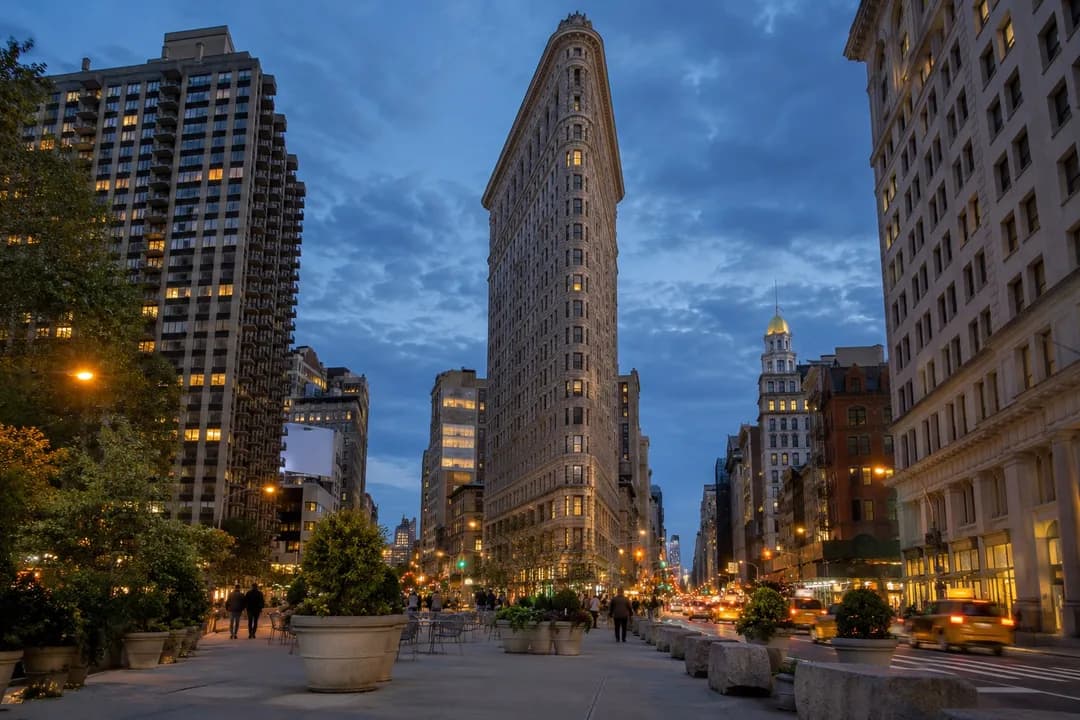
Madison Square Park is the rare spot in Manhattan where you can see four landmark towers from one bench, and the whole architectural landmark walk around it is free. Daniel Burnham's Flatiron Building, finished in 1902, holds the south tip. The Met Life clock tower, the world's tallest building from 1909 until 1913, rises on the east side. Add the Appellate Division courthouse and Cass Gilbert's gold-topped New York Life Building, and you have a compact loop of about an hour.
Start at the point of the Flatiron
Begin on the pedestrian plaza where Broadway crosses Fifth Avenue at 23rd Street, facing south toward the narrow prow of the Flatiron Building. Burnham's Chicago office designed it on a triangular lot, and the steel frame is wrapped in limestone and terra cotta, rising twenty-two stories to an ornate cornice. From the plaza the building looks almost two-dimensional, a single edge pointing down the avenue. Walk a few steps east or west and the wedge suddenly opens into a full block.
Spend a few minutes reading the facade from the bottom up. The base is rusticated and heavy, the middle shaft is a field of rippling windows, and the top flares into an elaborate crown, the classic three-part column that early skyscraper architects borrowed from classical design. Up close you will notice that the terra cotta is not flat but deeply patterned, which is why the building changes color as the sun moves from morning to late afternoon.
Cross the park to the Met Life clock tower
Walk east through the park toward Madison Avenue between 23rd and 24th Streets. The Metropolitan Life tower, completed in 1909 by Napoleon LeBrun and Sons, was modeled on the campanile of St Mark's in Venice. Its four clock faces are each about 26 feet across, among the largest in the world when they were installed. Today the tower houses the New York EDITION hotel, so the street-level experience is mostly about looking up rather than going in.
The best viewpoint is not directly underneath but from the middle of the park lawn, where you can see the full 700-foot shaft and the gilded lantern on top in one frame. Notice how the tower's windows grow smaller as it narrows toward the clock stage, a trick that makes it feel taller. Then look one block north to the stubby, Art Deco Met Life North Building, which was planned as an even taller tower before the Depression halted its upper floors.
The courthouse that reads like a sculpture gallery
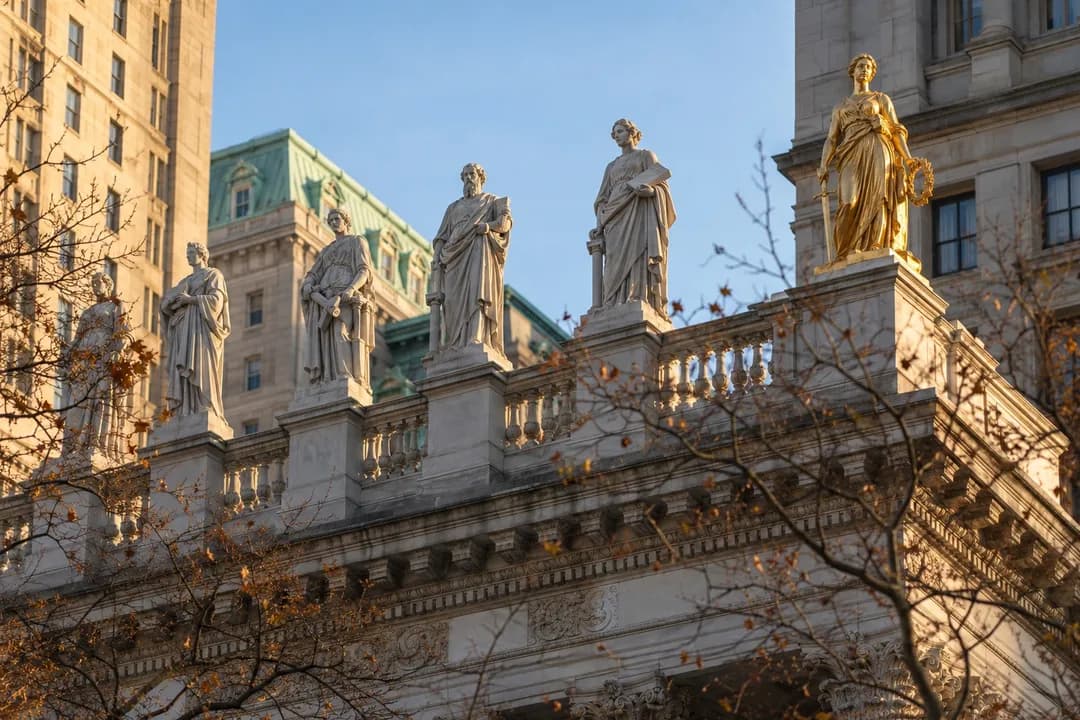
Continue north on Madison Avenue to 25th Street, where the Appellate Division Courthouse occupies the northeast corner. James Brown Lord designed this compact marble building, and the court moved in at the start of 1900. Sixteen sculptors worked on its exterior under Daniel Chester French, and the roofline is lined with figures of lawgivers from many civilizations. It is a small building with an outsized program, and the 25th Street side is where the statues line up best.
Look for the easternmost pedestal on that roofline. A statue of Muhammad stood there until 1955, when it was removed after objections from Muslim nations, and the pedestal stayed empty for decades. In 2023 it received NOW, a gilded female figure by Shahzia Sikander, which now reads as a deliberate answer to the all-male lineup beside it. It is the detail most passersby miss, and the one that makes this stop worth more than a glance.
Cass Gilbert's gold pyramid on the old Garden site
Keep walking north to Madison Avenue between 26th and 27th Streets for the New York Life Building, which Cass Gilbert completed in 1928, fifteen years after his Woolworth Building took the height record from Met Life. The site once held both versions of Madison Square Garden, the second designed by Stanford White, and Gilbert's tower replaced them. Its signature is the steep pyramidal roof covered in gold leaf, which flashes in late-afternoon sun.
To see the roof well, cross back into the park's northeast corner and look up past the trees. Gilbert gave the limestone shaft Gothic details at the top, a cousin of the lacework on Woolworth downtown, and the gold peak sits on top like a finial. If you only have time for two buildings on this loop, make them the Flatiron and this one, because together they show how quickly skyscraper style changed in twenty-six years.
Who you will meet on the loop
Expect a mix of people. Office workers eat lunch on the benches facing the Met Life clock, tourists line up at the Flatiron plaza for the prow photo, and architecture students sit on the lawn with sketchbooks angled toward the courthouse statues. The unspoken plaza rule is to step aside after your photo, since the triangle fills up fast. Dog owners crowd the park's dog run, so keep the center paths clear when you stop to look up.
An honest note: skip any plan to tour the Flatiron interior or the courthouse halls as part of a casual walk. The Flatiron is not a visitor attraction, and the courthouse is a working appellate court rather than a museum. This walk is about facades, rooflines and the way the four towers frame each other across the park, and that is plenty for a satisfying hour.
Best times and a plan for bad weather
Come in the hour before sunset for the most dramatic light. The gold roof of the New York Life Building and the Met Life lantern catch the low sun, while the Flatiron's prow glows from the side. Weekday early mornings are the quietest time for the Flatiron plaza photo. Midday on weekends is the busiest, especially when the park's seasonal art installations draw crowds.
If rain moves in, shorten the loop to the east side of the park, where the courthouse and the Met Life buildings sit close together, and duck under the arcaded entrances along Madison Avenue between stops. A wet evening has its own reward: the Met Life clock faces glow brighter against a low cloud ceiling, and reflections on Fifth Avenue make the Flatiron photo look like an old postcard.
Extend the walk south along Ladies' Mile
When you finish, walk south on Broadway or Sixth Avenue below 23rd Street into the Ladies' Mile Historic District, the late nineteenth-century shopping strip lined with cast-iron and masonry department store buildings. The old Siegel-Cooper store on Sixth Avenue at 18th Street, with its enormous arched entrance, is the showpiece. Continuing south brings you to Union Square in about fifteen minutes, which makes a natural end point.
Practical notes for the Madison Square loop
Getting there: the R and W trains stop at 23rd Street on Broadway, right at the Flatiron plaza, and the 6 train stops at 23rd Street on Park Avenue South, a short walk east of the Met Life tower. The full loop around the park is under a mile on flat ground, so it is easy with a stroller or a wheelchair. All four buildings are seen from public sidewalks and the park, so no ticket or reservation is needed.
Bring a zoom lens or use your camera's telephoto setting for the courthouse statues and the Met Life clock details, which sit well above street level. Benches ring the central lawn if you want to sit and compare rooflines. A sensible order is Flatiron, Met Life, courthouse, New York Life, which keeps you moving north with the afternoon sun behind you.
Ask Karpo for more information.
Keep reading
- Layover City Walk Planner: Tribeca Cobbles to Hudson Sunset
 Layover City Walk Planner: Harlem Row Houses and Soul Food
 Layover City Walk Planner: Astoria Close to LaGuardia