 SoHo Tailor Alteration Shop Finder for Sample Sale Finds
Neighborhood Guides
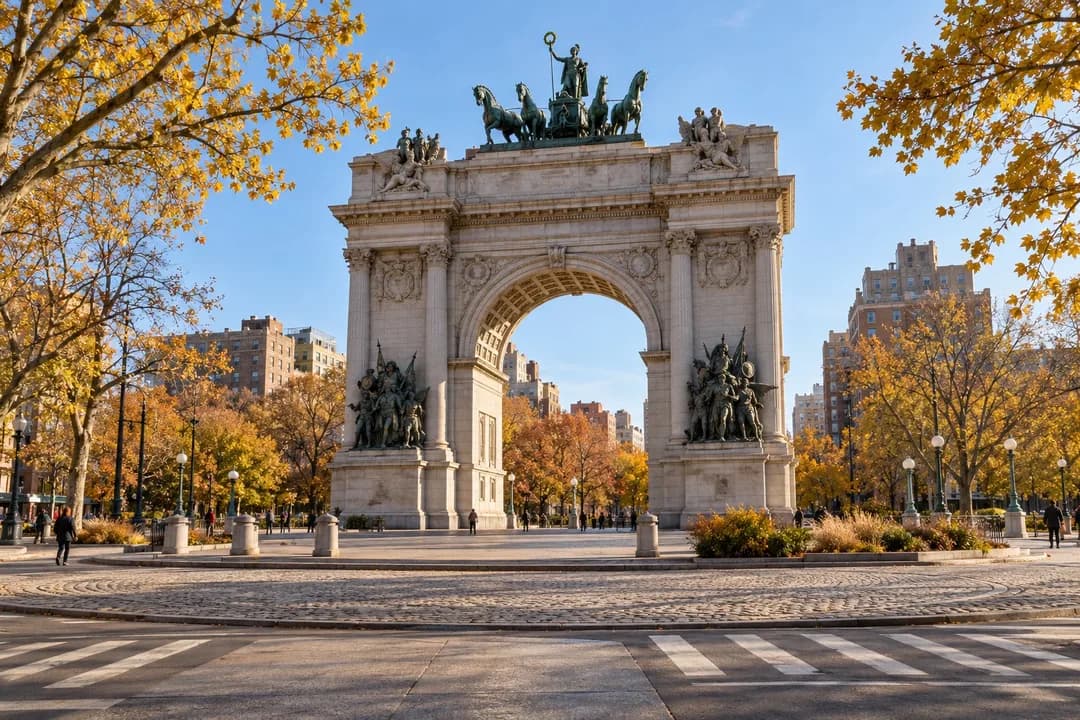
Grand Army Plaza: Free Brooklyn Architectural Landmark Walk
Grand Army Plaza is a free Brooklyn architecture walk: the 1892 victory arch, the gilded Art Deco Central Library and the Brooklyn Museum lie ten minutes apart.
Grand Army Plaza is Brooklyn's grandest outdoor room, and an architectural landmark walk around it costs nothing and takes about ninety minutes. The Soldiers' and Sailors' Arch, completed in 1892, stands at the center. The Central Library of the Brooklyn Public Library, opened in 1941, faces it with a gilded Art Deco entrance, and the Beaux-Arts Brooklyn Museum is a short stroll down Eastern Parkway. Together they span five decades of civic ambition in one loop.
Start under the Soldiers' and Sailors' Arch
Begin at the arch itself, which John H. Duncan designed as a memorial to the Union forces of the Civil War. It is a classic Roman triumphal arch in granite, and its crown carries a bronze quadriga by Frederick MacMonnies, a chariot drawn by four horses with Columbia riding on top. Walk all the way around it, because the bronze sculpture groups on the south side, showing the army and the navy, are packed with figures you will miss from a distance.
The plaza was laid out by Frederick Law Olmsted and Calvert Vaux as the formal entrance to Prospect Park, and the arch is placed to frame that approach. From the north side, look south through the opening and you will see the park entrance lined up behind it. Traffic circles the oval quickly, so use the marked crosswalks rather than darting across, and give yourself time to take in how the whole space is organized around this single axis.
Bailey Fountain on the north end
At the northern tip of the plaza stands Bailey Fountain, completed in 1932, a tangle of bronze figures including Neptune and a pair of allegorical nudes rising from a basin. It is more theatrical than the arch, a Depression-era piece that often gets overlooked by people heading straight to the park. Stand on the north side to see the fountain with the arch behind it, a useful frame that shows the two monuments in one shot.
The Central Library's gilded entrance
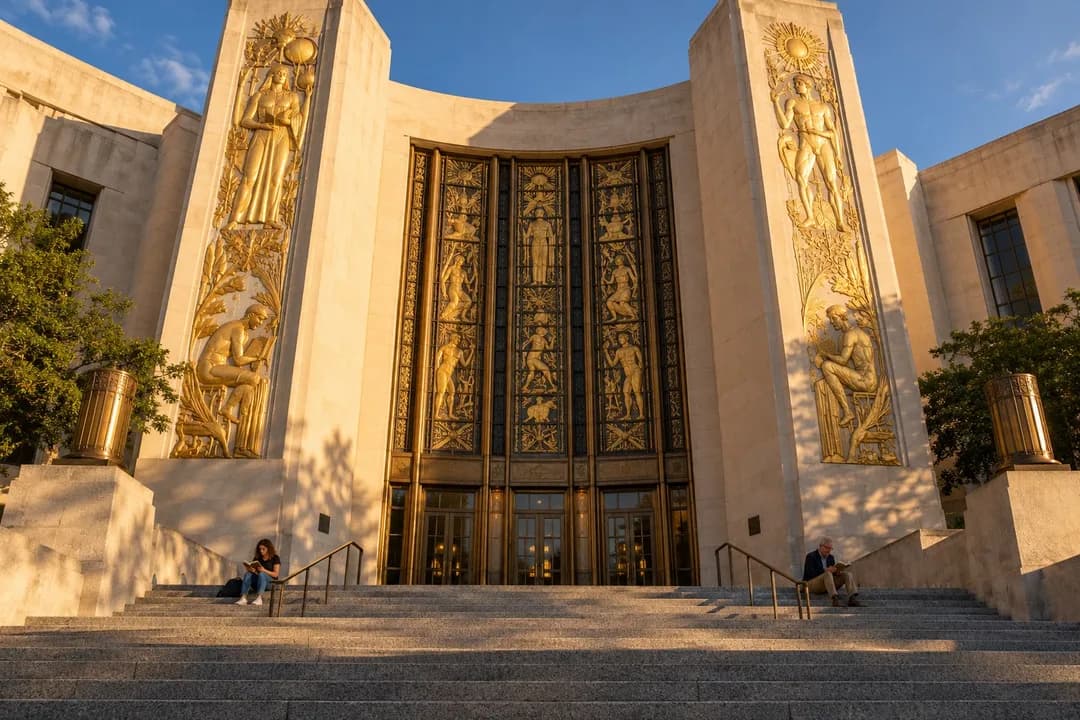
Cross to the Flatbush Avenue side of the plaza for the Central Library, which opened in 1941 after Alfred Morton Githens and Francis Keally reworked an earlier, unfinished Beaux-Arts design. The plan is famous for its shape: the building's two wings meet at the curved entrance on the plaza, so from above it resembles an open book. From street level, you feel it as a broad limestone facade bending toward you.
The entrance is the reason to slow down. Two limestone columns about 50 feet tall flank the doors, carved by C. Paul Jennewein with gilded reliefs, and between them hangs a 40-foot bronze screen by Thomas Hudson Jones with fifteen gilded panels of literary characters. Try to name the characters you recognize, then read the inscriptions carved beside the doors. Late afternoon sun makes the gold glow against the pale stone.
Down Eastern Parkway to the Brooklyn Museum
Walk east along Eastern Parkway, past the library's long side wall and the Brooklyn Botanic Garden's entrance, to the Brooklyn Museum, designed by McKim, Mead and White. The first section opened in 1897, and the original plan was for a building several times larger, which is why the facade feels like a fragment of something bigger. The row of allegorical statues along the cornice, representing great figures of thought and culture, rewards a slow walk along the parkway frontage.
Notice the contrast with the plaza. The museum is pure Beaux-Arts classicism, with a columned portico and pediment, while the library a few hundred yards away is stripped and streamlined Art Deco. Standing between them, you can see the shift in American civic architecture over four decades, from temple to modern monument, without walking more than ten minutes.
Who you will meet, and one honest call
On a Saturday the plaza fills with families crossing to the park, cyclists looping toward the park drives, and readers sitting on the library steps with a book. The unwritten rule on the steps is that the top terrace near the doors belongs to people coming and going, so sit lower down if you want to linger. On market days the north side of the plaza gets crowded, so time your photos of the arch for earlier in the morning.
An honest call: skip trying to climb into the arch or see its interior on a casual visit, since access to the top has historically been limited to occasional special openings, not daily visits. The outside is where the sculpture is anyway. Similarly, the library's interior is a working branch, so treat it as a quiet stop for the lobby rather than a tour.
Extend into Park Slope and its Venetian Gothic club
From the plaza, walk a few blocks west along Lincoln Place into Park Slope, where the brownstones of the Park Slope Historic District line the side streets. At the corner of Eighth Avenue and Lincoln Place stands the Montauk Club, completed in 1891 to designs by Francis H. Kimball. It is modeled on a Venetian Gothic palazzo, with pointed arches, terra cotta friezes and carved details that show Native American figures. It is a private club, so view it from the sidewalk.
If you still have energy, walk south along Prospect Park West to see the mansions facing the park, many built for wealthy Brooklyn families at the turn of the century. The stretch from Grand Army Plaza down to Third Street is especially rich in limestone and brick fronts, and the park's tree canopy on the opposite side keeps the walk shady even in warm weather.
Practical notes for the Grand Army Plaza walk
Getting there: the 2 and 3 trains stop at Grand Army Plaza station, right at the library side of the plaza, and the B and Q trains stop at Seventh Avenue in Park Slope, about ten minutes away on foot. The loop described here, including the museum and the Montauk Club, is roughly two miles on level ground. Every monument is visible from public sidewalks and plaza paths, so there is no ticket for the walk itself.
For the best light, save the library entrance for late afternoon, when the low sun warms its gilded panels, and visit the arch earlier in the day. In rain, the library lobby gives you shelter, and you can shorten the loop to the plaza and the library alone. A good final stop is the park entrance just south of the arch, where you can step onto the park paths and see the Long Meadow open up beyond the trees.
Ask Karpo for more information.
Keep reading
- SoHo Tailor Alteration Shop Finder for Sample Sale Finds
 Williamsburg Tailor Alteration Shop Finder for Bike Riders
 Upper West Side Tailor Alteration Shop Finder for Kids