 SoHo Tailor Alteration Shop Finder for Sample Sale Finds
Neighborhood Guides
Central Park West: A Free Architectural Landmark Walk
Walking Central Park West from 62nd to 91st Street is free and shows the Dakota plus the twin-towered 1930s apartment houses, best seen from the park side.
Central Park West has the most recognizable apartment skyline in New York, and the best way to read it is a free architectural landmark walk on the park side of the avenue, not the building side. Between 62nd and 91st Streets you pass the Dakota, finished in 1884, and four twin-towered apartment houses built around 1930 by Emery Roth and Irwin Chanin. Allow ninety minutes at an easy pace, and walk north so the towers stack up ahead of you.
Why you should walk on the park side
The first mistake most people make is walking along the building side of Central Park West, directly under the facades. From there you see doormen and canopies, not architecture. Cross to the stone wall that runs along the park edge and the towers come into proportion, since the avenue gives you about a hundred feet of distance. Better still, duck into the park at a few points described below, where the lawns and the Lake give you full-height views.
The Century and the Majestic: Chanin's Art Deco pair
Start at Columbus Circle and walk up to 62nd Street to the Century, completed in 1931 for developer Irwin Chanin. Its twin towers are pure Art Deco, with horizontal bands of windows that wrap the corners and a stepped silhouette at the top. Chanin was a builder who had trained as an engineer, and his buildings feel streamlined and modern compared with the classical towers further north. Look for the strong horizontal stripes, which are the giveaway of a Chanin design.
Nine blocks north, between 71st and 72nd Streets, the Majestic repeats the formula with the same developer and the same year of completion. Its two towers are slightly more massive, with wraparound corner windows that looked radical in 1931. Stand at the park wall opposite 71st Street and compare it with the Century in your memory: same architect's eye, same Depression-era timing, but a more muscular result on a wider site.
The Dakota, the oldest of the group
Directly north of the Majestic, at the corner of 72nd Street, sits the Dakota, designed by Henry J. Hardenbergh, the architect who later did the Plaza Hotel. When it opened in 1884, this part of the Upper West Side was still sparsely built, and the building's name is often explained as a joke about how remote it seemed. Look at its steep gables, dormers and copper trim, a German Renaissance mix that makes it the oddball among the sleek 1930s towers around it.
Most visitors also know the Dakota as the home of John Lennon, who was shot outside its 72nd Street entrance in December 1980. Directly across the avenue inside the park is Strawberry Fields, the memorial garden with the black-and-white Imagine mosaic. The doormen at the Dakota keep the sidewalk in front of the gate clear, so take your photographs from the park side, where you can frame the building over the trees without blocking anyone's way.
The San Remo across the Lake
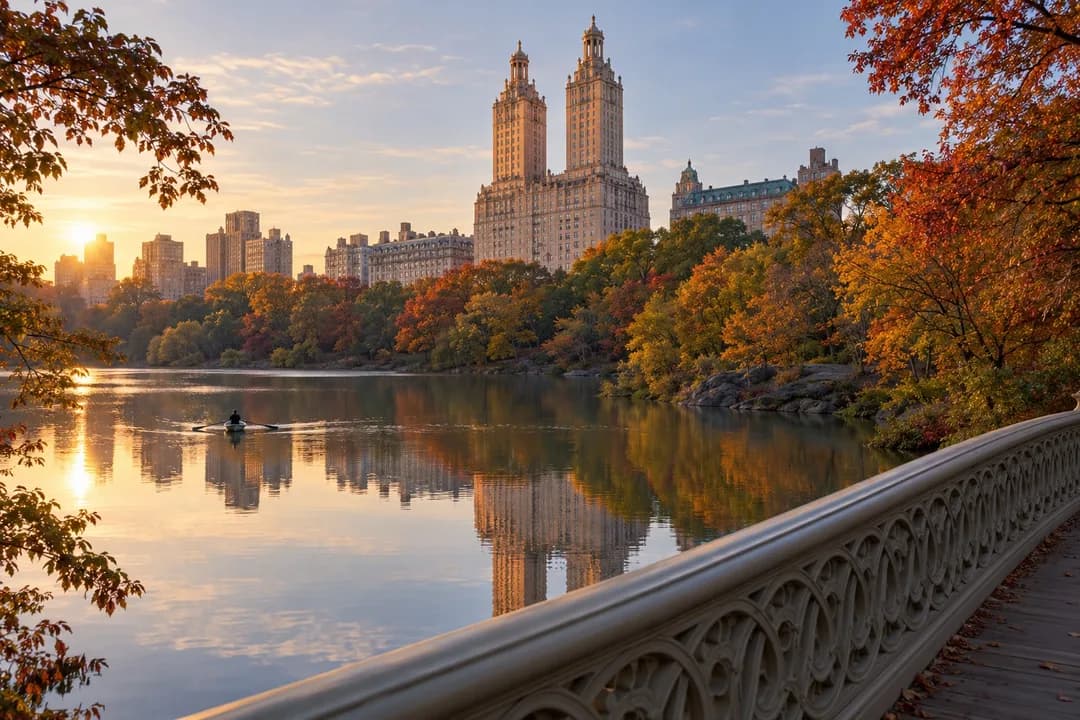
Walk into the park at 72nd Street and follow the path to Bow Bridge over the Lake. Look west: the twin towers of the San Remo, designed by Emery Roth and finished in 1930, rise above the trees like a pair of Roman temples, each capped with a columned crown modeled on classical monuments. This is the single best viewpoint on the whole walk, and the reason to bring a camera. On a still morning the towers reflect in the water.
Roth was the most prolific apartment architect of his era, and the San Remo shows how he used a 1929 state housing law. The new rules allowed taller towers on large lots if they were set back, so he split the upper floors into two slender towers instead of one bulky block. That decision gave Central Park West its paired silhouette, and it is why so many of the avenue's best-known buildings come in twos.
The Beresford and the El Dorado
Return to the avenue and continue north past the American Museum of Natural History, whose Central Park West entrance, the Theodore Roosevelt Memorial by John Russell Pope, is worth a pause for its giant columns, where the Roosevelt equestrian statue stood until its removal in 2022. At 81st Street the Beresford, another Emery Roth design from 1929, wraps the corner with octagonal towers topped by lanterns. Its scale is calmer than the San Remo, and it reads best from the park entrance at 81st Street.
The walk ends at 90th and 91st Streets with the El Dorado, completed in 1931 by Margon and Holder with Emery Roth as consulting architect. It is the most ornamental of the twin-tower buildings, with Art Deco finials and stylized details at the crowns. By the time you reach it, the reservoir is just inside the park to your right, and the running track there gives you one more long view south over the skyline you have just walked.
Who walks this route, and what to skip
You will share the park wall with dog walkers heading in at 72nd Street, joggers on their way to the reservoir, and tour groups gathering at Strawberry Fields. The unwritten rule at the Imagine mosaic is quiet: people leave flowers, sing softly, and step aside after a photo. Do not linger in the center of the mosaic or set up a tripod there, since the space is small and the crowd turns over every few minutes.
An honest call: skip trying to visit the lobbies. These are private co-op buildings, and doormen will politely stop you at the entrance. The interiors are not the point anyway, because the architects designed these buildings to be seen from the park. If you want to see a grand Upper West Side apartment interior in person, a guided program run by a local preservation group is the realistic route, not the front door.
Timing, weather and a backup plan
Morning light is best, because the sun rises behind you over the park and lights the west-side facades directly. By late afternoon the towers fall into shadow and turn into silhouettes, which can be beautiful from Bow Bridge but flat from the avenue. If it rains, shorten the walk to the stretch from 72nd to 81st Street, where the museum's covered entrances give you shelter between the Dakota, the San Remo and the Beresford.
Practical notes for the Central Park West walk
Getting there: the A, B, C, D and 1 trains all stop at 59th Street at Columbus Circle, where the walk begins. The B and C trains also stop along Central Park West at 72nd, 81st and 86th Streets, so you can cut the walk short or start in the middle. The route is level and paved, about one and a half miles one way, and everything described here is visible from public sidewalks and park paths, with no ticket required.
Benches line the park wall the whole way, and the park paths near 72nd and 81st Streets have the easiest entrances for strollers. Bring a wide-angle lens for the San Remo from Bow Bridge and something longer for the crowns of the Beresford and the El Dorado. For a final stop, walk east into the park at 90th Street to the reservoir, where the long view south shows every tower from this walk lined up together.
Ask Karpo for more information.
Keep reading
- SoHo Tailor Alteration Shop Finder for Sample Sale Finds
 Williamsburg Tailor Alteration Shop Finder for Bike Riders
 Upper West Side Tailor Alteration Shop Finder for Kids