 SoHo Tailor Alteration Shop Finder for Sample Sale Finds
Neighborhood Guides
42nd Street Art Deco: Free Architectural Landmark Walk
This free 42nd Street walk runs from Grand Central to Tudor City past the Chrysler, Chanin and Daily News towers, all finished in a two-year Art Deco burst.
East 42nd Street between Park Avenue and First Avenue packs three of New York's finest Art Deco towers into a free architectural landmark walk of under a mile. The Chanin Building opened in 1929, the Chrysler Building and the Daily News Building both followed in 1930, and Grand Central Terminal anchors the west end. Walk east from the terminal and you can see the whole Jazz Age skyline story in roughly an hour, ending at the Gothic towers of Tudor City.
Begin inside Grand Central's Main Concourse
Grand Central Terminal opened in 1913, designed by the firms Reed and Stem and Warren and Wetmore, and its Main Concourse is a public space you can walk through as part of any visit. Look up at the green celestial ceiling painted with the constellations, then at the four-faced brass clock above the information booth. The terminal is older than the Deco towers outside, and starting here lets you see what the 1920s architects were reacting against.
Leave through the 42nd Street exit and look back at the south facade, where the sculpture group of Mercury, Hercules and Minerva crowns the great arched windows over a large clock. This Beaux-Arts grandeur, all columns and allegory, is exactly the classical vocabulary that Art Deco would strip away a few blocks east within twenty years. Keep that sculpture group in mind as you turn toward Lexington Avenue.
The Chanin Building at Lexington Avenue
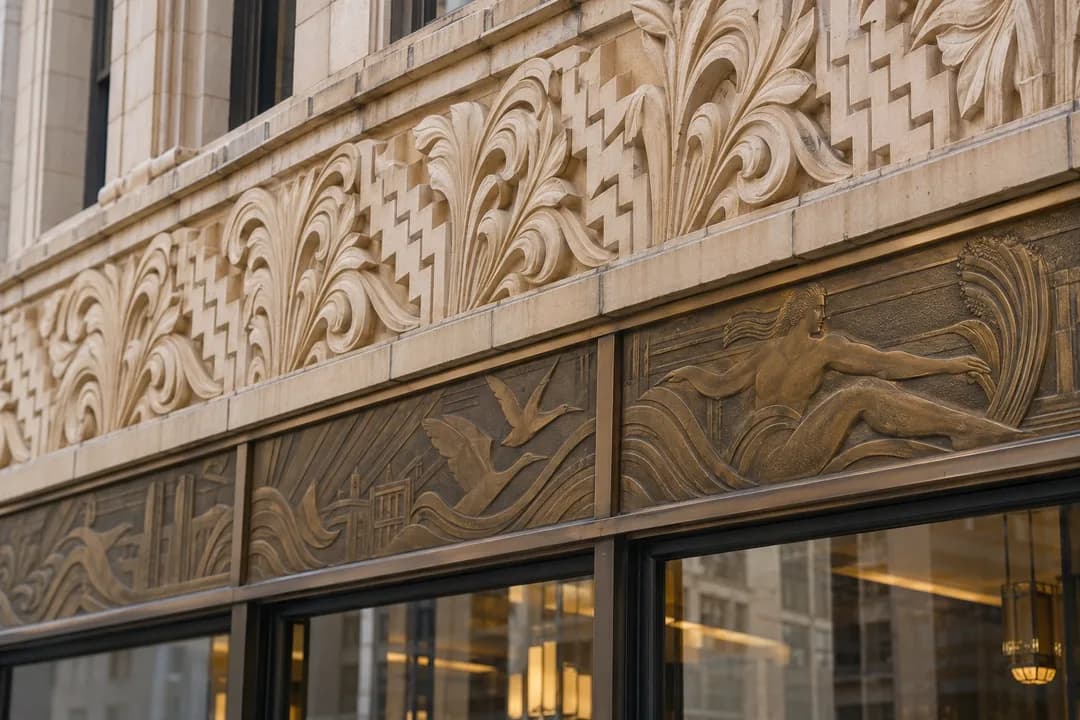
At the southwest corner of Lexington and 42nd Street stands the Chanin Building, finished in 1929 for developer Irwin Chanin and designed by Sloan and Robertson. Do not rush past the base. A band of terra cotta wraps the lower floors in dense, swirling plant forms and zigzags, and above the shopfronts a bronze frieze shows the evolution of life in stylized relief. This is the most detailed street-level ornament on the walk, best studied from directly across the street.
Step back to the north side of 42nd Street to see the tower's setbacks rising above the base, a direct product of the 1916 zoning resolution that required tall buildings to step back as they climbed. That rule is why so many towers of this era have wedding-cake silhouettes. From the corner of Lexington you can see how the buttressed crown was designed to read from far down the avenue.
The Chrysler Building's crown and spire
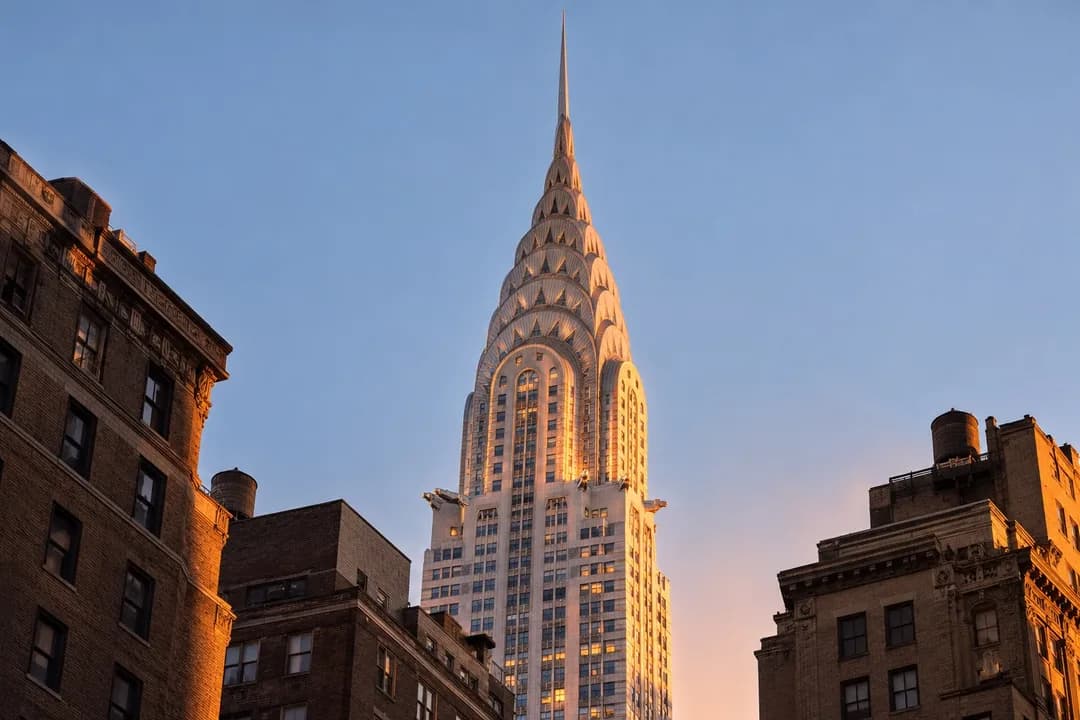
Diagonally across the intersection, at the northeast corner of Lexington and 42nd, rises the Chrysler Building, designed by William Van Alen and completed in 1930. For a few months it was the tallest building in the world, thanks to a stainless steel spire that was assembled inside the crown and raised into place, a move that beat a rival downtown tower. The Empire State Building overtook it in 1931.
The best close-up details are on the setbacks, where steel eagle gargoyles project from the corners and a frieze of stylized hubcaps and winged radiator caps recalls the automaker that commissioned the tower. From the sidewalk these are small, so walk east a block to Third Avenue and look back west: the crown's sunburst of triangular windows comes into full view, and at dusk the stainless steel turns pink and gold. Bring a zoom lens for the gargoyles.
Raymond Hood's striped Daily News Building
Continue east past Third Avenue to the Daily News Building between Second and Third Avenues, designed by Raymond Hood with John Mead Howells and finished in 1930. Hood dropped the decorative crown entirely. The facade is a field of vertical stripes, white brick piers alternating with darker window bays, so the tower seems to shoot straight up and simply stop. A critic once described it as almost nothing but stripes, which is the best compliment the building could get.
The entrance is where Hood put his ornament: a carved granite relief above the doors showing crowds of people beneath a beam of light. Inside, the famous lobby holds a large globe sunk in a stepped pit under a black glass dome, a feature that opened with the building in 1930 and was designated an interior landmark in 1998. Even if you only see it through the doors, it is the image that people remember from this stretch of 42nd Street.
Finish at Tudor City and the Ford Foundation
Between Second and First Avenues, climb the stairs on the north side of 42nd Street to Tudor City, the complex of brick apartment towers built by the Fred F. French Company in the mid-1920s. Instead of Deco, it uses English Tudor Gothic details, with stained-glass style windows and pointed arches. The bridge over 42nd Street gives a direct view west down the street you just walked, with the Chrysler spire framed at the end.
Before you leave, look across 42nd Street at the Ford Foundation Building, completed in 1968 by Kevin Roche and John Dinkeloo, whose glass-walled garden atrium was one of the first indoor public gardens in the city. It is a deliberate contrast to everything else on the walk, quiet weathering steel and greenery instead of ornament. Seen from the Tudor City bridge, it shows how far Midtown architecture traveled in forty years.
Who walks 42nd Street, and what to skip
This is a commuter street first. Expect fast-moving office workers out of Grand Central, delegates and staff heading toward the United Nations at the east end, and photographers bracing on the Third Avenue corner for the Chrysler shot. The unwritten rule at that corner is to stay against the building line while you shoot, since the crosswalk crowd will not slow down for a tripod. Weekday rush hours are the hardest times to stop and look.
An honest note: skip building your visit around the Chrysler Building lobby, since the tower is a working office building and the lobby has not always been open to sightseers. The exterior crown is the real show anyway. Weekend mornings are the easiest time for this walk, when 42nd Street empties out and you can stand still at every corner.
Practical notes for the 42nd Street Deco walk
Getting there: the 4, 5, 6, 7 and S trains all stop at Grand Central at 42nd Street, and Metro-North trains arrive directly into the terminal. The walk from Park Avenue to Tudor City is about three-quarters of a mile on flat sidewalks, plus one staircase up to Tudor City. Everything described here is visible from public streets, so no ticket is needed.
For photographs, the Chrysler crown looks best from Third Avenue in late afternoon, and the Chanin frieze is easiest to read under the even light of an overcast day. If it rains, use Grand Central's concourse and passages as shelter and limit the outdoor part to the stretch between Park and Lexington Avenues, where the terminal, the Chanin and the Chrysler sit within a single block of each other.
Ask Karpo for more information.
Keep reading
- SoHo Tailor Alteration Shop Finder for Sample Sale Finds
 Williamsburg Tailor Alteration Shop Finder for Bike Riders
 Upper West Side Tailor Alteration Shop Finder for Kids